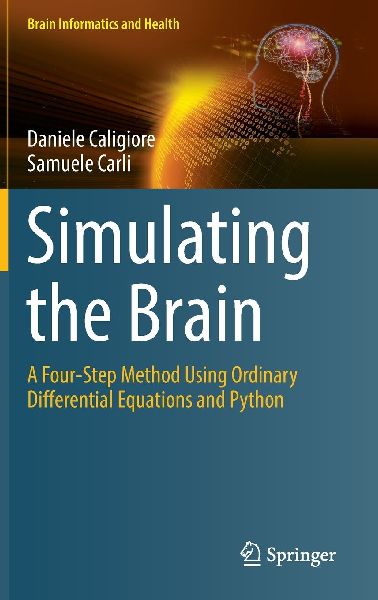
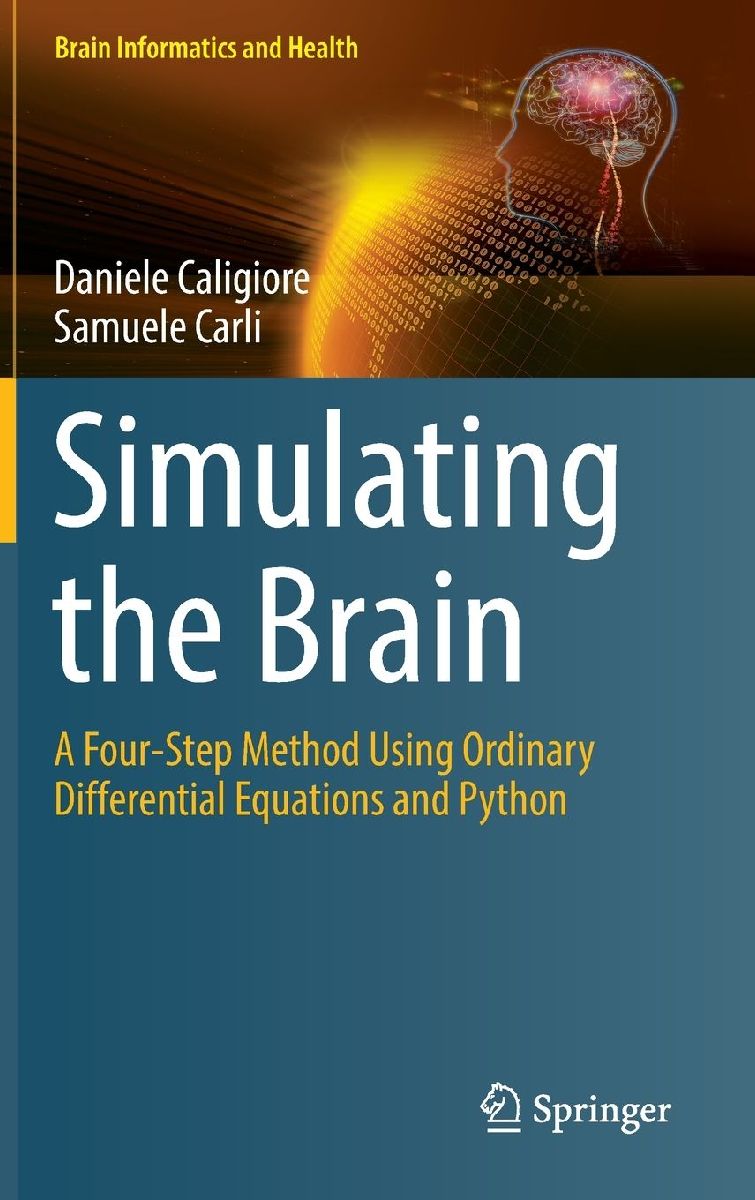
Simulating the Brain
A Four-Step Method Using Ordinary Differential Equations and Python
von Daniele Caligiore und Samuele Carli
Aus der Reihe Brain Informatics and Health
- Einband
- Gebunden
- Seiten
- 216
- Sprache
- Englisch
- Erschienen
- Juni 2025
- Verlag
- Springer
Buchbeschreibung
This book presents a new methodology to develop system-level brain models using ordinary differential equations (ODE), which are to be solved and analyzed through simple Python scripts.
Computer simulations of this kind of models allow the study of healthy and damaged brain functions, the discovery of new neural pathways that may be crucial for the emergence of pathologies, and to simulate the effects of possible new therapies acting on brain actors which are difficult to investigate in traditional research.
Ganze Beschreibung lesenWeniger anzeigen
The methodology consists of four steps: (i) design the model architecture which represents the interactions between different brain areas; (ii) write the ODE system which are implied by the model; (iii) build a Python script that correctly solves the equations; (iv) optimize the free model parameters using genetic algorithms or other techniques to obtain one or more model instances that reproduce the target investigated behavior.
This book is for all people who want to learn how to use Python and ODE to simulate brain functions regardless of their backgrounds. While rigorous mathematical proofs of many aspects of the arguments discussed are out of the scope of this work and are therefore omitted, the most important concepts necessary for the critical judgment and self-assessment of the practitioner's work are exposed in a simplified, readily applicable form, with extensive references for the adventurous reader to explore.
The book is a self-consistent textbook containing all pieces necessary to learn from scratch: from the essential mathematical and computing tools to the knowledge necessary to design, simulate, visualize, and interpret brain models. These skills are acquired through several hands-on examples explained step-by-step.
One important and distinctive aspect of the book is that, beside the theory, it provides the necessary contexts and practical examples which are key to the correct application of the proposed methodology.
Inhaltsverzeichnis
- Introduction: by Trang Phan (Vietnam National University Hanoi), Nguyen Tuan Cuong (Associate Professor, Vietnam Academy of Social Sciences) & Masaaki Shimizu (Professor, Osaka University)
- Etymological study of Vietnamese words for textiles and clothing by Mark Alves (Montgomery College)
- The rise of negative markers: the case of Sino-Vietnamese 'không' and beyond by Trang Phan (Vietnam National University Hanoi), Nguyen Tuan Cuong (Vietnam Academy of Social Sciences) & Masaaki Shimizu (Osaka University)
- On the development of particle 'chu¿ng' as a merger of object pronomial and relative pronomial functions: Evidence from the Cô¿ Châu Pháp Vân Ph¿¿t bän hành ng¿¿ lu¿c by John Phan (Columbia University)
- Initial Consonants Comparison of Tay and Nung in Trang Dinh district from the diachronic perspective by Hirana Ayaka (Osaka University)
- Reflections ofVoiced Initials in Tay Manuscripts from Cao Bang Province by David Holm (National Chengchi University)
- Possibility modals in Chinese and the morpho-syntax of their complements: a view from First Phase Syntax by Barbara Meisterernst (National Tsing Hua University)
- The multifunctionality of gwo in Cantonese: A synchronic and diachronic study by Carine Yuk-man Yiu (The Hong Kong University of Science and Technology)
Ganzes Inhaltsverzeichnis anzeigen (11 Einträge)Weniger anzeigen
- Deriving Syntactic Variation of Old Chinese and Contemporary Chinese from the Bidirectional Growth Model of Child Language Acquisition by Mengmeng Yang and Jianhua Hu (Institute of Linguistics, Chinese Academy of Social Sciences)
- Proto-Austronesian Interrogative Pronouns and Their Development by Edith Aldridge (Academia Sinica, Taiwan)
- Why do you give/put something when you say you take it? by Yoshihisa Taguchi (Chiba University)
Details
- Erscheinungstermin
- Juni 2025
- Kategorie
- Fremdsprachige Bücher
- Einband
- Gebunden
- Seiten
- 216
- Sprache
- Englisch
- Verlag
- Springer
- Reihe
- Brain Informatics and Health
- Format
- 24,1 × 16,0 cm
- Dicke
- 1,8 cm
- Gewicht
- 442 g
- EAN / ISBN-13
- 9789819627172
Versand und Rückgabe
Standardversand: 1 bis 3 Werktage, 3,99 €, kostenlos ab 35 €
Liefergebiet: Deutschland
Rücksendung: 14 Tage Widerrufsrecht. Bei einem Widerruf tragen Sie die Kosten der Rücksendung. Bei einer Falschlieferung oder einem Fehler von uns erstatten wir Ihnen das Rückporto. Den Widerruf erklären Sie über den Knopf „Vertrag widerrufen“ im Fuß der Seite.
Hersteller und ProduktsicherheitSpringer Nature Customer Service Center GmbH
Springer Nature Customer Service Center GmbH
Europaplatz 3
69115 Heidelberg
Deutschland
ProductSafety@springernature.com
Mehr aus der Reihe Brain Informatics and Health




Ähnliche Titel

Geometric Properties for Incomplete Data
Reinhard Klette (Hrsg.)
Gebunden, Englisch, 2 Ausgaben
ab 53,49 €


Uncertainty Analyses in Environmental Sciences and Hydrogeology
Rachid Ababou
Kartoniert, Englisch
48,14 €

Loewy Decomposition of Linear Differential Equations
Fritz Schwarz
Gebunden, Englisch, 2 Ausgaben
ab 106,99 €
Bewertungen
Zu diesem Titel gibt es noch keine Bewertung. Bewerten kann, wer ihn bei uns gekauft hat.
So prüfen wir Bewertungen
Eine Bewertung kann bei uns nur abgeben, wer den Titel über sein Kundenkonto bei uns gekauft hat. Jede Bewertung ist fest mit der zugehörigen Bestellung verknüpft; anders kommt sie technisch gar nicht zustande. Deshalb trägt jede angezeigte Bewertung den Hinweis „Verifizierter Kauf". Wir zeigen positive wie negative Bewertungen und löschen nur bei Rechtsverstößen. Für Bewertungen gibt es keine Gegenleistung.
80,24 €Voraussichtlich 3. bis 7. Dez.