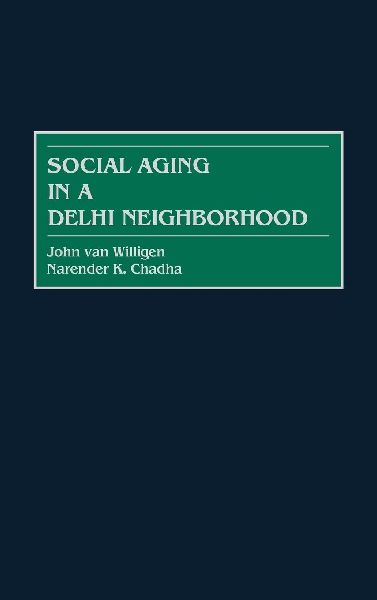
Social Aging in a Delhi Neighborhood
von John Van Willigen, Narender Chada und Narender K. Chadha
- Einband
- Gebunden
- Seiten
- 176
- Sprache
- Englisch
- Erschienen
- November 1999
- Verlag
- Praeger
Buchbeschreibung
The core of the research reported in this study was a survey of men and women 55 years and older sampled from a comprehensive list of residents.
The authors asked questions about social networks, control over household assets, household composition, life satisfaction, and subjective health, among other things. The social network questions had been used in an earlier study done in Kentucky. Nearly everything else had been developed for the Delhi study.
Ganze Beschreibung lesenWeniger anzeigen
The findings were similar to those in the earlier study: the size of people's networks does not decline materially until they are older (80 plus). Age itself did not seem that important, but health was crucial. Persons who reported they were healthy had larger networks.
As one might expect, joint family life has great impact on the nature of social life among older people. This has to do with the big difference in the situation of men and women in India. In addition to being patrilineal kin groups, joint families are dominated by male economic interests. The males as a collective group inherit property. Women have much less control of household assets.
This ethnographic fact appeared very clearly in the answers to questions about participation in household decision making. High involvement in decisions, which the authors construed as a measure of power, spilled over into other aspects of the social aging process. Persons who were powerful in their households tended to have large networks, better subjective health, and much higher life satisfaction.
They also tended to be men. The women tended to have small networks, low life satisfaction, lower subjective health, and less power. These differences between men and women were all substantial and highly significant. Gender is an extraordinarily important factor in the outcomes of social aging processes in India.
Inhaltsverzeichnis
- Preface
- Our Study of Social Aging
- A Theory of Social Aging
- The Ecology of Social Aging in India
- Researching Social Aging in a Delhi Neighborhood
- Rana Pratap Bagh: The Study Neighborhood
- The Household and Social Aging
- Networks: The World Beyond the Family
Ganzes Inhaltsverzeichnis anzeigen (11 Einträge)Weniger anzeigen
- Social Aging in Comparative Perspective
- References
- Index
Details
- Erscheinungstermin
- November 1999
- Kategorie
- Fremdsprachige Bücher
- Einband
- Gebunden
- Seiten
- 176
- Sprache
- Englisch
- Verlag
- Praeger
- Format
- 23,5 × 15,7 cm
- Dicke
- 1,4 cm
- Gewicht
- 367 g
- EAN / ISBN-13
- 9780897896757
Autorenporträt
JOHN VAN WILLIGEN is Professor of Anthropology, University of Kentucky./e
NARENDER CHADHA is Professor of Psychology, University of Delhi, India./e
Versand und Rückgabe
Standardversand: 1 bis 3 Werktage, 3,99 €, kostenlos ab 35 €
Liefergebiet: Deutschland
Rücksendung: 14 Tage Widerrufsrecht. Bei einem Widerruf tragen Sie die Kosten der Rücksendung. Bei einer Falschlieferung oder einem Fehler von uns erstatten wir Ihnen das Rückporto. Den Widerruf erklären Sie über den Knopf „Vertrag widerrufen“ im Fuß der Seite.
Hersteller und ProduktsicherheitPraeger
Praeger
Europaallee 1
36244 Bad Hersfeld
Deutschland
gpsr@libri.de
Verantwortliche Person in der EU
Libri GmbHEuropaallee 1
36244 Bad Hersfeld
Deutschland
gpsr@libri.de
Mehr von John Van Willigen


Ähnliche Titel



Ageing, Wellbeing and Climate Change in the Arctic
Paivi Naskali (Hrsg.)
Kartoniert, Englisch, 2 Ausgaben
ab 78,70 €
Bewertungen
Zu diesem Titel gibt es noch keine Bewertung. Bewerten kann, wer ihn bei uns gekauft hat.
So prüfen wir Bewertungen
Eine Bewertung kann bei uns nur abgeben, wer den Titel über sein Kundenkonto bei uns gekauft hat. Jede Bewertung ist fest mit der zugehörigen Bestellung verknüpft; anders kommt sie technisch gar nicht zustande. Deshalb trägt jede angezeigte Bewertung den Hinweis „Verifizierter Kauf". Wir zeigen positive wie negative Bewertungen und löschen nur bei Rechtsverstößen. Für Bewertungen gibt es keine Gegenleistung.
98,20 €Voraussichtlich 7. bis 9. Dez.