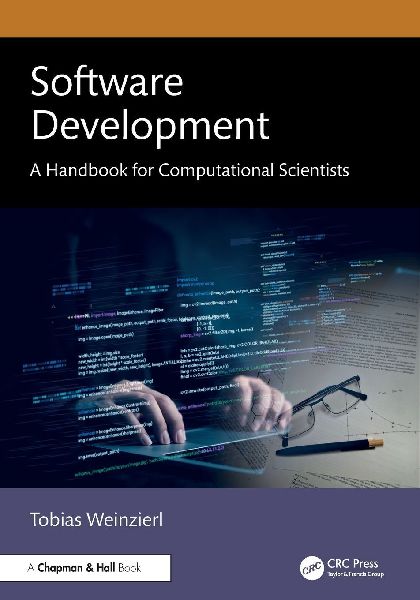
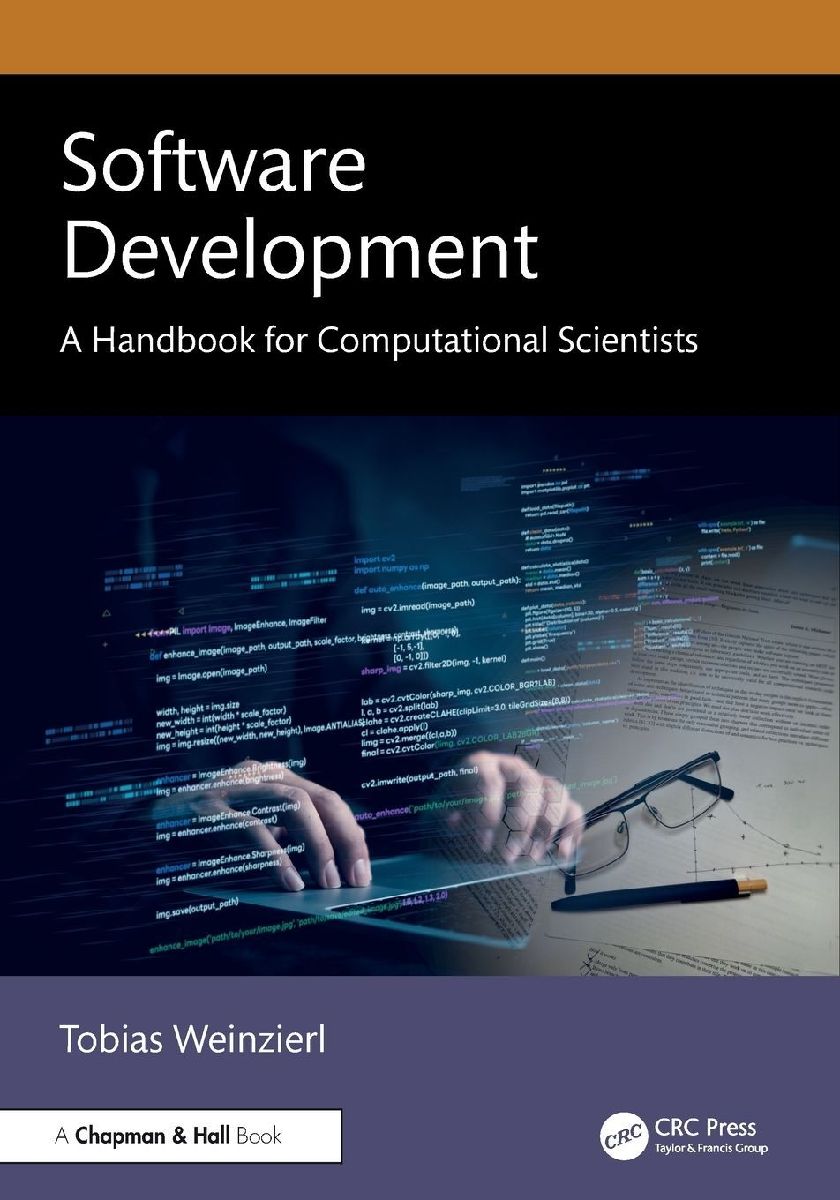
Software Development
A Handbook for Computational Scientists
von Tobias Weinzierl
- Einband
- Kartoniert
- Seiten
- 280
- Sprache
- Englisch
- Erschienen
- Dezember 2026
- Verlag
- Taylor & Francis Ltd
Buchbeschreibung
Computational software is the backbone of progress in many fields of science and engineering.
As the importance and complexity of this software grows, developers should apply software development best practices systematically. However, exploratory, agile, and numerical codes present unique challenges.
Ganze Beschreibung lesenWeniger anzeigen
Developers must combine cutting-edge expertise from applied mathematics, computer science, high-performance computing and domain-specific knowledge, relying on small, highly specialised research groups and individuals from diverse career levels, to maintain codebases across generations of team members, often working asynchronously across the globe. These conditions demand bespoke development techniques tailored to the research environment.
This book presents a collection of best practices and lessons learned from the computational science community, offering critical observations on where mainstream development techniques struggle or fail in this specialised domain, or where mainstream software development technology is widely adopted yet might not be the best fit overall.
The author challenges common recommendations for code development and suggests that there is a need to design and implement bespoke software development workflows that deliver research software capable of facilitating new insights in challenging research environments.
The discussion remains technically focused, avoiding high-level management theory, career development frameworks, and team dynamics discussions in favour of practical ideas that make day-to-day research code development more efficient, effective, and enjoyable.
The book is written specifically for practitioners who develop software as part of computational science research. It addresses techniques, recipes, and principles relevant to PhD students, research software engineers, postdoctoral researchers, and senior academics who mentor and instruct colleagues.
Inhaltsverzeichnis
- Part 1: The ecosystem
- 1. Context and environment Part 2: Principles and doctrines
- 2. Artefact organisation
- 3. Artefact quality
- 4. Behaviour Part 3: Techniques
- 5. Collaborate and communicate
- 6. Branching and merging
- 7. Code review
Ganzes Inhaltsverzeichnis anzeigen (18 Einträge)Weniger anzeigen
- 8. Debugging
- 9. Tests
- 10. Defensive programming
- 11. Ingredients of good documentation and architecture descriptions
- 12. How to write documentation and architecture documents Part 4: Structure and organisation
- 13. Workflows
- 14. Organise your day-to-day work
- 15. Interacting with stakeholders 15. Closing remarks
- Bibliography
- V Appendix A. Correlation of context, principles, and techniques B. Discussion of sources C. Further resources D. Chapter summaries Index
Details
- Erscheinungstermin
- Dezember 2026
- Kategorie
- Fremdsprachige Bücher
- Einband
- Kartoniert
- Seiten
- 280
- Sprache
- Englisch
- Verlag
- Taylor & Francis Ltd
- Format
- 25,4 × 17,8 cm
- EAN / ISBN-13
- 9781041274889
Über Tobias Weinzierl
Tobias Weinzierl is Professor of High-Performance Computing (HPC) in the Department of Computer Science at Durham University in the UK, where he leads the Scientific Computing research group and …
Mehr über Tobias WeinzierlWeniger anzeigen
Tobias Weinzierl is Professor of High-Performance Computing (HPC) in the Department of Computer Science at Durham University in the UK, where he leads the Scientific Computing research group and serves as Director of Durham's Institute for Data Science (IDAS). After studying Computer Science with a minor in Mathematics, Tobias earned a Dr. rer. nat. (PhD) as well as a habilitation in Computer Science from Technische Universität München (TUM). His research centres on the fundamental question of how to translate state-of-the-art algorithms - for example, multigrid, higher-order discontinuous Galerkin, and smoothed-particle hydrodynamics-into fast code that leverages modern architectures and pushes the frontiers of computational insight.
His publications bridge applied mathematics and theoretical computer science, with contributions spanning multiple application domains. They are characterised by a strong methodological and algorithmic focus, but all have a "cody" touch.
Like many academics in scientific computing, Tobias relies on a core set of open source codes for his research. Together with his team, he has developed, curated, and extended these codes over decades. Rather than following a masterplan or employing traditional large-scale software engineering practices, the codes have evolved organically from research grant to research grant.
Through his work with multiple generations of graduate students, PhD candidates, postdocs, and research software engineers-as well as colleagues and collaborators from around theworld-Tobias has witnessed scientific software development at its most successful and its most problematic. This book is a collection of lessons drawn from these experiences. Having them written down and consolidated into a handbook, the author hopes they will help him make his own software development more sustainable and form the foundation for future successful research, while also helping other development teams reflect on their established processes and improve them incrementally.
Versand und Rückgabe
Standardversand: 1 bis 3 Werktage, 3,99 €, kostenlos ab 35 €
Liefergebiet: Deutschland
Rücksendung: 14 Tage Widerrufsrecht. Bei einem Widerruf tragen Sie die Kosten der Rücksendung. Bei einer Falschlieferung oder einem Fehler von uns erstatten wir Ihnen das Rückporto. Den Widerruf erklären Sie über den Knopf „Vertrag widerrufen“ im Fuß der Seite.
Hersteller und ProduktsicherheitTaylor & Francis Ltd
Taylor & Francis Ltd
Europaallee 1
36244 Bad Hersfeld
Deutschland
gpsr@libri.de
Verantwortliche Person in der EU
Libri GmbHEuropaallee 1
36244 Bad Hersfeld
Deutschland
gpsr@libri.de
Mehr von Tobias Weinzierl
Ähnliche Titel
Bewertungen
Zu diesem Titel gibt es noch keine Bewertung. Bewerten kann, wer ihn bei uns gekauft hat.
So prüfen wir Bewertungen
Eine Bewertung kann bei uns nur abgeben, wer den Titel über sein Kundenkonto bei uns gekauft hat. Jede Bewertung ist fest mit der zugehörigen Bestellung verknüpft; anders kommt sie technisch gar nicht zustande. Deshalb trägt jede angezeigte Bewertung den Hinweis „Verifizierter Kauf". Wir zeigen positive wie negative Bewertungen und löschen nur bei Rechtsverstößen. Für Bewertungen gibt es keine Gegenleistung.
72,50 €Erscheint 12/2026