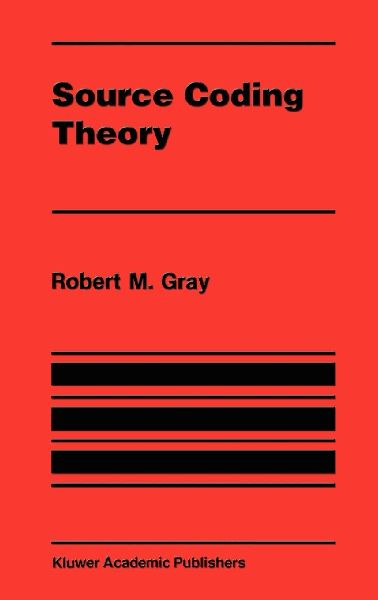
Source Coding Theory
von Robert M. Gray
Aus der Reihe The Springer International Series in Engineering and Computer Science
- Einband
- Gebunden
- Seiten
- 206
- Sprache
- Englisch
- Erschienen
- Oktober 1989
- Verlag
- Springer
Buchbeschreibung
Source coding theory has as its goal the characterization of the optimal performance achievable in idealized communication systems which must code an information source for transmission over a digital communication or storage channel for transmission to a user. The user must decode the information into a form that is a good approximation to the original.
Ganze Beschreibung lesenWeniger anzeigen
A code is optimal within some class if it achieves the best possible fidelity given whatever constraints are imposed on the code by the available channel. In theory, the primary constraint imposed on a code by the channel is its rate or resolution, the number of bits per second or per input symbol that it can transmit from sender to receiver. In the real world, complexity may be as important as rate.
The origins and the basic form of much of the theory date from Shan non's classical development of noiseless source coding and source coding subject to a fidelity criterion (also called rate-distortion theory) [73] [74]. Shannon combined a probabilistic notion of information with limit theo rems from ergodic theory and a random coding technique to describe the optimal performance of systems with a constrained rate but with uncon strained complexity and delay.
An alternative approach called asymptotic or high rate quantization theory based on different techniques and approx imations was introduced by Bennett at approximately the same time [4]. This approach constrained the delay but allowed the rate to grow large.
Inhaltsverzeichnis
- 1 Information Sources
- 1.1 Probability Spaces
- 1.2 Random Variables and Vectors
- 1.3 Random Processes
- 1.4 Expectation
- 1.5 Ergodic Properties
- Exercises
- 2 Codes, Distortion, and Information
Ganzes Inhaltsverzeichnis anzeigen (56 Einträge)Weniger anzeigen
- 2.1 Basic Models of Communication Systems
- 2.2 Code Structures
- 2.3 Code Rate
- 2.4 Code Performance
- 2.5 Optimal Performance
- 2.6 Information
- 2.7 Limiting Properties
- 2.8 Related Reading
- Exercises
- 3 Distortion-Rate Theory
- 3.1 Introduction
- 3.2 Distortion-Rate Functions
- 3.3 Almost Noiseless Codes
- 3.4 The Source Coding Theorem for Block Codes
- 3.5 Synchronizing Block Codes
- 3.6 Sliding-Block Codes
- 3.7 Trellis Encoding
- Exercises
- 4 Rate-Distortion Functions
- 4.1 Basic Properties
- 4.2 The Variational Equations
- 4.3 The Discrete Shannon Lower Bound
- 4.4 The Blahut Algorithm
- 4.5 Continuous Alphabets
- 4.6 The Continuous Shannon Lower Bound
- 4.7 Vectors and Processes
- 4.8 Norm Distortion
- Exercises
- 5 High Rate Quantization
- 5.1 Introduction
- 5.2 Asymptotic Distortion
- 5.3 The High Rate Lower Bound
- 5.4 High Rate Entropy
- 5.5 Lattice Vector Quantizers
- 5.6 Optimal Performance
- 5.7 Comparison of the Bounds
- 5.8 Optimized VQ vs. Uniform Quantization
- 5.9 Quantization Noise
- Exercises
- 6 Uniform Quantization Noise
- 6.1 Introduction
- 6.2 Uniform Quantization
- 6.3 PCM Quantization Noise: Deterministic Inputs
- 6.4 Random Inputs and Dithering
- 6.5 Sigma-Delta Modulation
- 6.6 Two-Stage Sigma-Delta Modulation
- 6.7 Delta Modulation
- Exercises
Details
- Erscheinungstermin
- Oktober 1989
- Kategorie
- Fremdsprachige Bücher
- Einband
- Gebunden
- Seiten
- 206
- Sprache
- Englisch
- Verlag
- Springer
- Reihe
- The Springer International Series in Engineering and Computer Science
- Format
- 24,1 × 16,0 cm
- Dicke
- 1,6 cm
- Gewicht
- 428 g
- EAN / ISBN-13
- 9780792390480
Über Robert M. Gray
Robert M. Gray is the Alcatel-Lucent Technologies Professor of Communications and Networking in the School of Engineering and Professor of Electrical Engineering at Stanford University.
Mehr über Robert M. GrayWeniger anzeigen
For over four decades he has done research, taught, and published in the areas of information theory and statistical signal processing. He is a Fellow of the IEEE and the Institute for Mathematical Statistics. He has won several professional awards, including a Guggenheim Fellowship, the Society Award and Education Award of the IEEE Signal Processing Society, the Claude E. Shannon Award from the IEEE Information Theory Society, the Jack S. Kilby Signal Processing Medal, Centennial Medal, and Third Millennium Medal from the IEEE, and a Presidential Award for Excellence in Science, Mathematics and Engineering Mentoring (PAESMEM). He is a member of the National Academy of Engineering.
Versand und Rückgabe
Standardversand: 1 bis 3 Werktage, 3,99 €, kostenlos ab 35 €
Liefergebiet: Deutschland
Rücksendung: 14 Tage Widerrufsrecht. Bei einem Widerruf tragen Sie die Kosten der Rücksendung. Bei einer Falschlieferung oder einem Fehler von uns erstatten wir Ihnen das Rückporto. Den Widerruf erklären Sie über den Knopf „Vertrag widerrufen“ im Fuß der Seite.
Hersteller und ProduktsicherheitSpringer Nature Customer Service Center GmbH
Springer Nature Customer Service Center GmbH
Europaplatz 3
69115 Heidelberg
Deutschland
ProductSafety@springernature.com
Mehr von Robert M. Gray

Probability, Random Processes, and Ergodic Properties
Robert M. Gray
Kartoniert, Englisch, 2 Ausgaben
ab 171,19 €
Mehr aus der Reihe The Springer International Series in Engineering and Computer Science
Integrated Circuit Defect-Sensitivity: Theory and Computational Models
José Pineda de Gyvez
Kartoniert, Englisch, 2 Ausgaben
ab 106,99 €

JPEG2000 Image Compression Fundamentals, Standards and Practice
David Taubman
Kartoniert, Englisch, 2 Ausgaben
ab 160,49 €

Automated Calibration of Modulated Frequency Synthesizers
Dan McMahill
Kartoniert, Englisch, 2 Ausgaben
ab 106,99 €

Multi-Standard CMOS Wireless Receivers: Analysis and Design
Xiaopeng Li
Kartoniert, Englisch, 2 Ausgaben
ab 106,99 €
Ähnliche Titel

Computational Modeling of Objects Presented in Images
Paolo Di Giamberardino (Hrsg.)
Gebunden, Englisch, 2 Ausgaben
ab 106,99 €


Digital System Test and Testable Design
Zainalabedin Navabi
Kartoniert, Englisch, 2 Ausgaben
ab 85,59 €
Deep Learning for Computational Problems in Hardware Security
Pranesh Santikellur
Gebunden, Englisch, 2 Ausgaben
ab 106,99 €
Bewertungen
Zu diesem Titel gibt es noch keine Bewertung. Bewerten kann, wer ihn bei uns gekauft hat.
So prüfen wir Bewertungen
Eine Bewertung kann bei uns nur abgeben, wer den Titel über sein Kundenkonto bei uns gekauft hat. Jede Bewertung ist fest mit der zugehörigen Bestellung verknüpft; anders kommt sie technisch gar nicht zustande. Deshalb trägt jede angezeigte Bewertung den Hinweis „Verifizierter Kauf". Wir zeigen positive wie negative Bewertungen und löschen nur bei Rechtsverstößen. Für Bewertungen gibt es keine Gegenleistung.
53,49 €Voraussichtlich 3. bis 7. Dez.