
Buch-OWLOnline-Buchhandel

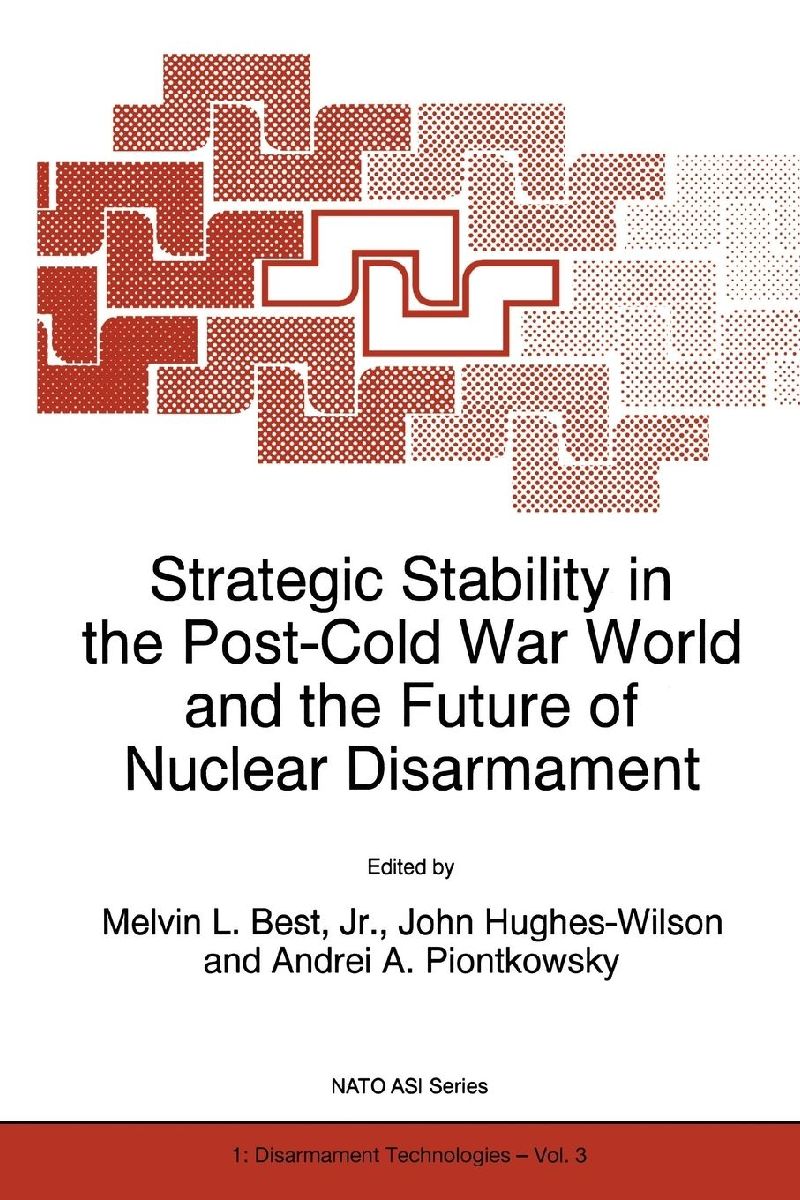
Strategic Stability in the Post-Cold War World and the Future of Nuclear Disarmament

von Jr. Best (Hrsg.)

Herausgegeben von: Jr. Best, Herausgegeben von: Andrei A. Piontkowsky, Herausgegeben von: John Hughes-Wilson

Aus der Reihe NATO Science Partnership Subseries: 1

Einband
Kartoniert
Seiten
344
Sprache
Englisch
Erschienen
Dezember 2010
Verlag
Springer

Buchbeschreibung

This Report contains a Consensus Report and the papers submitted to the April 6 -10, 1995 NATO Advanced Research Workshop on Strategic Stability In The Post-Cold War World And The Future Of Nuclear Disarmament, held in Washington D. C. , United States Of America of at The Airlie Conference Center.

Ganze Beschreibung lesenWeniger anzeigen

The workshop was sponsored by the NATO Division Scientific and Environmental Affairs as part of its ongoing outreach programme to widen and deepen scientific contacts between NATO member countries and the Cooperation Partner countries of the former Warsaw Treaty Organization.

The participants recognize that the collapse of the former Soviet Union has left a conceptual vacuum in the definition of a new world order. Never before have the components of world order all changed so rapidly, so deeply, or so globally.

As Henry Kissinger points out, the emergence of the new world order will have answered three fundamental questions:" What are the basic units of the international order? What are their means of interacting? and What are the goals on behalf of which they interact? " The main question is whether the establishment and maintenance of an international system will turn out to be a conscious design, or the outgrowth of a test of strength.

The concept of a planning framework that could shape or govern these interactions is emerging and may now be at hand. Capturing this emerging framework is the thrust of this NATO-sponsored Advanced Research Workshop.

Inhaltsverzeichnis

  • Preface
  • 1. Consensus report
  • 2. Contributing papers
  • Deterrence, disarmament, and post-cold war stability: enhancing security for both `haves' and `have nots'
  • R.F. Lehmann II. 2.1: Qualitative - global
  • On deterrence, balance of power, and geopolitics
  • R.W. Chandler
  • Proliferation stability and instability: conditioning factors
Ganzes Inhaltsverzeichnis anzeigen (51 Einträge)Weniger anzeigen
  • F. Ermarth
  • Verifying the future: towards and international conventional arms control and conversion regime for the 21st century
  • R. Giles
  • Crisis stability in a multipolar world
  • R. Linhard
  • 2.2: Qualitative - European
  • Russia and the west: a partnership? R. Braithwaite
  • Possibilities for cooperation of Russia and the USA in designing, correction and realization of national security doctrines
  • D.S. Chereshkin
  • Deterrence and stability
  • V.I. Krivokhizha
  • 2.3: Qualitative - Asian
  • Geo- political stability and the balance of power in East Asia
  • A. Farrar-Hockley
  • Strategic stability in the early 2000s: an Indian view of a south Asian model
  • K. Sundarji
  • Non-nuclear proliferation and strategic stability in the Asia-Pacific region
  • Xia Liping
  • 2.4: Quantitative: geopolitical stability and balance of power
  • Balance of power versus collective security: a game-theoretic analysis
  • E.M.S. Niou
  • Russia's nuclear strategy: 90s and after
  • A. Piontkowsky, A. Skorokhodov
  • 2.5: Quantitative: deterrence, crisis stability and first strike stability
  • Multipolar nuclear stability: incentives to strike and incentives to preempt
  • J. Bracken
  • Controlling instabilities caused by rogue governments
  • G.A. Kent
  • From MAD to MAD
  • M. Rudnianski
  • FSSI as a universalmeasure of stability: from MAD-stability toward MAP-stability
  • A. Piontkowsky, A. Skorokhodov
  • 2.6: Quantitative: arms race
  • Analyzing three-way arms races
  • F.S. Nyland
  • New patterns in the arms race: some guidelines
  • C. Schmidt
  • Approaches to mathematical modeling of the process of world-wide strategic nuclear conflict used in the former USSR
  • A.V. Surikov
  • 2.7: Quantitative: proliferation
  • Stability, reassurance and non-proliferation
  • I. Amit
  • Index

Details

Erscheinungstermin
Dezember 2010
Kategorie
Fremdsprachige Bücher
Einband
Kartoniert
Seiten
344
Sprache
Englisch
Verlag
Springer
Reihe
NATO Science Partnership Subseries: 1
Format
23,5 × 15,5 cm
Dicke
1,9 cm
Gewicht
522 g
EAN / ISBN-13
9789048146420
Maßstabsgetreu: Deckel und Buchrücken neben einer Hand (18 cm).
Versand und Rückgabe

Standardversand: 1 bis 3 Werktage, 3,99 €, kostenlos ab 35 €

Liefergebiet: Deutschland

Rücksendung: 14 Tage Widerrufsrecht. Bei einem Widerruf tragen Sie die Kosten der Rücksendung. Bei einer Falschlieferung oder einem Fehler von uns erstatten wir Ihnen das Rückporto. Den Widerruf erklären Sie über den Knopf „Vertrag widerrufen“ im Fuß der Seite.

Hersteller und ProduktsicherheitSpringer Nature Customer Service Center GmbH
Springer Nature Customer Service Center GmbH
Europaplatz 3
69115 Heidelberg
Deutschland
ProductSafety@springernature.com

Mehr aus der Reihe NATO Science Partnership Subseries: 1

Bewertungen

Zu diesem Titel gibt es noch keine Bewertung. Bewerten kann, wer ihn bei uns gekauft hat.

So prüfen wir Bewertungen
Eine Bewertung kann bei uns nur abgeben, wer den Titel über sein Kundenkonto bei uns gekauft hat. Jede Bewertung ist fest mit der zugehörigen Bestellung verknüpft; anders kommt sie technisch gar nicht zustande. Deshalb trägt jede angezeigte Bewertung den Hinweis „Verifizierter Kauf". Wir zeigen positive wie negative Bewertungen und löschen nur bei Rechtsverstößen. Für Bewertungen gibt es keine Gegenleistung.
213,99 €Voraussichtlich 2. bis 4. Dez.

Inhalte ab 18

Cover von Titeln für Erwachsene, etwa erotische Romane, Manga oder Comics, bleiben unscharf, bis Sie bestätigen. Die Bestätigung gilt für alle Seiten und Tabs, bis Sie den Browser schließen.

Zurück zum Katalog