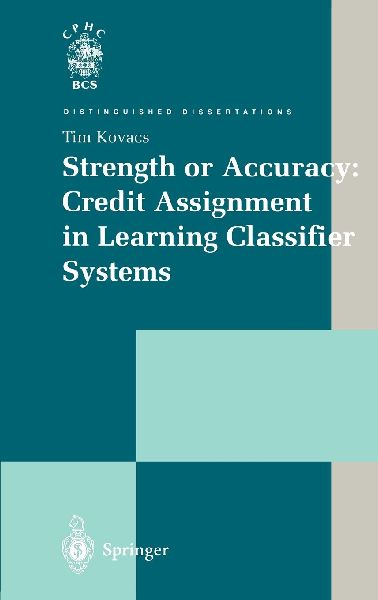
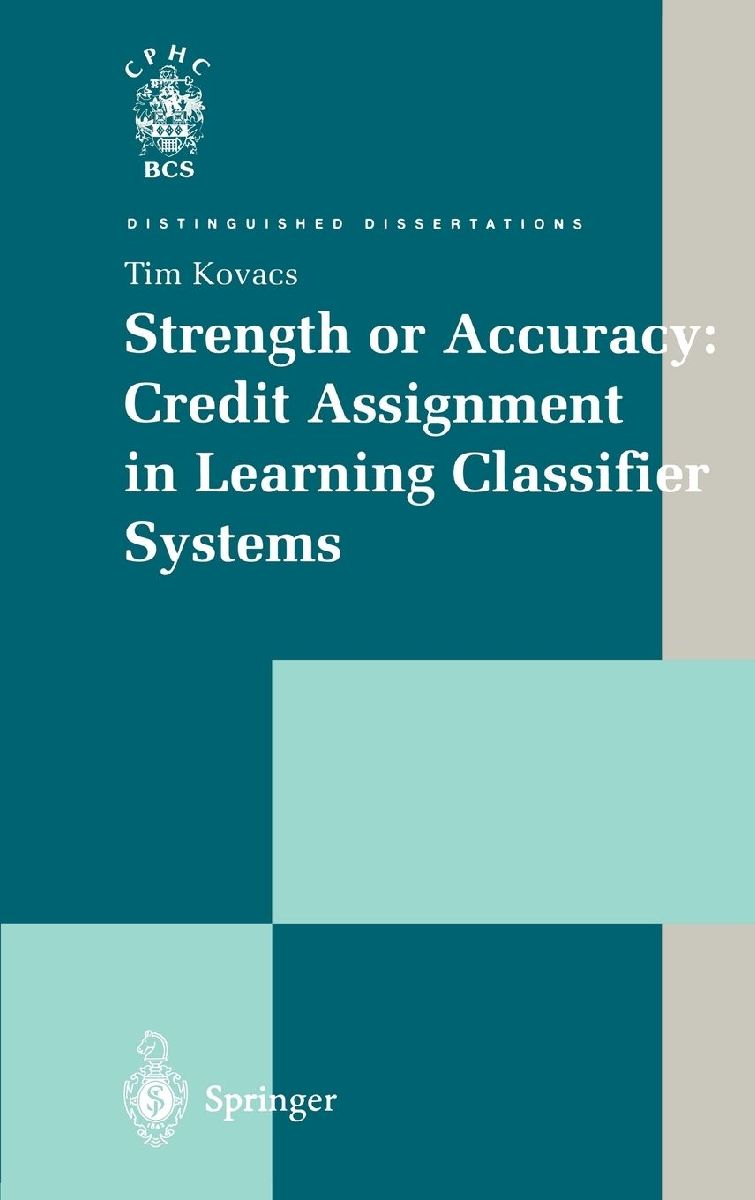
Strength or Accuracy: Credit Assignment in Learning Classifier Systems
von Tim Kovacs
Aus der Reihe Distinguished Dissertations
- Einband
- Gebunden
- Seiten
- 328
- Sprache
- Englisch
- Erschienen
- Januar 2004
- Verlag
- Springer
Buchbeschreibung
Classifier systems are an intriguing approach to a broad range of machine learning problems, based on automated generation and evaluation of condi tion/action rules.
In reinforcement learning tasks they simultaneously address the two major problems of learning a policy and generalising over it (and re lated objects, such as value functions). Despite over 20 years of research, however, classifier systems have met with mixed success, for reasons which were often unclear.
Ganze Beschreibung lesenWeniger anzeigen
Finally, in 1995 Stewart Wilson claimed a long-awaited breakthrough with his XCS system, which differs from earlier classifier sys tems in a number of respects, the most significant of which is the way in which it calculates the value of rules for use by the rule generation system. Specifically, XCS (like most classifier systems) employs a genetic algorithm for rule generation, and the way in which it calculates rule fitness differs from earlier systems.
Wilson described XCS as an accuracy-based classifier system and earlier systems as strength-based. The two differ in that in strength-based systems the fitness of a rule is proportional to the return (reward/payoff) it receives, whereas in XCS it is a function of the accuracy with which return is predicted.
The difference is thus one of credit assignment, that is, of how a rule's contribution to the system's performance is estimated. XCS is a Q learning system; in fact, it is a proper generalisation of tabular Q-learning, in which rules aggregate states and actions. In XCS, as in other Q-learners, Q-values are used to weight action selection.
Inhaltsverzeichnis
- Introduction
- Learning Classifier Systems
- How Strength and Accuracy Differ
- What Should a Classifier System Learn?- Prospects for Adaption
- Classifier Systems and Q-Learning
- Conclusion
- Appendices
- Evaluation of Macroclassifiers
Ganzes Inhaltsverzeichnis anzeigen (17 Einträge)Weniger anzeigen
- Example XCS Cycle
- Learning from Reinforcement
- Generalisation Problems
- Value Estimation Algorithms
- Generalised Policy Iteration Algorithms
- Evolutionary Algorithms
- The Origins of Sarsa
- Notation
- References
Details
- Erscheinungstermin
- Januar 2004
- Kategorie
- Fremdsprachige Bücher
- Einband
- Gebunden
- Seiten
- 328
- Sprache
- Englisch
- Verlag
- Springer
- Reihe
- Distinguished Dissertations
- Format
- 24,1 × 16,0 cm
- Dicke
- 2,3 cm
- Gewicht
- 607 g
- EAN / ISBN-13
- 9781852337704
Versand und Rückgabe
Standardversand: 1 bis 3 Werktage, 3,99 €, kostenlos ab 35 €
Liefergebiet: Deutschland
Rücksendung: 14 Tage Widerrufsrecht. Bei einem Widerruf tragen Sie die Kosten der Rücksendung. Bei einer Falschlieferung oder einem Fehler von uns erstatten wir Ihnen das Rückporto. Den Widerruf erklären Sie über den Knopf „Vertrag widerrufen“ im Fuß der Seite.
Hersteller und ProduktsicherheitSpringer Nature Customer Service Center GmbH
Springer Nature Customer Service Center GmbH
Europaplatz 3
69115 Heidelberg
Deutschland
ProductSafety@springernature.com
Mehr aus der Reihe Distinguished Dissertations


Inheritance Relationships for Disciplined Software Construction
Tracy A. Gardner
Kartoniert, Englisch, 2 Ausgaben
ab 53,49 €


User-Developer Cooperation in Software Development
Eamonn O'Neill
Kartoniert, Englisch, 2 Ausgaben
ab 106,99 €
Ähnliche Titel




Bewertungen
Zu diesem Titel gibt es noch keine Bewertung. Bewerten kann, wer ihn bei uns gekauft hat.
So prüfen wir Bewertungen
Eine Bewertung kann bei uns nur abgeben, wer den Titel über sein Kundenkonto bei uns gekauft hat. Jede Bewertung ist fest mit der zugehörigen Bestellung verknüpft; anders kommt sie technisch gar nicht zustande. Deshalb trägt jede angezeigte Bewertung den Hinweis „Verifizierter Kauf". Wir zeigen positive wie negative Bewertungen und löschen nur bei Rechtsverstößen. Für Bewertungen gibt es keine Gegenleistung.
160,49 €Voraussichtlich 4. bis 8. Dez.