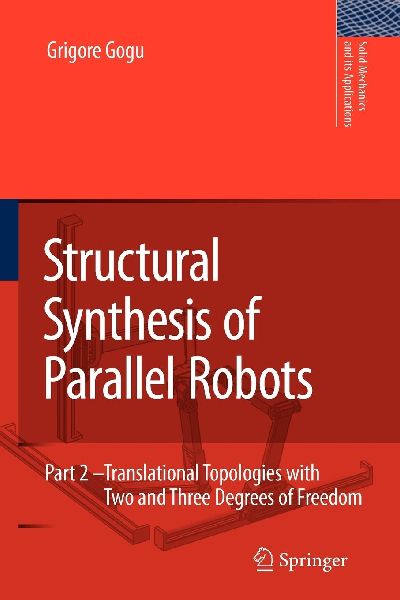
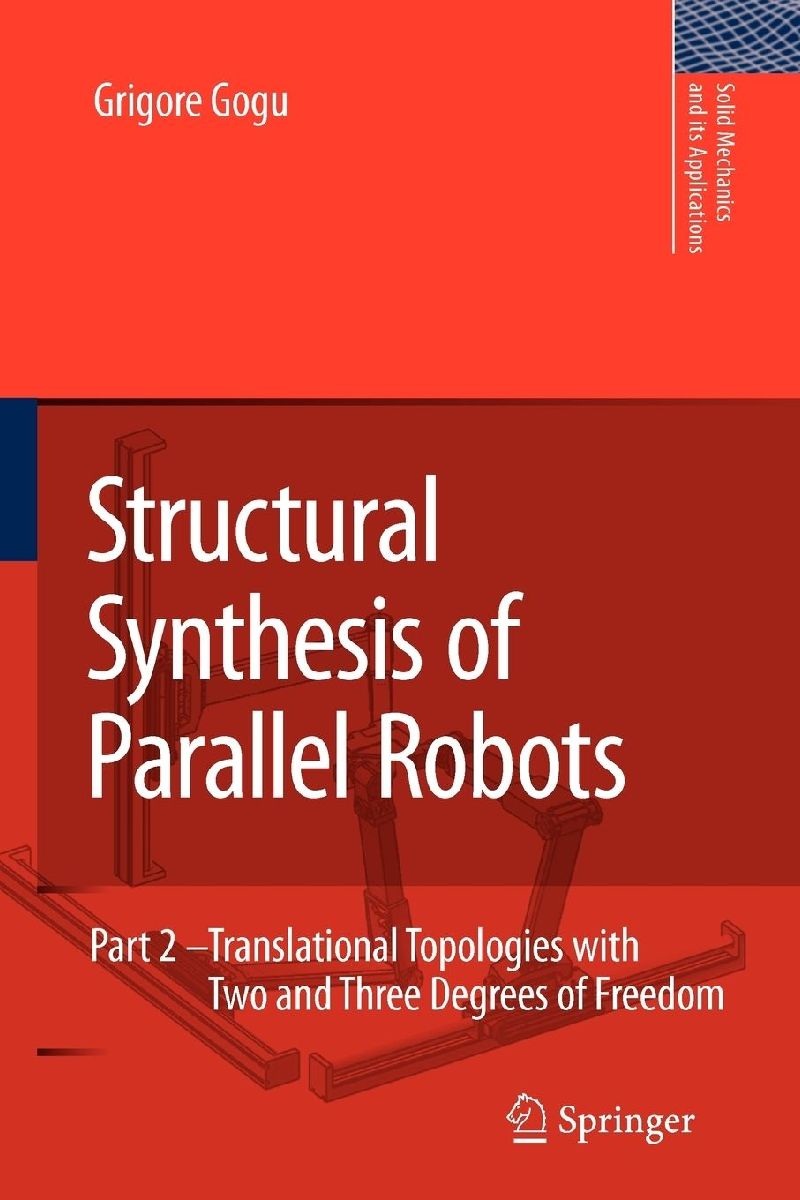
Structural Synthesis of Parallel Robots
Part 2: Translational Topologies with Two and Three Degrees of Freedom
von Grigore Gogu
Aus der Reihe Solid Mechanics and Its Applications
- Einband
- Kartoniert
- Seiten
- 780
- Sprache
- Englisch
- Erschienen
- Oktober 2010
- Verlag
- Springer
Buchbeschreibung
"The mathematical investigations referred to bring the whole apparatus of a great science to the examination of the properties of a given mechanism, and have accumulated in this direction rich material, of enduring and increasing value. What is left unexamined is however the other, immensely deeper part of the problem, the question: How did the mechanism, or the elements of which it is composed, originate? What laws govern its building up?
Ganze Beschreibung lesenWeniger anzeigen
Is it indeed formed according to any laws whatever? Or have we simply to accept as data what invention gives us, the analysis of what is thus obtained being the only scientific problem left - as in the case of natural history?"
Reuleaux, F., Theoretische Kinematik, Braunschweig: Vieweg, 1875 Reuleaux, F., The Kinematics of Machinery, London: Macmillan, 1876 and New York: Dover, 1963 (translated by A.B.W. Kennedy) This book represents the second part of a larger work dedicated to the structural synthesis of parallel robots. Part 1 already published in 2008 (Gogu 2008a) has presented the methodology proposed for structural synthesis.
This book focuses on various topologies of translational parallel robots systematically generated by using the structural synthesis approach proposed in Part 1. The originality of this work resides in the fact that it combines the new formulae for mobility connectivity, redundancy and overconstraints, and the evolutionary morphology in a unified approach of structural synthesis giving interesting innovative solutions for parallel mechanisms.
Inhaltsverzeichnis
- Preface
- Acknowledgements
- List of abbreviations and notations
- 1 Introduction
- 1.1 Terminology
- 1.2 Methodology of structural synthesis
- 1.2.1 New formulae for mobility, connectivity, redundancy and overconstraint of parallel robots
- 1.2.2 Evolutionary morphology approach
Ganzes Inhaltsverzeichnis anzeigen (49 Einträge)Weniger anzeigen
- 1.2.3 Types of parallel robots with respect to motion coupling
- 1.3 Translational parallel robots
- 2 Translational parallel robots with two degrees of freedom
- 2.1 T2-type translational parallel robots with coupled motions
- 2.1.1 Overconstrained solutions
- 2.1.2 Non overconstrained solutions
- 2.2 T2-type translational parallel robots with decoupled motions
- 2.2.1 Overconstrained solutions
- 2.2.2 Non overconstrained solutions
- 2.3 T2-type translational parallel robots with uncoupled motions
- 2.3.1 Overconstrained solutions
- 2.3.2 Non overconstrained solutions
- 2.4 Maximally regular T2-type translational parallel robots
- 2.4.1 Overconstrained solutions
- 2.4.2 Non overconstrained solutions
- 2.5 Other T2-type translational parallel robots
- 2.5.1 Overconstrained solution
- 2.5.2 Non overconstrained solutions
- 3 Overconstrained T3-type TPMs with coupled motions
- 3.1 Basic solutions with linear actuators
- 3.2 Derived solutions with linear actuators
- 3.3 Basic solutions with rotating actuators
- 3.4 Derived solutions with rotating actuators
- 4 Non overconstrained T3-type TPMs with coupled motions
- 4.1 Basic solutions with linear actuators
- 4.2 Derived solutions with linear actuators
- 4.3 Basic solutions with rotating actuators
- 4.4 Derived solutions with rotating actuators
- 5 Overconstrained T3-type TPMs with uncoupled motions
- 5.1 Basic solutions with rotating actuators
- 5.2 Derived solutions with rotating actuators
- 6 Non overconstrained T3-type TPMs with uncoupled motions
- 6.1 Basic solutions with rotating actuators
- 6.2 Derived solutions with rotating actuators
- 7 Maximally regular T3-type translational parallel robots
- 7.1 Overconstrained solutions
- 7.1.1 Basic solutions with no idle mobilities
- 7.1.2 Derived solutions with idle mobilities
- 7.2 Non overconstrained solutions
- References
- Index
Details
- Erscheinungstermin
- Oktober 2010
- Kategorie
- Fremdsprachige Bücher
- Einband
- Kartoniert
- Seiten
- 780
- Sprache
- Englisch
- Verlag
- Springer
- Reihe
- Solid Mechanics and Its Applications
- Format
- 23,5 × 15,5 cm
- Dicke
- 4,2 cm
- Gewicht
- 1.159 g
- EAN / ISBN-13
- 9789048182022
Versand und Rückgabe
Standardversand: 1 bis 3 Werktage, 3,99 €, kostenlos ab 35 €
Liefergebiet: Deutschland
Rücksendung: 14 Tage Widerrufsrecht. Bei einem Widerruf tragen Sie die Kosten der Rücksendung. Bei einer Falschlieferung oder einem Fehler von uns erstatten wir Ihnen das Rückporto. Den Widerruf erklären Sie über den Knopf „Vertrag widerrufen“ im Fuß der Seite.
Hersteller und ProduktsicherheitSpringer Nature Customer Service Center GmbH
Springer Nature Customer Service Center GmbH
Europaplatz 3
69115 Heidelberg
Deutschland
ProductSafety@springernature.com
Mehr von Grigore Gogu
Recent Advances in Integrated Design and Manufacturing in Mechanical Engineering
Grigore Gogu (Hrsg.)
Kartoniert, Englisch, 2 Ausgaben
ab 213,99 €
Mehr aus der Reihe Solid Mechanics and Its Applications

The Boundary Element Method for Engineering Analysis of Plates and Shells
Jairo Useche Vivero
Kartoniert, Englisch, 2 Ausgaben
ab 117,69 €

Ähnliche Titel

New Trends in Mechanism and Machine Science
Giulio Rosati (Hrsg.)
Gebunden, Englisch, 2 Ausgaben
ab 320,99 €

Deterministic and Stochastic Time-Delay Systems
El-Kebir Boukas
Kartoniert, Englisch, 2 Ausgaben
ab 106,99 €
Bewertungen
Zu diesem Titel gibt es noch keine Bewertung. Bewerten kann, wer ihn bei uns gekauft hat.
So prüfen wir Bewertungen
Eine Bewertung kann bei uns nur abgeben, wer den Titel über sein Kundenkonto bei uns gekauft hat. Jede Bewertung ist fest mit der zugehörigen Bestellung verknüpft; anders kommt sie technisch gar nicht zustande. Deshalb trägt jede angezeigte Bewertung den Hinweis „Verifizierter Kauf". Wir zeigen positive wie negative Bewertungen und löschen nur bei Rechtsverstößen. Für Bewertungen gibt es keine Gegenleistung.
160,49 €Voraussichtlich 1. bis 3. Dez.