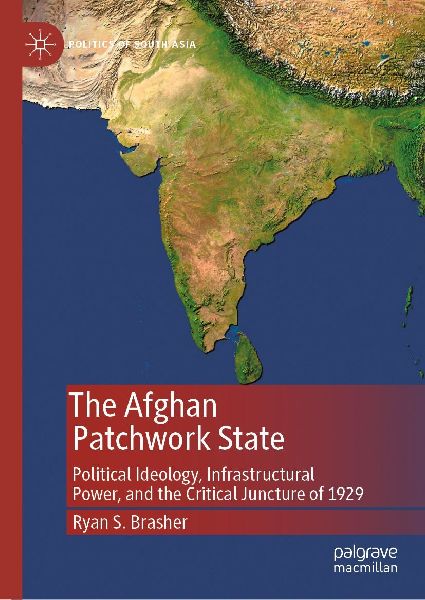
The Afghan Patchwork State
Political Ideology, Infrastructural Power, and the Critical Juncture of 1929
von Ryan S. Brasher
Aus der Reihe Politics of South Asia
- Einband
- Gebunden
- Seiten
- 224
- Sprache
- Englisch
- Erschienen
- September 2024
- Verlag
- Springer
Buchbeschreibung
This book provides a theoretically grounded and empirically fine-grained analysis of uneven state development in Afghanistan beginning in the early 20th Century.
Based on archival research, the book shows that after Amanullah Shah's abortive modernist authoritarian experiment and Habibullah Kalakani's brief rule, a newly empowered Musahiban dynasty charted a patrimonial absolutist course.
Ganze Beschreibung lesenWeniger anzeigen
The new regime delegated considerable authority to traditional tribal areas in the southeastern and eastern part of the country, while pursuing a coercive strategy in other parts of the country that usurped traditional leadership at the regional and local levels.
Previous explanations of the weakness of the Afghan state tend to emphasize structural determinants such as difficult geography, acephalous tribal organization, ethnic heterogeneity, as well as colonial interventions. Others have focused only on events after the Soviet or NATO interventions, pointing out faulty external decision-making, corrupt government officials and warlords, neighboring insurgent safe havens, or the international aid-fueled rentier economy.
This book proposes an intermediate explanation for the patchwork nature of the Afghan state rooted in institutional choices made by a new ruling elite that took over in 1929. The year represents one critical juncture in Afghan history, where individual agency based on certain ideological preferences set in motion a path-dependent process that shaped its politics well into the latter half of the century.
Inhaltsverzeichnis
- Chapter 1: Introduction
- Chapter 2: Political Ideology in Afghanistan: The Modernist Alternative
- Chapter 3: Political Ideology in Afghanistan: Patrimonial Absolutism
- Chapter 4: 1929 as a Critical Juncture
- Chapter 5: Regime Perception of and Actions Toward Local Elites: Allies
- Chapter 6: Regime Perceptions of and Actions Toward Local Elites: Rivals
- Chapter 7: Long-Term Development of Infrastructural Power
- Chapter 8: Conclusion
Details
- Erscheinungstermin
- September 2024
- Kategorie
- Fremdsprachige Bücher
- Einband
- Gebunden
- Seiten
- 224
- Sprache
- Englisch
- Verlag
- Springer
- Reihe
- Politics of South Asia
- Format
- 21,6 × 15,3 cm
- Dicke
- 1,7 cm
- Gewicht
- 369 g
- EAN / ISBN-13
- 9789819765980
Über Ryan S. Brasher
Ryan Brasher is Associate Professor of Political Science in the Department of History and Political Science at Simpson University in Redding California.
Mehr über Ryan S. BrasherWeniger anzeigen
His research focus is centered on ethnic identity, nationalism, political religion, and state-building in Central and South Asia. He has previously published on the construction of Tajik identity in Tajikistan and Afghanistan, on different manifestations of Political Islam in Afghanistan and Pakistan, on domestic determinants of Pakistan's foreign policy toward its neighbors, the political attitudes of the Christian minority in Pakistan, as well as ethnic identity and assimilation of Afghan refugees in Pakistan.
Versand und Rückgabe
Standardversand: 1 bis 3 Werktage, 3,99 €, kostenlos ab 35 €
Liefergebiet: Deutschland
Rücksendung: 14 Tage Widerrufsrecht. Bei einem Widerruf tragen Sie die Kosten der Rücksendung. Bei einer Falschlieferung oder einem Fehler von uns erstatten wir Ihnen das Rückporto. Den Widerruf erklären Sie über den Knopf „Vertrag widerrufen“ im Fuß der Seite.
Hersteller und ProduktsicherheitSpringer Nature Customer Service Center GmbH
Springer Nature Customer Service Center GmbH
Europaplatz 3
69115 Heidelberg
Deutschland
ProductSafety@springernature.com
Mehr aus der Reihe Politics of South Asia
The Belt and Road Initiative and the Politics of Connectivity
Bhumitra Chakma (Hrsg.)
Gebunden, Englisch, 2 Ausgaben
ab 106,99 €
Religion, Extremism and Violence in South Asia
Imran Ahmed (Hrsg.)
Gebunden, Englisch, 2 Ausgaben
ab 149,79 €
Ähnliche Titel




Bewertungen
Zu diesem Titel gibt es noch keine Bewertung. Bewerten kann, wer ihn bei uns gekauft hat.
So prüfen wir Bewertungen
Eine Bewertung kann bei uns nur abgeben, wer den Titel über sein Kundenkonto bei uns gekauft hat. Jede Bewertung ist fest mit der zugehörigen Bestellung verknüpft; anders kommt sie technisch gar nicht zustande. Deshalb trägt jede angezeigte Bewertung den Hinweis „Verifizierter Kauf". Wir zeigen positive wie negative Bewertungen und löschen nur bei Rechtsverstößen. Für Bewertungen gibt es keine Gegenleistung.
128,39 €Voraussichtlich 4. bis 8. Dez.