Aspects of Visual Sensation in Edgar Allan Poe's Depiction of Violence against Women
Amelie Meyer
Kartoniert, Englisch
17,95 €
von Amelie Meyer
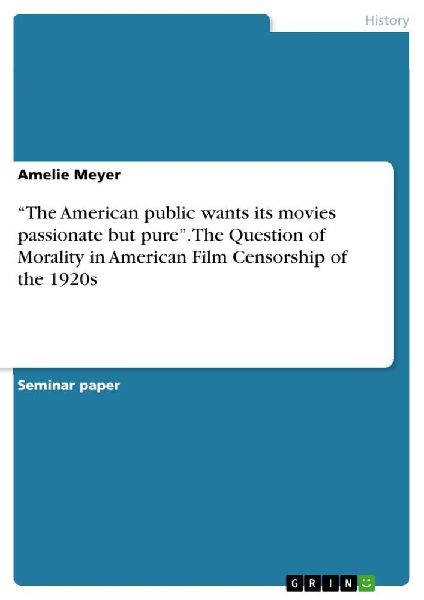
Seminar paper from the year 2012 in the subject History - America, grade: 1,0, University of Göttingen (Seminar für Mittlere und Neuere Geschichte), course: The "Roaring Twenties": Die Massenkultur der 1920er Jahre in transatlantischer Perspektive, language: English, abstract: For as long as there have been moving pictures, there have also been attempts to regulate their content.
The first court case surrounding moving pictures has been recorded as early as 1897 and many more were to follow. While film was thus always subjected to scrutiny from various groups, the 1920s saw a more fervent battle for control over censorship which resulted in the formation of the 1930 Production Code remaining in effect until 1968. Lee Grieveson's study Policing Cinema: Movies and Censorship in Early-Twentieth-Century America comprehensively describes long-lasting battles over movie content regulation and the discussion of the function of cinema.
Yet, he is among many scholars who sees the 1915 Supreme Court decision in the case "Mutual Film Corporation v. Industrial Commission of Ohio" as the culmination of these struggles as it proved "the validity of state censorship." Justice McKenna is quoted ruling that "the exhibition of moving picture is a business, pure and simple, originated and conducted for profit, like other spectacles, not to be regarded … as part of the press of the country, or as organs of the public opinion."
This ruling was not only significant for the increased state and city censorship which followed, but it also fueled censorship demands by various parties including religious groups, social reformers, politicians, and journalists who all called for the elusive concept of morality. The road from this first ruling which titled the film industry as a business to be regulated towards a formal censorship with the aim of restoring morality manifested in the so-called Production Code in 1934 will be the focus of this paper.
The first part will consist of an analysis of the various parties involved in the attempt to regulate movie content in order to expose the individual motives behind their requests as well as their practices to reach their goal of censorship. The following part will then deal with the question of how well the reformers were able to realize their goal of censoring the movies during the first years of the 1920s.
The questions posed above will mainly be studied on the basis of guiding works written by Gregory D. Black, Francis G. Couvares, Stephen Vaughn, Lee Grieveson and Leonard J. Leff. Analyzed sources will include newspaper articles, state review board standards, studies on audience behavior, and an original text written by a direct participant of the 1920 censorship struggle, MPPDA president William Hays.
Standardversand: 1 bis 3 Werktage, 3,99 €, kostenlos ab 35 €
Liefergebiet: Deutschland
Rücksendung: 14 Tage Widerrufsrecht. Bei einem Widerruf tragen Sie die Kosten der Rücksendung. Bei einer Falschlieferung oder einem Fehler von uns erstatten wir Ihnen das Rückporto. Den Widerruf erklären Sie über den Knopf „Vertrag widerrufen“ im Fuß der Seite.
Amelie Meyer
Kartoniert, Englisch
17,95 €
Amelie Meyer
Kartoniert, Englisch
27,95 €
Amelie Meyer
Kartoniert, Englisch
17,95 €
Zu diesem Titel gibt es noch keine Bewertung. Bewerten kann, wer ihn bei uns gekauft hat.