The Assyrian Genocide
Cultural and Political Legacies
Herausgegeben von: Hannibal Travis
- Einband
- Gebunden
- Seiten
- 316
- Sprache
- Englisch
- Erschienen
- Juli 2017
- Verlag
- Taylor & Francis

Buchbeschreibung
For a brief period, the attention of the international community has focused once again on the plight of religious minorities in Iraq, Syria, and Turkey.
In particular, the abductions and massacres of Yezidis and Assyrians in the Sinjar, Mosul, Nineveh Plains, Baghdad, and Hasakah regions in 2007-2015 raised questions about the prevention of genocide.
Ganze Beschreibung lesenWeniger anzeigen
This book, while principally analyzing the Assyrian genocide of 1914-1925 and its implications for the culture and politics of the region, also raises broader questions concerning the future of religious diversity in the Middle East.
It gathers and analyzes the findings of a broad spectrum of historical and scholarly works on Christian identities in the Middle East, genocide studies, international law, and the politics of the late Ottoman Empire, as well as the politics of the Ottomans' British and Russian rivals for power in western Asia and the eastern Mediterranean basin.
A key question the book raises is whether the fate of the Assyrians maps onto any of the concepts used within international law and diplomatic history to study genocide and group violence. In this light, the Assyrian genocide stands out as being several times larger, in both absolute terms and relative to the size of the affected group, than the Srebrenica genocide, which is recognized by Turkey as well as by international tribunals and organizations.
Including its Armenian and Greek victims, the Ottoman Christian Genocide rivals the Rwandan, Bengali, and Biafran genocides. The book also aims to explore the impact of the genocide period of 1914-1925 on the development or partial unraveling of Assyrian group cohesion, including aspirations to autonomy in the Assyrian areas of northern Iraq, northwestern Iran, and southeastern Turkey.
Scholars from around the world have collaborated to approach these research questions by reference to diplomatic and political archives, international legal materials, memoirs, and literary works.
Inhaltsverzeichnis
- List of figures and tables
- List of contributors
- Acknowledgements
- Glossary
- List of judicial decisions cited
- Table of legislation
- 1. The Assyrian genocide across history: collective memory, legal theory, and power politics
- Hannibal Travis
Ganzes Inhaltsverzeichnis anzeigen (27 Einträge)Weniger anzeigen
- 2. The term Seyfo in historical perspective Michael Abdalla
- 3. The atrocities against the Assyrians in 1915: a legal perspective
- Sara Demir
- 4. The Ottoman genocide of the Assyrians in Persia
- Anahit Khosroeva
- 5. Abduction, rape and genocide: Urmia's Assyrian girls and women
- Eden Naby
- 6. Genocide/Seyfo - and how resistance became a way of life
- Sait Çetinölu (Abdulmesih Bar
- Abraham, trans.)
- 7. Lady Surma: the pillar of the Assyrian nation, 1883-1975 Stavros Stavridis
- 8. The Assyrian delegation in the Paris Peace Conference
- Racho Donef
- 9. The Assyrian "concept of unity" after Seyfo
- Aryo Makko
- 10. Exile or extinction: the Assyrian genocide from 1915 to 2015 Hannibal Travis
- 11. Epilogue: tombstones and inverted crosses
- Nineb Lamassu
- Index
Details
- Erscheinungstermin
- Juli 2017
- Kategorie
- Fremdsprachige Bücher
- Einband
- Gebunden
- Seiten
- 316
- Sprache
- Englisch
- Verlag
- Taylor & Francis
- Format
- 24,1 × 15,9 cm
- Dicke
- 2,7 cm
- Gewicht
- 646 g
- EAN / ISBN-13
- 9781138284050
Über Hannibal Travis (Hrsg.)
Hannibal Travis publishes work and teaches classes at Florida International University relating to international law, Internet law, and intellectual property. He has also served as Visiting Associate Professor of Law at Villanova University.
Mehr über Hannibal Travis (Hrsg.)Weniger anzeigen
He graduated magna cum laude from Harvard Law School in 1999, where he served as a teaching assistant in Harvard College. He has published widely on genocide studies and human rights law, including Genocide in the Middle East: The Ottoman Empire, Iraq, and Sudan (2010); "Genocide in Sudan: The Role of Oil Exploration and the Entitlement of the Victims to Reparations," in The Top Ten Global Justice Law Review Articles 2008 (Amos Guiora ed., 2009), 107-162; "On the Original Understanding of the Crime of Genocide," Genocide Studies and Prevention 7 (2012): 30-55; "Did the Armenian Genocide Inspire Hitler?" Middle East Quarterly 20, no. 1, Winter 2013, pp. 27-35; and "Why Was Benghazi 'Saved,' But Sinjar Allowed to Be Lost?: New Failures of Genocide Prevention, 2007-2015," Genocide Studies International 10, no. 2 (2017), https://muse.jhu.edu/journal/690.
Versand und Rückgabe
Standardversand: 1 bis 3 Werktage, 3,99 €, kostenlos ab 35 €
Liefergebiet: Deutschland
Rücksendung: 14 Tage Widerrufsrecht. Bei einem Widerruf tragen Sie die Kosten der Rücksendung. Bei einer Falschlieferung oder einem Fehler von uns erstatten wir Ihnen das Rückporto. Den Widerruf erklären Sie über den Knopf „Vertrag widerrufen“ im Fuß der Seite.
Hersteller und ProduktsicherheitTaylor & Francis
Taylor & Francis
Europaallee 1
36244 Bad Hersfeld
Deutschland
gpsr@libri.de
Verantwortliche Person in der EU
Libri GmbHEuropaallee 1
36244 Bad Hersfeld
Deutschland
gpsr@libri.de
Mehr von Hannibal Travis



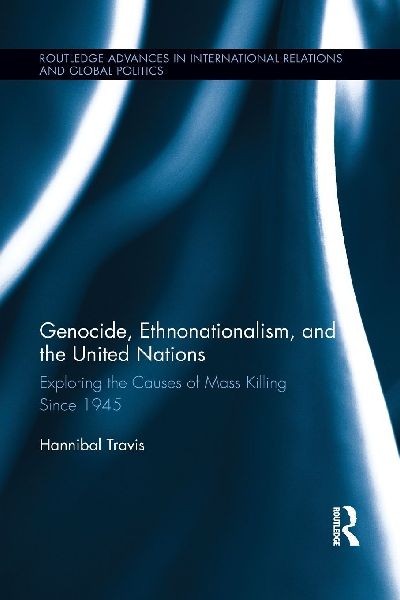
Genocide, Ethnonationalism, and the United Nations
Hannibal Travis
Kartoniert, Englisch, 2 Ausgaben
ab 71,20 €
Ähnliche Titel



Bewertungen
Zu diesem Titel gibt es noch keine Bewertung. Bewerten kann, wer ihn bei uns gekauft hat.
So prüfen wir Bewertungen
Eine Bewertung kann bei uns nur abgeben, wer den Titel über sein Kundenkonto bei uns gekauft hat. Jede Bewertung ist fest mit der zugehörigen Bestellung verknüpft; anders kommt sie technisch gar nicht zustande. Deshalb trägt jede angezeigte Bewertung den Hinweis „Verifizierter Kauf". Wir zeigen positive wie negative Bewertungen und löschen nur bei Rechtsverstößen. Für Bewertungen gibt es keine Gegenleistung.
237,50 €