
Buch-OWLOnline-Buchhandel

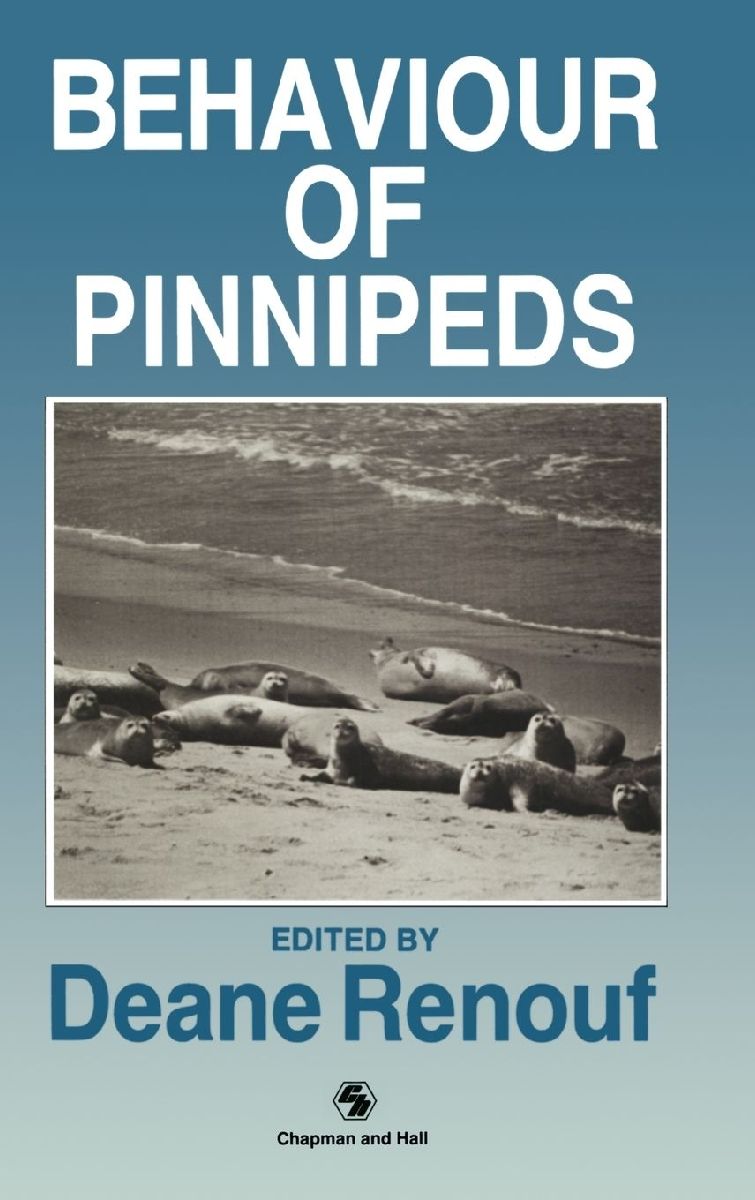
The Behaviour of Pinnipeds

von D. Renouf

Einband
Gebunden
Seiten
432
Sprache
Englisch
Erschienen
Dezember 1990
Verlag
Springer

Buchbeschreibung

We teach our students of behavioural science that one first defines a research problem, and then the most appropriate animal is selected to investigate hypotheses.

The reverse order of events is improper: a particular class of animals should not be studied for its own sake. In the case of the Pinnipeds (seals, sea lions, fur seals and walruses) the organism and the problem are essentially the same.

Ganze Beschreibung lesenWeniger anzeigen

The research questions presented in this volume in one way or another relate to survival in two worlds, the ocean for foraging, and the terrain at its edge or frozen above it for breeding.

The evolution of Pinniped behaviour and the mechanisms which underlie it are a consequence of having to cope with two seemingly incompatible sets of environmental constraints. The physiological adaptations for concomitant functioning in two media with very different physical characteristics have produced correlated behav­ ioural modifications.

The energetic demands of reproduction and foraging are idiosyncratic because each activity occurs on opposite sides of the air/water interface. As a result, the mating system must reconcile aquatic design for such functions as locomotion and thermoregulation, with the terrestrial requirements for successful pupping.

Similarly, the ecology of this dual habitat prescribes the rules governing the behaviour of the neonate and its interactions with its mother.

Inhaltsverzeichnis

  • 1 Determinants of mating systems in the Otariidae (Pinnipedia)
  • 1.1 Introduction
  • 1.2 Overview of current theory
  • 1.3 Types of mating system among Otariids
  • 1.4 Variation in the form of Otariid mating systems
  • 1.5 Conclusions
  • Acknowledgements
  • References
Ganzes Inhaltsverzeichnis anzeigen (69 Einträge)Weniger anzeigen
  • 2 Pinniped mating system on land, ice and in the water Emphasis on the Phocidae
  • 2.1 What do we expect in pinnipeds and other mammals?
  • 2.2 What do we find in mammals?
  • 2.3 What determines the distribution of females and the degree of polygyny?
  • 2.4 Do the unique features of pinnipeds give an advantage to one sex and affect the form that mating systems take?
  • 2.5 What are the consequences of mating on land verses in the water?
  • 2.6 Conclusions
  • References
  • 3 Behavioural ecology of pinniped neonates
  • 3.1 Introduction
  • 3.2 Life history characteristics
  • 3.3 The lactation period
  • 3.4 Weaning
  • 3.5 Behaviour and diet of weaned pups
  • 3.6 Discussion
  • Acknowledgements
  • References
  • 4 Communication in pinnipeds, with special reference to non-acoustic signaling
  • 4.1 Introduction
  • 4.2 Signal structure and variation
  • 4.3 Some concepts in communication
  • 4.4 Combat behaviour and the communication of threat
  • 4.5 Ecological variation and time/activity budgets
  • 4.6 Evolutionary patterns
  • 4.7 Concluding comments
  • Acknowledgements
  • References
  • 5 Physiology of behaviour in pinnipeds
  • 5.1 Introduction
  • 5.2 The physiology of reproductive behaviour
  • 5.3 Maternal behaviour
  • 5.4 Motor development and play
  • 5.5 Immune system
  • 5.6 Diving
  • 5.7 Metabolism
  • 5.8 Activity patterns
  • 5.9 Thermoregulation
  • 5.10 Moult
  • 5.11 Orientation
  • 5.12 Conclusion
  • Acknowledgements
  • References
  • 6 Reproductive and foraging energetics of pinnipeds: Implictions for life history patterns
  • 6.1 Introduction
  • 6.2 Reproductive biology
  • 6.3 Maternal investment
  • 6.4 Foraging behaviour
  • 6.5 Summary and conclusions
  • Acknowledgements
  • References
  • 7 Sensory reception and processing in: Phocidae and Otariidae
  • 7.1 Introduction
  • 7.2 Methodological caveats in psychophysical threshold measurement
  • 7.3 Vision
  • 7.4 Hearing
  • 7.5 Tactile sensation: Vibrissae
  • 7.6 Chemoreception
  • 7.7 Magnetic reception
  • 7.8 Discussion
  • 7.9 Umwelten: Beyond the receptor
  • References

Details

Erscheinungstermin
Dezember 1990
Kategorie
Fremdsprachige Bücher
Einband
Gebunden
Seiten
432
Sprache
Englisch
Verlag
Springer
Format
24,1 × 16,0 cm
Dicke
2,8 cm
Gewicht
759 g
EAN / ISBN-13
9780412305405
Maßstabsgetreu: Deckel und Buchrücken neben einer Hand (18 cm).
Versand und Rückgabe

Standardversand: 1 bis 3 Werktage, 3,99 €, kostenlos ab 35 €

Liefergebiet: Deutschland

Rücksendung: 14 Tage Widerrufsrecht. Bei einem Widerruf tragen Sie die Kosten der Rücksendung. Bei einer Falschlieferung oder einem Fehler von uns erstatten wir Ihnen das Rückporto. Den Widerruf erklären Sie über den Knopf „Vertrag widerrufen“ im Fuß der Seite.

Hersteller und ProduktsicherheitSpringer Nature Customer Service Center GmbH
Springer Nature Customer Service Center GmbH
Europaplatz 3
69115 Heidelberg
Deutschland
ProductSafety@springernature.com

Ähnliche Titel

Bewertungen

Zu diesem Titel gibt es noch keine Bewertung. Bewerten kann, wer ihn bei uns gekauft hat.

So prüfen wir Bewertungen
Eine Bewertung kann bei uns nur abgeben, wer den Titel über sein Kundenkonto bei uns gekauft hat. Jede Bewertung ist fest mit der zugehörigen Bestellung verknüpft; anders kommt sie technisch gar nicht zustande. Deshalb trägt jede angezeigte Bewertung den Hinweis „Verifizierter Kauf". Wir zeigen positive wie negative Bewertungen und löschen nur bei Rechtsverstößen. Für Bewertungen gibt es keine Gegenleistung.
320,99 €Voraussichtlich 4. bis 8. Dez.

Inhalte ab 18

Cover von Titeln für Erwachsene, etwa erotische Romane, Manga oder Comics, bleiben unscharf, bis Sie bestätigen. Die Bestätigung gilt für alle Seiten und Tabs, bis Sie den Browser schließen.

Zurück zum Katalog