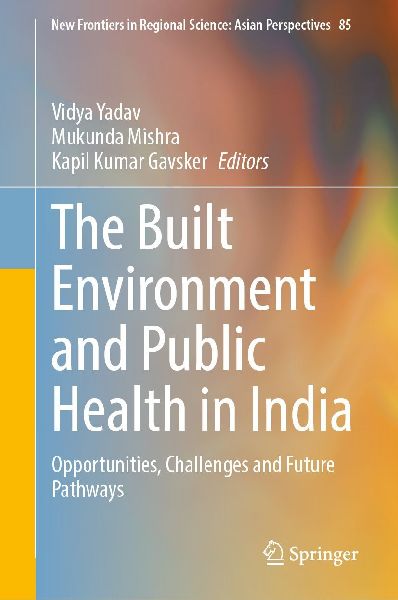
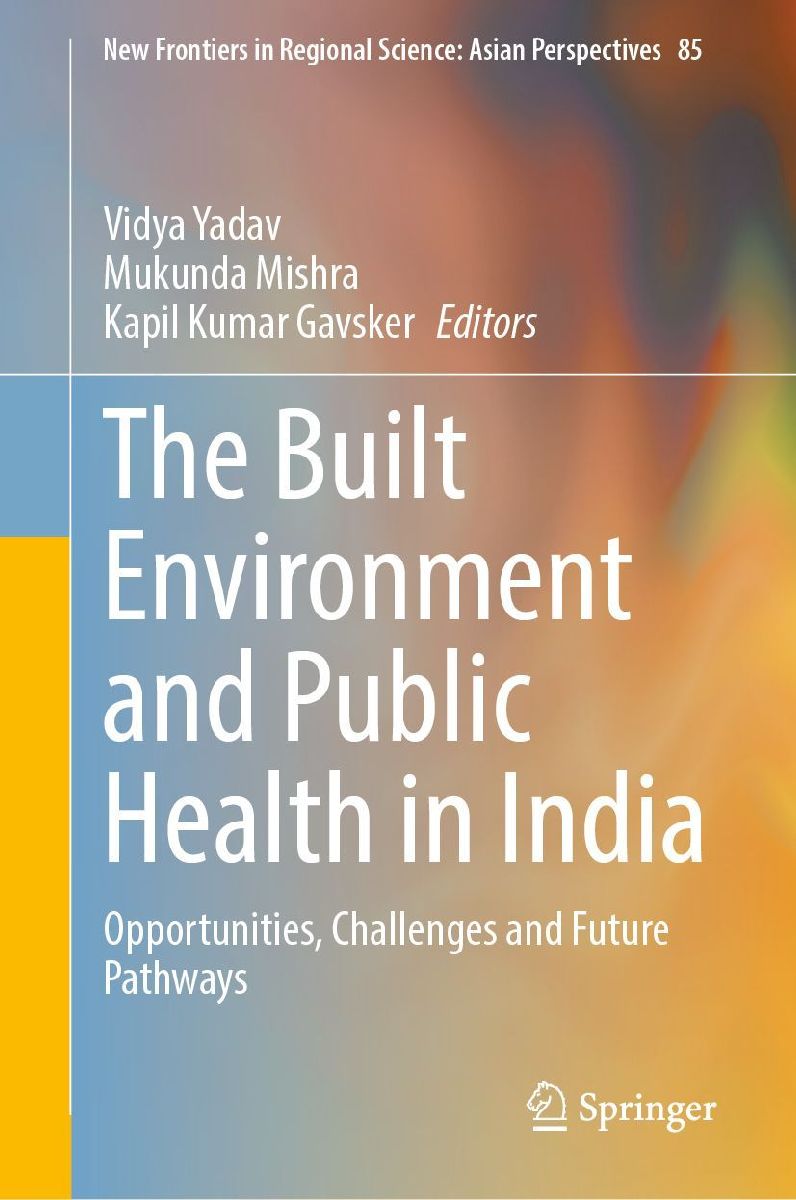
The Built Environment and Public Health in India
Opportunities, Challenges and Future Pathways
Herausgegeben von: Vidya Yadav, Herausgegeben von: Mukunda Mishra, Herausgegeben von: Kapil Kumar Gavsker
Aus der Reihe New Frontiers in Regional Science: Asian Perspectives
- Einband
- Gebunden
- Seiten
- 256
- Sprache
- Englisch
- Erschienen
- Januar 2026
- Verlag
- Springer
Buchbeschreibung
This volume deals with the determinants of both good and bad health, at individual as well as community levels, or in a broader sense, all of which are determined by multiple, critically interlinked actors that are surprisingly concentrated within the built environment. It analyzes the critical challenges in contemporary Indian cities — rapid urbanization accompanied by challenges from climate change, abnormal weather, urban flooding, and many other extreme events.
Ganze Beschreibung lesenWeniger anzeigen
This work is a timely effort that encompasses the prospects and constraints of public health when India is rapidly urbanizing, which puts severe strains on pre-existing urban health infrastructure and services to meet basic human needs, along with significant shrinkage of open, green spaces. It is also relevant when India is recovering from the nightmare of the COVID-19 pandemic, which was largely an urban health hazard, and the Indian urban health system needs substantial renewal.
The book sheds light on those Indian cities, surprisingly two-thirds of the total numbers, that lack local area plans, zonal plans, and master plans. This absence affects a significant proportion of the urban population that is outside the planned neighborhoods, with unplanned, and in most cases inadequate, health infrastructure and services.
This volume takes into account the typical health behavior in the built environment due to the increasing likelihood of a sedentary lifestyle that leads to anxiety, cardiovascular diseases, depression, diabetes, high blood pressure, obesity, asthma, and many other similar signs of poor health associated with this lifestyle.
The book serves to explore the linkages between the isolated notions of green spaces, smart cities, physical activities, mental health, and other beneficial elements. Amid the urban–industrial framework, these factors could be effective in resolving the critical public health crisis in transformative built environments and cityscapes through the synthesis of cross-disciplinary knowledge.
Inhaltsverzeichnis
- Chapter 1. The Built Environment and Public Health in India: Introductory Remarks (Mishra)
- Chapter 2. Evaluating Outdoor Thermal Comfort of Different Million-Plus Cities of India Using Geographically Weighted Regression Approach (Mondal and Gavsker)
- Chapter 3. Socioeconomic and Geographic Disparities in Household Environment in Urban India: Insights from the National Family Health Survey, 2019-21 (Singh and Chakrabarty)
- Chapter 4. Replacing Plastic with Seaweed for a Cleaner Urban Environment: A Managerial Perspective (Sen et al)
- Chapter 5. Recreational Facilities and Safety in Urban Public Green Spaces: A Study on Open Spaces, Parks and Playgrounds in Patna Municipal Corporation of Bihar (Nigam)
- Chapter 6. Regional Disparities in Health, Physical and Economic Parameters: A Decadal Analysis of North Bengal Districts (Sengupta and Chakrabarti)
- Chapter 7. Linkages between Built Environment, Lifestyle and Physical Activity: A Study of Selected Localities in Greater Mumbai City (Yadav)
- Chapter 8. Examining the Health Status of Urbanization Induced Displaced Peoples: On Transformation of Bhubaneswar City, Odisha (Sahoo and Rout)
Ganzes Inhaltsverzeichnis anzeigen (12 Einträge)Weniger anzeigen
- Chapter 9. Built Environment Towards Active Transport and Enhancing Physical Activity: A Study of Proposed Smart Cities of Bihar (Rahman)
- Chapter 10. Demographic, Epidemiological, and Nutritional Status and their Influences on Health and Well Being of Elderly People: A Study of Kalyani City, West Bengal (Das)
- Chapter 11. Disabilities Prevalence in Million-plus Cities, India: A Comparative Analysis (Rout et al)
- Chapter 12. GIS to Machine Learning: Application of Emerging Tools to Assess the Accessible Built Environment In Indian Cities (Saha et al)
Details
- Erscheinungstermin
- Januar 2026
- Kategorie
- Fremdsprachige Bücher
- Einband
- Gebunden
- Seiten
- 256
- Sprache
- Englisch
- Verlag
- Springer
- Reihe
- New Frontiers in Regional Science: Asian Perspectives
- Format
- 24,1 × 16,0 cm
- Dicke
- 2,0 cm
- Gewicht
- 501 g
- EAN / ISBN-13
- 9789819518647
Versand und Rückgabe
Standardversand: 1 bis 3 Werktage, 3,99 €, kostenlos ab 35 €
Liefergebiet: Deutschland
Rücksendung: 14 Tage Widerrufsrecht. Bei einem Widerruf tragen Sie die Kosten der Rücksendung. Bei einer Falschlieferung oder einem Fehler von uns erstatten wir Ihnen das Rückporto. Den Widerruf erklären Sie über den Knopf „Vertrag widerrufen“ im Fuß der Seite.
Hersteller und ProduktsicherheitSpringer Nature Customer Service Center GmbH
Springer Nature Customer Service Center GmbH
Europaplatz 3
69115 Heidelberg
Deutschland
ProductSafety@springernature.com
Mehr aus der Reihe New Frontiers in Regional Science: Asian Perspectives



Reconstruction Period and the Stages of Regeneration After a Great Earthquake
Keiko Nosse Hirono (Hrsg.)
Gebunden, Englisch
117,69 €

Sustainability of Economic Growth in East Asia
Hiroyuki Taguchi (Hrsg.)
Gebunden, Englisch, 2 Ausgaben
ab 139,09 €
Ähnliche Titel
Employment Guarantee Programme and Dynamics of Rural Transformation in India
Madhusudan Bhattarai (Hrsg.)
Gebunden, Englisch, 2 Ausgaben
ab 53,49 €

Economic Planning and Industrial Policy in the Globalizing Economy
Murat Yülek (Hrsg.)
Gebunden, Englisch, 2 Ausgaben
ab 106,99 €

Social and Economic Transitions in China and India
Keerty Nakray (Hrsg.)
Gebunden, Englisch, 2 Ausgaben
ab 181,89 €
Bewertungen
Zu diesem Titel gibt es noch keine Bewertung. Bewerten kann, wer ihn bei uns gekauft hat.
So prüfen wir Bewertungen
Eine Bewertung kann bei uns nur abgeben, wer den Titel über sein Kundenkonto bei uns gekauft hat. Jede Bewertung ist fest mit der zugehörigen Bestellung verknüpft; anders kommt sie technisch gar nicht zustande. Deshalb trägt jede angezeigte Bewertung den Hinweis „Verifizierter Kauf". Wir zeigen positive wie negative Bewertungen und löschen nur bei Rechtsverstößen. Für Bewertungen gibt es keine Gegenleistung.
171,19 €Voraussichtlich 7. bis 9. Dez.