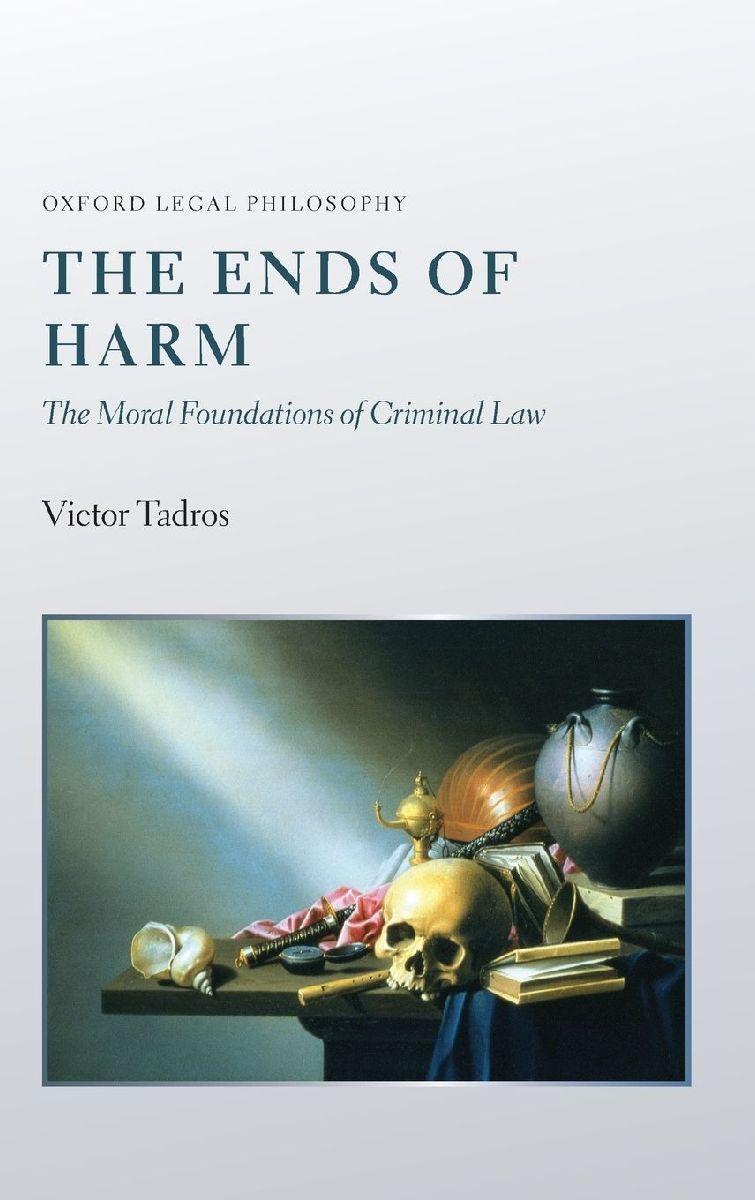
The Ends of Harm
The Moral Foundations of Criminal Law
von Victor Tadros
- Einband
- Gebunden
- Seiten
- 386
- Sprache
- Englisch
- Erschienen
- November 2011
- Verlag
- OUP Oxford
Buchbeschreibung
Every modern democratic state imprisons thousands of offenders every year, depriving them of their liberty, causing them a great deal of psychological and sometimes physical harm.
Relationships are destroyed, jobs are lost, the risk of the offender being harmed by other offenders is increased and all at great expense to the state.
Ganze Beschreibung lesenWeniger anzeigen
How can this brutal and costly enterprise be justified? Traditionally, philosophers answering this question have argued either that the punishment of wrongdoers is a good in itself (retributivism), or that it is a regrettable means to a valuable end, such as the deterrence of future wrongdoing, and thus justifiable on consequentialist grounds.
This book offers a critical examination of those theories and advances a new argument for punishment's justification, calling it the 'duty view'. On this view, the permission to punish offenders is grounded in the duties that they incur in virtue of their wrongdoing. The most important duties that ground the justification of punishment are the duty to recognize that the offender has done wrong and the duty to protect others against wrongdoing.
In the light of these duties the state has a permission to punish offenders to ensure that they recognize that what they have done is wrong, but also to protect others from crime.
In contrast to other justifications of punishment grounded in deterrence, the duty view is developed in the light of a non-consequentialist moral theory: a theory which endorses constraints on the pursuit of the good. It is shown that it is normally wrong to harm a person as a means to pursue a greater good.
However, there are exceptions to this principle in cases where the person harmed has an enforceable duty to pursue the good. The implications of this idea are explored both in the context of self-defence, and then in the context of punishment.
Through the systematic exploration of the relationship between self-defence and punishment, the book makes significant progress in defending a plausible set of non-consequentialist moral principles that justify the punishment of wrongdoers, and marks a significant contribution to the philosophical literature on punishment.
Inhaltsverzeichnis
- 1: Introduction
- The Aims of Punishment
- 2: Justifying Punishment
- 3: Recognition and Choice
- 4: Against Desert
- 5: The Limits of Communication
- Means, Motivations, and Ends
- 6: Defending the Means Principle
- 7: Wrongdoing and Motivation
- Permissibility, Harm, and Self-Defence
- 8: Choice, Responsibility, and Permissible Harm
- 9: Conflicts and Permissibility
Ganzes Inhaltsverzeichnis anzeigen (19 Einträge)Weniger anzeigen
- 10: Mistakes and Self-Defence
- 11: Responsibility and Self-Defence
- Punishment and the Duties of Offenders
- 12: Punishment as a Remedy
- 13: State Punishment
- 14: Protection Against Punishment
- 15: Proportionate Punishment
Details
- Erscheinungstermin
- November 2011
- Kategorie
- Fremdsprachige Bücher
- Einband
- Gebunden
- Seiten
- 386
- Sprache
- Englisch
- Verlag
- OUP Oxford
- Format
- 24,0 × 16,1 cm
- Dicke
- 2,5 cm
- Gewicht
- 693 g
- EAN / ISBN-13
- 9780199554423
Über Victor Tadros
Victor Tadros is Professor of Criminal Law and Legal Theory at the University of Warwick. Prior to his appointment at Warwick he held positions at the Universities of Aberdeen and Edinburgh.
Mehr über Victor TadrosWeniger anzeigen
He has written on criminal responsibility, criminal offences, criminal trials, the presumption of innocence, just war theory, and various aspects of moral and political philosophy. He is currently engaged in a major project on criminalization with Antony Duff, Lindsay Farmer, Sandra Marshall, and Massimo Renzo, funded by the AHRC for which he is currently writing a book entitled Wrongs and Crimes.
Versand und Rückgabe
Standardversand: 1 bis 3 Werktage, 3,99 €, kostenlos ab 35 €
Liefergebiet: Deutschland
Rücksendung: 14 Tage Widerrufsrecht. Bei einem Widerruf tragen Sie die Kosten der Rücksendung. Bei einer Falschlieferung oder einem Fehler von uns erstatten wir Ihnen das Rückporto. Den Widerruf erklären Sie über den Knopf „Vertrag widerrufen“ im Fuß der Seite.
Hersteller und ProduktsicherheitOUP Oxford
OUP Oxford
Europaallee 1
36244 Bad Hersfeld
Deutschland
gpsr@libri.de
Verantwortliche Person in der EU
Libri GmbHEuropaallee 1
36244 Bad Hersfeld
Deutschland
gpsr@libri.de
Mehr von Victor Tadros

Ähnliche Titel




Bewertungen
Zu diesem Titel gibt es noch keine Bewertung. Bewerten kann, wer ihn bei uns gekauft hat.
So prüfen wir Bewertungen
Eine Bewertung kann bei uns nur abgeben, wer den Titel über sein Kundenkonto bei uns gekauft hat. Jede Bewertung ist fest mit der zugehörigen Bestellung verknüpft; anders kommt sie technisch gar nicht zustande. Deshalb trägt jede angezeigte Bewertung den Hinweis „Verifizierter Kauf". Wir zeigen positive wie negative Bewertungen und löschen nur bei Rechtsverstößen. Für Bewertungen gibt es keine Gegenleistung.
182,00 €Voraussichtlich 4. bis 8. Dez.