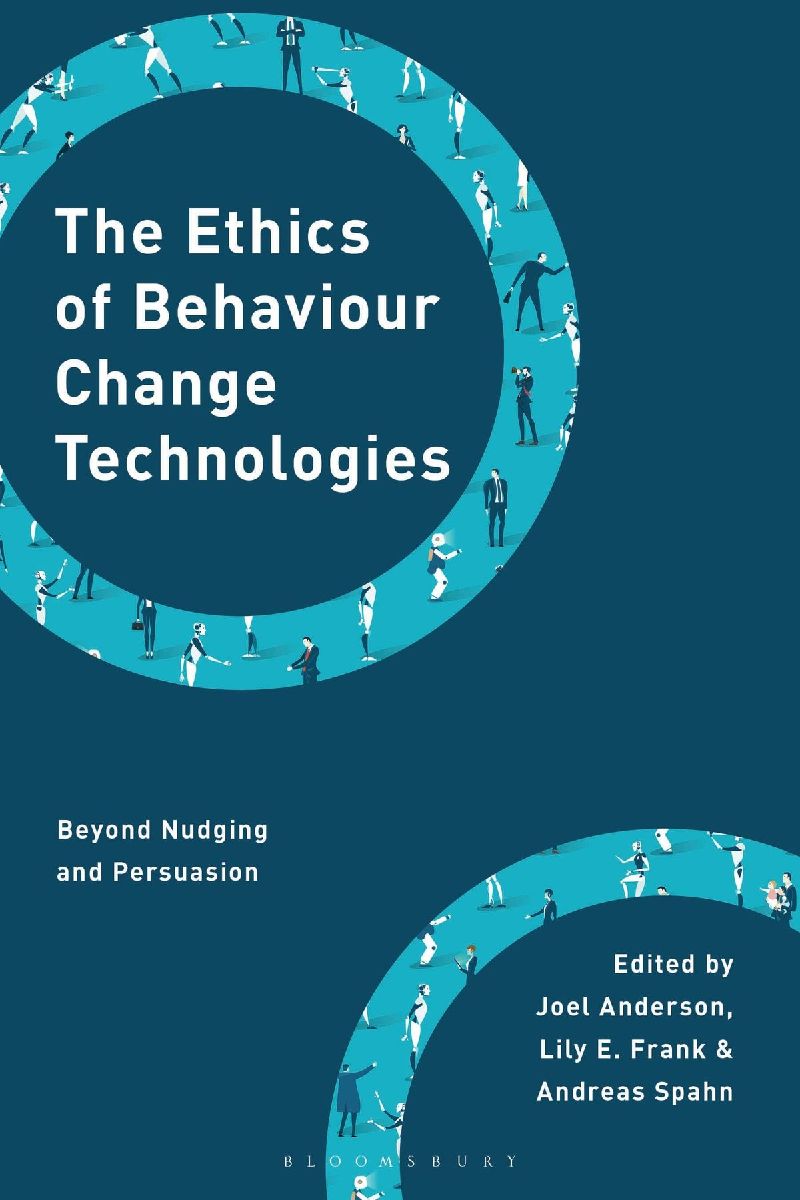
The Ethics of Behaviour Change Technologies
Beyond Nudging and Persuasion
Herausgegeben von: Joel Anderson, Herausgegeben von: Lily E. Frank, Herausgegeben von: Andreas Spahn
Aus der Reihe Philosophy, Technology and Society
- Einband
- Gebunden
- Seiten
- 288
- Sprache
- Englisch
- Erschienen
- Oktober 2025
- Verlag
- Bloomsbury Academic
Buchbeschreibung
This book investigates behaviour change technologies (BCTs) from an ethical perspective, examining the broader societal and philosophical implications of these types of technologies.
These technologies-ranging from fitness trackers and smart home systems to digital nudging and persuasive AI-are increasingly shaping our choices, habits, and lifestyles.
Ganze Beschreibung lesenWeniger anzeigen
This book moves beyond nudging and persuasion to explore a broader spectrum of ethical concerns, including autonomy, privacy, trust, responsibility, and social justice.
Contributors from leading scholars do not merely critique BCTs but also offer constructive ethical frameworks and ethical analysis for their responsible design and implementation.
Inhaltsverzeichnis
- Introduction: The Ethical Landscape of Behaviour Change Technology
- Joel Anderson (Utrecht University, the Netherlands), Lily E. Frank (Eindhoven University of Technology, the Netherlands), Andreas Spahn (Eindhoven University of Technology, the Netherlands) and Arianna Sica (Eindhoven University of Technology, the Netherlands)
- Part I. Foundations
- 1. Psychology of Behaviour Change
- Wokje Abrahamse (Victoria University of Wellington, New Zealand) and Nadja Contzen (Eawag: Swiss Federal Institute of Aquatic Science and Technology, Switzerland, and University of Groningen, the Netherlands)
- Chapter 2. Technologies of Behaviour Change
- Harri Oinas-Kukkonen (University of Oulu, Finland) and Eunice E.Y.F. Agyei (University of Oulu, Finland)
- Chapter 3. Guiding Hands or Invisible Chains? On the Ethics and Philosophy of Behaviour Change Technologies
Ganzes Inhaltsverzeichnis anzeigen (33 Einträge)Weniger anzeigen
- Andreas Spahn (Eindhoven University of Technology, the Netherlands) and Lily E. Frank (Eindhoven University of Technology, the Netherlands)
- Part II. Values and Principles
- Chapter 4. Control, Personal Autonomy, and Behaviour Change Technologies
- Sven Nyholm (Ludwig Maximilian University of Munich, Germany)
- Chapter 5. Transparency and Trust in Behaviour Change Technologies
- Philip J. Nickel (Eindhoven University of Technology, the Netherlands)
- Chapter 6. Privacy, Consent, and Behaviour Change Technologies
- Titus Stahl (University of Groningen, the Netherlands)
- Chapter 7. Social Justice, Autonomous Agency, and Interpersonal Recognition
- Joel Anderson (Utrecht University, the Netherlands)
- Part III. Cases and Applications
- Chapter 8. Limiting Driver Autonomy for Safety and Sustainability
- Jilles Smids (Erasmus University Rotterdam, the Netherlands)
- Chapter 9. 'Good Patients Manage Their Health': A Critical Conceptual Analysis of the Patient as Health Manager Using Smart Technology
- Tania Moerenhout (University of Otago, New Zealand) and Katleen Gabriels (Maastricht University, the Netherlands)
- Chapter 10. The Ethics of Using Boosts to Change Behaviour
- Till Grüne-Yanoff (Royal Institute of Technology, Sweden)
- Chapter 11. The Cumulative Impact of Behaviour Change Interventions
- Will Tiemeijer (Erasmus University Rotterdam, the Netherlands)
- Chapter 12. Pandemic Behaviour Change Technology, Autonomy, and Confucian Philosophy: The Case of Jiankangma (China's Digital Health Code)
- Tom Xiaowei Wang (Renmin University of China, China) and Pak-Hang Wong (Hong Kong Baptist University, Hong Kong)
- Chapter 13. Behaviour Change, Technology, and the Regulation of the Poor: A Case Study of the 'Water Wars' in South Africa
- Brendon R. Barnes (University of Johannesburg, South Africa)
- Index
- About the Contributors
Details
- Erscheinungstermin
- Oktober 2025
- Kategorie
- Fremdsprachige Bücher
- Einband
- Gebunden
- Seiten
- 288
- Sprache
- Englisch
- Verlag
- Bloomsbury Academic
- Reihe
- Philosophy, Technology and Society
- Format
- 23,5 × 15,7 cm
- Dicke
- 2,0 cm
- Gewicht
- 523 g
- EAN / ISBN-13
- 9781786613264
Über Joel Anderson (Hrsg.)
Joel Anderson is Professor of Moral Psychology and Social Philosophy at the Ethics Institute in the Department of Philosophy and Religious Studies of Utrecht University, the Netherlands.
Mehr über Joel Anderson (Hrsg.)Weniger anzeigen
In his work, he develops a relational and intersubjectivist conception of autonomy, a recognitional account of critical social theory, an "extended" approach to self-regulation and disability studies, and a social ethics of technology. He is currently working on a book on "Autonomy Gaps" and editing a collection about how technology is "Disrupting the Human." He is also a principal investigator in the research consortium Ethics of Socially Disruptive Technologies (ESDiT.nl).
Lily E. Frank is Assistant Professor of Philosophy and Ethics at Eindhoven University of Technology, the Netherlands. Her research encompasses biomedical ethics, biotechnology, moral psychology, and ethics of technology. Currently, she investigates topics such as moral expertise, the moralization of health conditions, and the interplay between technology and moral progress. She also explores reproductive ethics, including issues like abortion and the development of artificial uteruses. Frank serves as a Senior Researcher at the 4TU Center for Ethics and Technology and is a board member of the TU/e Center for Humans and Technology.
Andreas Spahn is Associate Professor in the Philosophy and Ethics research group at the Eindhoven University of Technology, the Netherlands. He has worked and published on ethics of behaviour change technologies and persuasive technologies, ethics of energy systems, and environmental ethics, as well as on the role of ethics in engineering education. Spahn is a member of the management team and senior researchers in the 4TU Center for Ethics and Technology, as well as in the ESDiT research program on Ethics of Socially Disruptive Technologies.
Versand und Rückgabe
Standardversand: 1 bis 3 Werktage, 3,99 €, kostenlos ab 35 €
Liefergebiet: Deutschland
Rücksendung: 14 Tage Widerrufsrecht. Bei einem Widerruf tragen Sie die Kosten der Rücksendung. Bei einer Falschlieferung oder einem Fehler von uns erstatten wir Ihnen das Rückporto. Den Widerruf erklären Sie über den Knopf „Vertrag widerrufen“ im Fuß der Seite.
Hersteller und ProduktsicherheitBloomsbury Academic
Bloomsbury Academic
Europaallee 1
36244 Bad Hersfeld
Deutschland
gpsr@libri.de
Verantwortliche Person in der EU
Libri GmbHEuropaallee 1
36244 Bad Hersfeld
Deutschland
gpsr@libri.de
Mehr aus der Reihe Philosophy, Technology and Society



Bewertungen
Zu diesem Titel gibt es noch keine Bewertung. Bewerten kann, wer ihn bei uns gekauft hat.
So prüfen wir Bewertungen
Eine Bewertung kann bei uns nur abgeben, wer den Titel über sein Kundenkonto bei uns gekauft hat. Jede Bewertung ist fest mit der zugehörigen Bestellung verknüpft; anders kommt sie technisch gar nicht zustande. Deshalb trägt jede angezeigte Bewertung den Hinweis „Verifizierter Kauf". Wir zeigen positive wie negative Bewertungen und löschen nur bei Rechtsverstößen. Für Bewertungen gibt es keine Gegenleistung.
134,10 €Voraussichtlich 4. bis 8. Dez.