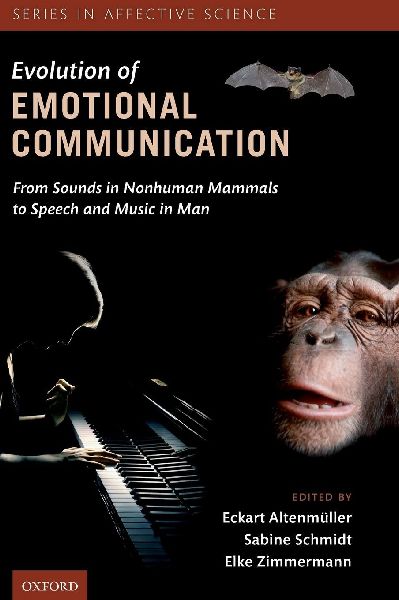
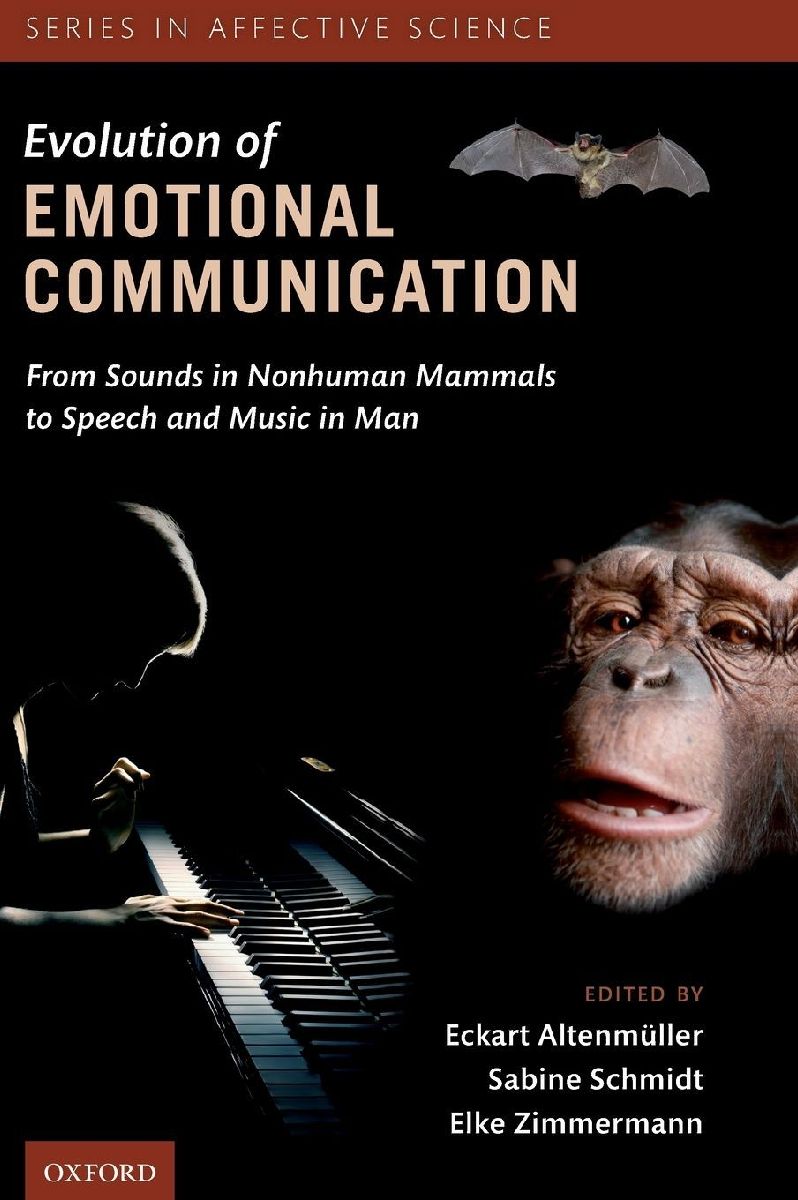
The Evolution of Emotional Communication
von Eckart Altenmüller (Hrsg.)
Herausgegeben von: Eckart Altenmüller
- Einband
- Gebunden
- Seiten
- 392
- Sprache
- Englisch
- Erschienen
- Juni 2014
- Verlag
- ACADEMIC
Buchbeschreibung
Why do we think that we can understand animal voices - such as the aggressive barking of a pet dog, and the longing meows of the family cat?
Why do we think of deep voices as dominant and high voices as submissive. Are there universal principles governing our own communication system? Can we even see how close animals are related to us by constructing an evolutionary tree based on similarities and dissimilarities in acoustic signaling?
Ganze Beschreibung lesenWeniger anzeigen
Research on the role of emotions in acoustic communication and its evolution has often been neglected, despite its obvious role in our daily life. When we infect others with our laugh, soothe a crying baby with a lullaby, or get goose bumps listening to classical music, we are barely aware of the complex processes upon which this behavior is based.
It is not facial expressions or body language that are affecting us, but sound. They are present in music and speech as "emotional prosody" andallow us to communicate not only verbally but also emotionally.
This groundbreaking book presents a thorough exploration into how acoustically conveyed emotions are generated and processed in both animals and man. It is the first volume to bridge the gap between research in the acoustic communication of emotions in humans with those in animals, using a comparative approach.
With the communication of emotions being an important research topic for a range of scientific fields, this book is valuable for those in the fields of animal behaviour, anthropology, evolutionary biology, human psychology, linguistics, musicology, and neurology.
Inhaltsverzeichnis
- Part A: Introductory Section
- 1: M. Mortillaru, M. Mehu and K.R. Scherer: The evolutionary origin of multimodal synchronisation and emotional expression
- 2: W.T. Fitch and K. Zuberbühler: Primate precursors to human language: Beyond discontinuity
- 3: J.P. Rauschecker: Brain networks for the encoding of emotions in communication sounds of human and nonhuman primates
- Part B: Different mammalian taxa
- 4: G. Ehret: Sound communication in house mice: Emotions in their voices and ears?
- 5: S. Brudzynks: Vocalizations as indicators of emotional states in rats and cats
- 6: S. Schmidt: Beyond echolocation: Emotional acoustic communication in bats
Ganzes Inhaltsverzeichnis anzeigen (26 Einträge)Weniger anzeigen
- 7: J. Soltis: Emotional communication in African Elephants
- 8: E. Zimmermann, L. Leliveld, and S. Schehka: Toward the evolutionary roots of affective prosody in human acoustic communication: A comparative approach to mammalian voices
- 9: C.T. Snowdon and D. Teie: Emotional communication in monkeys: Music to their ears?
- Part C: Non-speech Human vocalizations
- 10: P. Zeskind: Infant crying and the synchrony of arousal
- 11: M. J. Owren, M. Philipp, E. Vanman, N. Trivedi, A. Schulman, and J.A. Bachorowski: Understanding spontaneous human laughter: The role of voicing in inducing positive emotion
- 12: D. Szameitat, D. Wildgruber, and K. Alter: Vocal expression of emotions in laughter
- Part D: Human Prosody
- 13: D. Grandjean and S. Frühholz: An integrative model of brain processes for the decoding of emotional prosody
- 14: S.A. Kotz, A.S. Hasting, and S. Paulmann: On the orbito-striatal interface in (acoustic) emotional processing
- 15: C. Schroeder and R. Dengler: The role of dopamine in perception and expression of emotional communication in Parkinson's disease
- 16: P.N. Juslin: Vocal affect expression: Problems and promises
- Part E: Music
- 17: I. Peretz, W. Aube, and J. Armony: Towards a neurobiology of musical emotions
- 18: T. Fritz and S. Koelsch: Acoustically mediated emotional contagion as an across-species homology underlying music processing
- 19: E. Altenmüller R. Kopiez, and O. Grewe: A contribution to the evolutionary basis of music: Lessons from the chill-response
- Part F: Summary: Where to go?
- 20: 1. E. Altenmüller, S. Schmidt, and E. Zimmermann: A cross-taxa concept of emotion in acoustic communication: An ethological perspective
Details
- Erscheinungstermin
- Juni 2014
- Kategorie
- Fremdsprachige Bücher
- Einband
- Gebunden
- Seiten
- 392
- Sprache
- Englisch
- Verlag
- ACADEMIC
- Format
- 26,0 × 18,3 cm
- Dicke
- 2,6 cm
- Gewicht
- 868 g
- EAN / ISBN-13
- 9780199583560
Über Eckart Altenmüller (Hrsg.)
Prof. Dr. med. Eckart Altenmüller (b. 1955) holds a Masters degree in classical flute, and is a Medical Doctor.
Mehr über Eckart Altenmüller (Hrsg.)Weniger anzeigen
After clinical training as a neurologist and habilitation, he became in 1994 chairman and director of the Institute of Music Physiology and Musicians' Medicine at the University of Music, Drama, and Media in Hannover. He continues research into the neurobiology of emotions and into movement disorders in musicians as well as motor, auditory and sensory learning. Since 2005 he is President of the German Society of Music Physiology and Musicians' Medicine and Member of the Göttingen Academy of Sciences.
Privatdozent Dr. rer nat. Sabine Schmidt is an experimental behavioural and sensory biologist and Head of the Sensory Biology group of the Institute of Zoology at the University of Veterinary Medicine and the Centre for Systems Neuroscience in Hannover, Germany. Her main research interests cover behavioural ecology and psychoacoustics, with special emphasis on echolocation and acoustic communication in bats.
Prof. Dr. rer nat. Elke Zimmermann is an experimental behavioural and evolutionary biologist and Director of the Institute of Zoology and Professor at the University of Veterinary Medicine and the Center for Systems Neuroscience in Hannover, Germany. Her main research interests cover patterns, processes and mechanisms of primate adaptation, speciation and evolution, with special emphasis to the evolution of communication and cognition. She is spokesperson of the DFG-funded interdisciplinary Research Unit Acoustic communication of emotions in humans and nonhuman mammals.
Versand und Rückgabe
Standardversand: 1 bis 3 Werktage, 3,99 €, kostenlos ab 35 €
Liefergebiet: Deutschland
Rücksendung: 14 Tage Widerrufsrecht. Bei einem Widerruf tragen Sie die Kosten der Rücksendung. Bei einer Falschlieferung oder einem Fehler von uns erstatten wir Ihnen das Rückporto. Den Widerruf erklären Sie über den Knopf „Vertrag widerrufen“ im Fuß der Seite.
Hersteller und ProduktsicherheitACADEMIC
ACADEMIC
Europaallee 1
36244 Bad Hersfeld
Deutschland
gpsr@libri.de
Verantwortliche Person in der EU
Libri GmbHEuropaallee 1
36244 Bad Hersfeld
Deutschland
gpsr@libri.de
Mehr von Eckart Altenmüller

Ähnliche Titel



Bewertungen
Zu diesem Titel gibt es noch keine Bewertung. Bewerten kann, wer ihn bei uns gekauft hat.
So prüfen wir Bewertungen
Eine Bewertung kann bei uns nur abgeben, wer den Titel über sein Kundenkonto bei uns gekauft hat. Jede Bewertung ist fest mit der zugehörigen Bestellung verknüpft; anders kommt sie technisch gar nicht zustande. Deshalb trägt jede angezeigte Bewertung den Hinweis „Verifizierter Kauf". Wir zeigen positive wie negative Bewertungen und löschen nur bei Rechtsverstößen. Für Bewertungen gibt es keine Gegenleistung.
139,10 €Voraussichtlich 7. bis 9. Dez.