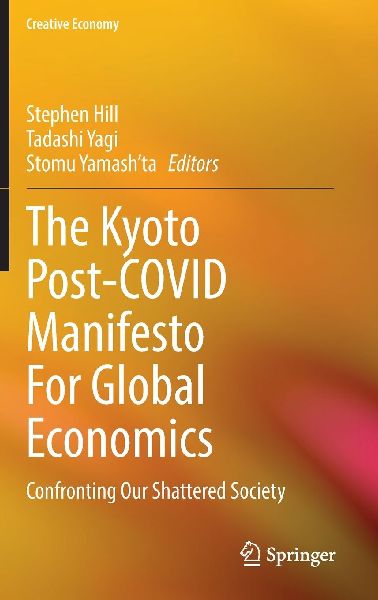
The Kyoto Post-COVID Manifesto For Global Economics
Confronting Our Shattered Society
Herausgegeben von: Stephen Hill, Herausgegeben von: Tadashi Yagi, Herausgegeben von: Stomu Yamash'Ta
Aus der Reihe Creative Economy
- Einband
- Gebunden
- Seiten
- 388
- Sprache
- Englisch
- Erschienen
- Mai 2022
- Verlag
- Springer
Buchbeschreibung
This book, The Kyoto Post-COVID Manifesto for Global Economics (KM-PC), is a sequel to our 2018 book, The Kyoto Manifesto for Global Economics (KM-I, 2018). It further exposes the failures of a global economic regime that, based on self-interest, has led to the enormously unequal and fragmented society of today and our decreased ability to respond and recover from the critical worldwide consequences of such a regime over time - notably, climate change.
Ganze Beschreibung lesenWeniger anzeigen
At stake is our very survival beyond the twenty-first century. The fundamental tenet of this book is that our power to heal our currently fractured society lies in the depth of our humanity - in our shared human spirit and spirituality. What is sacred or of imperishable supreme value is what we can be as a human race: empowered, fulfilled individuals, living in harmony, deeply sharing and caring for one another and the environment that sustains us across our distinct cultures and worlds in whichwe live.
Thus, the norms in our economic relations do not have to be those of self-interest that separates us, the ever-watchful distrust represented by "the deal" and immediate economic advantage for me. Instead, we can build an economic frame for our society based on mindfulness, care, mutual human benefit, and trust - on our shared humanity. Our argument was complete and we were ready to publish.
But then, suddenly, from the dawning of 2020, everything changed. COVID-19 invaded and the world as we knew it simply stopped. No one saw it coming. As authors, we waited to watch and seek to understand. The result is that the book captures the COVID trauma and, against the fractures based on self-interest already visible in today's society, assesses the impact of COVID-19 now and for the future.
Focusing on a humanity-based economics is even more important now, and this book shows why. Chapter 15 is available open access under a Creative
Commons Attribution 4.0 International License via link.springer.com.
Inhaltsverzeichnis
- Chapter 1:Confronting Our Shattered Society
- Chapter 2: Embracing the Circle of Wholeness
- Chapter 3: Polyphony as a System for Delivering Co-creation, Empowerment, Sustainability and Trust
- Chapter 4: Creating an Economy of Care
- Chapter 5: Universal Care - Including the Excluded
- Chapter 6: Sustainability Conditions for Universal Basic Income in the Economic Recession Caused by COVID-19
- Chapter 7: Towards the Reconstruction of the Cosmos: In Consideration of a Polyphonic Way of Life
- Chapter 8: Achieving Transformation in Our Highly Interconnected World - I: Systems Thinking and Network Thinking
Ganzes Inhaltsverzeichnis anzeigen (20 Einträge)Weniger anzeigen
- Chapter 9: Achieving Transformation in Our Highly Interconnected World - II: The Role of the Individual
- Chapter 10: Transdisciplinary Study of How to Integrate Our Shattered World: The Self-Non-Self Circulation Principle of 'Living Wholeness
- Chapter 11: The Self-Non-Self Circulation Principle of 'Living' Nature: How to Survive Our Shattered World
- Chapter 12: A Case Study of the Self-Non-Self Circulation Principle in Action - Towards a New Synthesis beyond Division between Inside and Outside Worlds in Nursing
- Chapter 13: Taiji: - Philosophical, Cultural and Educational Views from Tian Zhen Yuan
- Chapter 14: Systemic Change Driven by Circular Change
- Chapter 15: The New Natural State of the Market
- Chapter 16: The Role of Sustainable Resource Management in an Economy We Want
- Chapter 17: Stewarding System Aliveness - Pathways to Transformation
- Chapter 18: From Sustainability to Thrivability: Transforming Systems with Purpose
- Chapter 19: Where Did Humanity Go?
- Chapter 20: Discovering Our Humanity - Economics of the Future
Details
- Erscheinungstermin
- Mai 2022
- Kategorie
- Fremdsprachige Bücher
- Einband
- Gebunden
- Seiten
- 388
- Sprache
- Englisch
- Verlag
- Springer
- Reihe
- Creative Economy
- Format
- 24,1 × 16,0 cm
- Dicke
- 2,7 cm
- Gewicht
- 694 g
- EAN / ISBN-13
- 9789811685651
Versand und Rückgabe
Standardversand: 1 bis 3 Werktage, 3,99 €, kostenlos ab 35 €
Liefergebiet: Deutschland
Rücksendung: 14 Tage Widerrufsrecht. Bei einem Widerruf tragen Sie die Kosten der Rücksendung. Bei einer Falschlieferung oder einem Fehler von uns erstatten wir Ihnen das Rückporto. Den Widerruf erklären Sie über den Knopf „Vertrag widerrufen“ im Fuß der Seite.
Hersteller und ProduktsicherheitSpringer Nature Customer Service Center GmbH
Springer Nature Customer Service Center GmbH
Europaplatz 3
69115 Heidelberg
Deutschland
ProductSafety@springernature.com
Mehr von Stephen Hill


Mehr aus der Reihe Creative Economy

Cultural Heritage in Japan and Italy
Nobuko Kawashima (Hrsg.)
Gebunden, Englisch, 2 Ausgaben
ab 192,59 €
The Cultural Basis of Economic Growth in India
Kazuo Mino (Hrsg.)
Gebunden, Englisch, 2 Ausgaben
ab 106,99 €
Bewertungen
Zu diesem Titel gibt es noch keine Bewertung. Bewerten kann, wer ihn bei uns gekauft hat.
So prüfen wir Bewertungen
Eine Bewertung kann bei uns nur abgeben, wer den Titel über sein Kundenkonto bei uns gekauft hat. Jede Bewertung ist fest mit der zugehörigen Bestellung verknüpft; anders kommt sie technisch gar nicht zustande. Deshalb trägt jede angezeigte Bewertung den Hinweis „Verifizierter Kauf". Wir zeigen positive wie negative Bewertungen und löschen nur bei Rechtsverstößen. Für Bewertungen gibt es keine Gegenleistung.
149,79 €Voraussichtlich 7. bis 9. Dez.