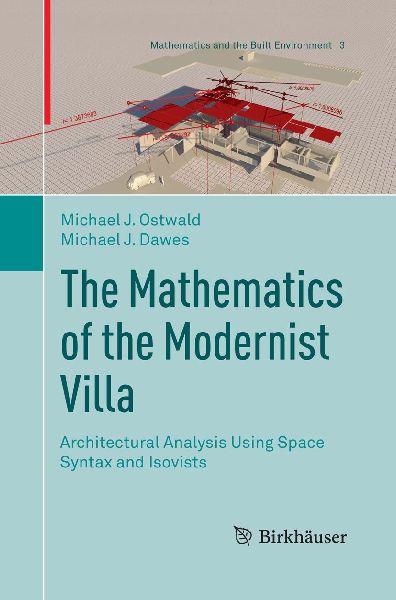
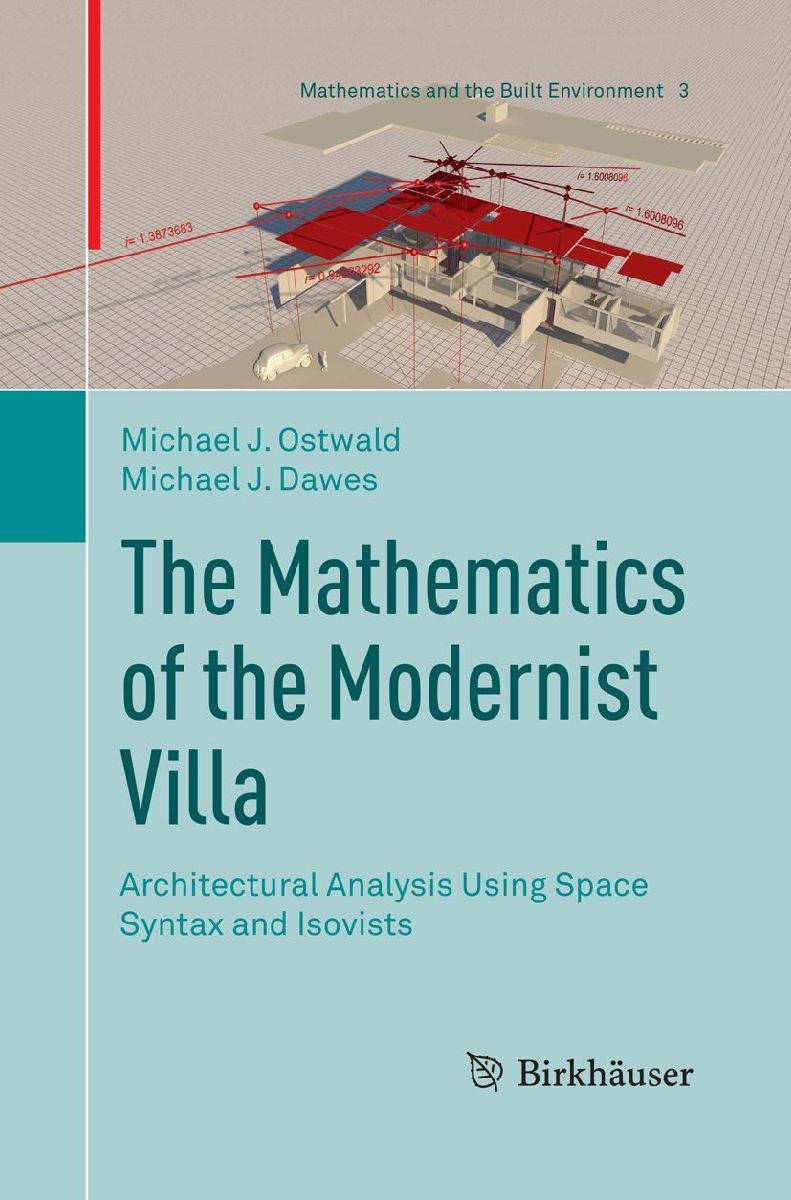
The Mathematics of the Modernist Villa
Architectural Analysis Using Space Syntax and Isovists
von Michael J. Ostwald und Michael J. Dawes
Aus der Reihe Mathematics and the Built Environment
- Einband
- Kartoniert
- Seiten
- 440
- Sprache
- Englisch
- Erschienen
- Februar 2019
- Verlag
- Palgrave Macmillan
Buchbeschreibung
This book presents the first detailed mathematical analysis of the social, cognitive and experiential properties of Modernist domestic architecture.
The Modern Movement in architecture, which came to prominence during the first half of the twentieth century, may have been famous for its functional forms and machine-made aesthetic, but it also sought to challenge the way people inhabit, understand and experience space.
Ganze Beschreibung lesenWeniger anzeigen
Ludwig Mies van der Rohe's buildings were not only minimalist and transparent, they were designed to subvert traditional social hierarchies.
Frank Lloyd Wright's organic Modernism not only attempted to negotiate a more responsive relationship between nature and architecture, but also shape the way people experience space. Richard Neutra's Californian Modernism is traditionally celebrated for its sleek, geometric forms, but his intention was to use design to support a heightened understanding of context.
Glenn Murcutt's pristine pavilions, seemingly the epitome ofregional Modernism, actually raise important questions about the socio-spatial structure of architecture. Rather than focussing on form or style in Modernism, this book examines the spatial, social and experiential properties of thirty-seven designs by Wright, Mies, Neutra and Murcutt.
The computational and mathematical methods used for this purpose are drawn from space syntax, isovist geometry and graph theory. The specific issues that are examined include: the sensory and emotional appeal of space and form; shifting social and spatial structures in architectural planning; wayfinding and visual understanding; and the relationship between form and program.
Inhaltsverzeichnis
- Preface.-1. Introduction
- Part I Methods: 2. Space Syntax, Theory and Techniques
- 3. Spaces, Lines and Intersections
- 4. Isovist Analysis, Theories and Methods
- Part II Mies, Neutra and Murcutt: 5. Mies van der Rohe: Characteristics of the Free Plan
- 6. Richard Neutra: Spatial Theory and Practice
- 7. Glenn Murcutt: Form and Social Function
- Part III Frank Lloyd Wright: 8. Wright and Spatial Preference Theory
Ganzes Inhaltsverzeichnis anzeigen (14 Einträge)Weniger anzeigen
- 9. Experiencing Wright's Living Spaces
- 10
- Enticement In, and Through, Wright's Architecture
- 11. Conclusion
- References
- Index
Details
- Erscheinungstermin
- Februar 2019
- Kategorie
- Fremdsprachige Bücher
- Einband
- Kartoniert
- Seiten
- 440
- Sprache
- Englisch
- Verlag
- Palgrave Macmillan
- Reihe
- Mathematics and the Built Environment
- Format
- 23,5 × 15,5 cm
- Dicke
- 2,3 cm
- Gewicht
- 755 g
- EAN / ISBN-13
- 9783030100872
Über Michael J. Ostwald
Michael J. Ostwald is Professor and Dean of Architecture at the University of Newcastle (Australia).
Mehr über Michael J. OstwaldWeniger anzeigen
He has previously been a Professorial Research Fellow at Victoria University Wellington (New Zealand), a visiting Professor and Research Fellow at RMIT University, an Australian Research Council (ARC) Future Fellow at Newcastle and a visiting fellow at ANU, MIT, HKU and UCLA. Michael has a PhD in architectural history and theory and a DSc in design mathematics and computing. Under the auspices of the Byera Hadley international fellowship he completed postdoctoral research on geometry at the CCA (Montreal) and Harvard (Cambridge, USA). In 2016, the Australian Institute of Architects (AIA) awarded him the Neville Quarry Medal for Services to Architecture. Michael is Co-Editor-in-Chief of the Nexus Network Journal: Architecture and Mathematics (Springer) and on the editorial boards of ARQ (Cambridge) and Architectural Theory Review (Taylor and Francis). He is co-editor with Kim Williams of the two volume Architecture and Mathematics from Antiquity to the Future (Birkhäuser 2015) and co-author with Josephine Vaughan of The Fractal Dimension of Architecture (Birkhäuser 2016). Michael J. Dawes has Bachelor degrees in Science (Architecture) and Construction Management and a Masters degree in Architecture. He is currently completing a PhD investigating Christopher Alexander's A Pattern Language. Since 2010 he has worked as a Research Associate and Academic at the University of Newcastle (Australia). His publications include refereed journal papers and chapters on graph theory, syntactical analysis and isovists. His research combines computational and mathematical analysis with architectural history and theory.
Versand und Rückgabe
Standardversand: 1 bis 3 Werktage, 3,99 €, kostenlos ab 35 €
Liefergebiet: Deutschland
Rücksendung: 14 Tage Widerrufsrecht. Bei einem Widerruf tragen Sie die Kosten der Rücksendung. Bei einer Falschlieferung oder einem Fehler von uns erstatten wir Ihnen das Rückporto. Den Widerruf erklären Sie über den Knopf „Vertrag widerrufen“ im Fuß der Seite.
Hersteller und ProduktsicherheitSpringer Nature Customer Service Center GmbH
Springer Nature Customer Service Center GmbH
Europaplatz 3
69115 Heidelberg
Deutschland
ProductSafety@springernature.com
Mehr aus der Reihe Mathematics and the Built Environment
Mathematical Thinking and Properties in Architecture
Ju Hyun Lee
Gebunden, Englisch, 2 Ausgaben
ab 160,49 €
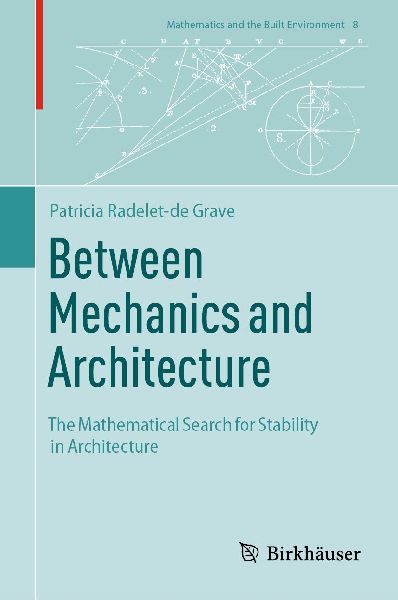
Between Mechanics and Architecture
Patricia Radelet-de Grave
Gebunden, Englisch, 2 Ausgaben
ab 171,19 €

Ähnliche Titel

Bewertungen
Zu diesem Titel gibt es noch keine Bewertung. Bewerten kann, wer ihn bei uns gekauft hat.
So prüfen wir Bewertungen
Eine Bewertung kann bei uns nur abgeben, wer den Titel über sein Kundenkonto bei uns gekauft hat. Jede Bewertung ist fest mit der zugehörigen Bestellung verknüpft; anders kommt sie technisch gar nicht zustande. Deshalb trägt jede angezeigte Bewertung den Hinweis „Verifizierter Kauf". Wir zeigen positive wie negative Bewertungen und löschen nur bei Rechtsverstößen. Für Bewertungen gibt es keine Gegenleistung.
128,39 €Voraussichtlich 3. bis 7. Dez.