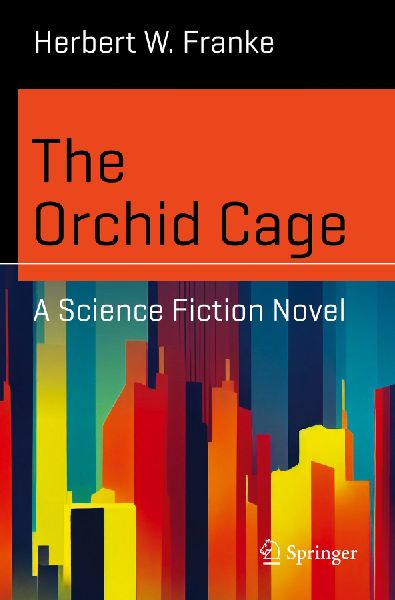
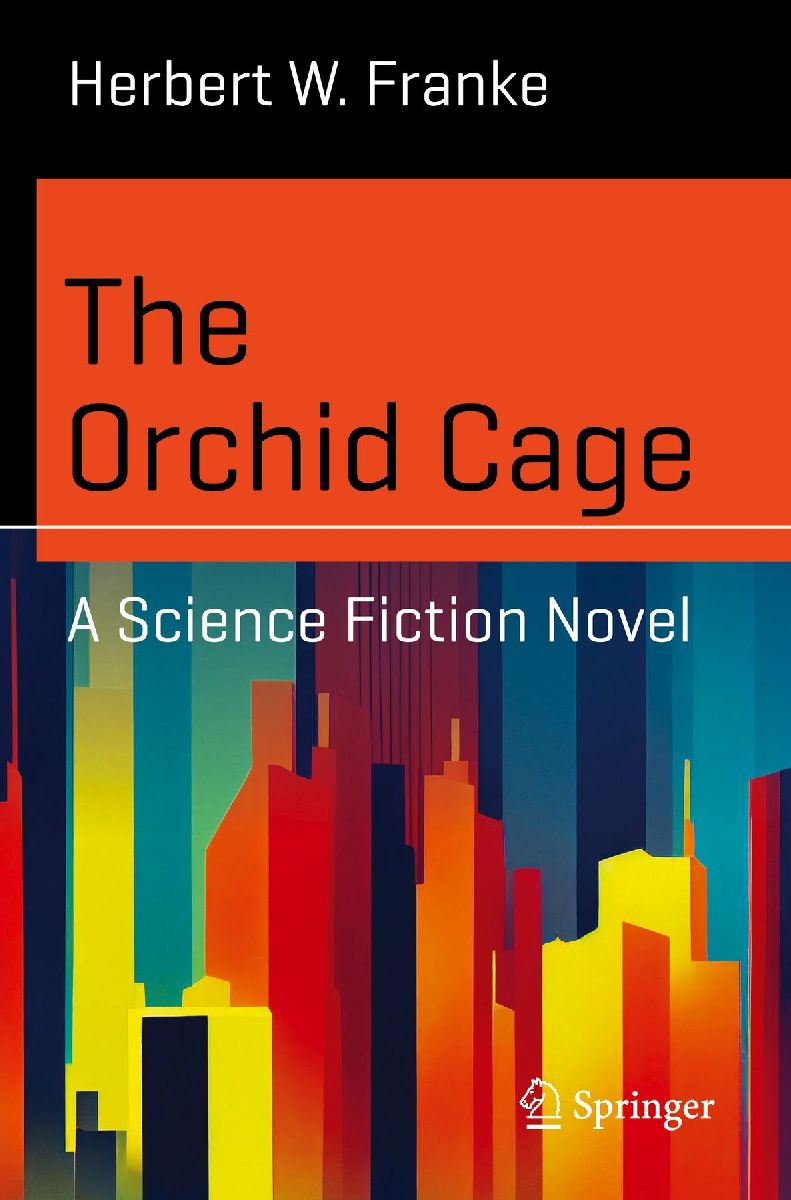
The Orchid Cage
A Science Fiction Novel
Aus der Reihe Science and Fiction
- Einband
- Kartoniert
- Seiten
- 160
- Sprache
- Englisch
- Erschienen
- Juni 2024
- Verlag
- Birkhäuser
Buchbeschreibung
This book is a new English translation of the classic science fiction story written in 1961 by Herbert W. Franke, widely held to be the most important German-language science-fiction writer.
A dead city on a distant planet, two groups of people trying to explore it. Step by step, they penetrate the outer ring with its ultra-modern technology, the half-ruined medieval city center and finally the mysterious center. But is the eerie city really dead?
Ganze Beschreibung lesenWeniger anzeigen
Suddenly the factories start working again, the automatons intervene, and somewhere in the background there is still something hidden that could perhaps awaken.
But is it people or machines? Herbert W. Franke leads the reader into an oppressively strange world; only after the startling resolution does it become clear what lies behind the adventures of the intruders - not a cosmic strangeness, but a threatening development that could affect humans in the same way. Franke's novel is thus a parable of the evolution of all humans in the age of technical communication …
Inhaltsverzeichnis
- The First Attempt
- The Second Attempt
- The Third Attempt
- Epilog
- Afterword by Hans Esselborn
Details
- Erscheinungstermin
- Juni 2024
- Kategorie
- Fremdsprachige Bücher
- Einband
- Kartoniert
- Seiten
- 160
- Sprache
- Englisch
- Verlag
- Birkhäuser
- Reihe
- Science and Fiction
- Format
- 23,5 × 15,5 cm
- Dicke
- 0,9 cm
- Gewicht
- 254 g
- EAN / ISBN-13
- 9783031604980
Über Herbert W. Franke
Herbert W. Franke (1927-2022) was born in Vienna. He studied physics and philosophy there. In 1951 he received his doctorate in theoretical physics.
Mehr über Herbert W. FrankeWeniger anzeigen
Today Franke is known as the most important post-war German-language writer of the science fiction genre. In 2017, he was awarded the title "Grand Master of Science Fiction" by the European Science Fiction Association for his complete works. However, Franke is also recognized worldwide as a pioneer of algorithmic art. His intellectual work is based equally on the rationality of the researcher and the creativity of the artist - thus a pioneer of bridging art and science since the 1950s. He was particularly interested in creating aesthetically interesting structures with the help of computers. In addition to creating works of art, Franke has also been intensively involved in questions of rational aesthetics. In his "rational theory of art," published as early as the mid-1960s, he described the perception of art as a construct that can be grasped with the help of information theory. Since his student days, he has also worked as a speleologist and was the first to describe theoretically that stalagmites could be dated by the C14-method in 1952. Today, his method is well established and forms an important building block for climate research of the fading ice age; thus, Franke is also one of the pioneers of paleoclimatological research based on isotope measurements. In addition, Franke was also concerned with the aspect that a program should be sought to describe the physical world instead of a "world formula." Using cellular automata, he developed visualizations of different world models, addressing the question of the extent to which "real" chance plays a role in such a world program. He published these findings in a philosophical-theoretical book entitled "The P-Principle" in 1995. In 1980, the Austrian Ministry of Education and the Arts awarded him the professional title of Professor, and in 2007 he received the Austrian Cross of Honor for Science and the Arts 1st Class. In 2008, Franke was appointed Senior Fellow by the prestigious Zuse Institute Berlin ZIB. The research project "math goes art" initiated there investigated the interaction of mathematics and art, in particular in the context of three-dimensional worlds on the web. In 2018, he received an honorary doctorate from the University of Design in Karlsruhe. The first part of the archive Herbert W. Franke was given to the ZKM Center for Art and Media Karlsruhe in autumn 2017. It comprises about 22 linear meters of documents and about 50 books. The archive consists of documents, sketches, correspondence, typographical scripts, manuscripts, photographs, as well as sound and image recordings of his sixty years of activity in the field of art and science; it also displays his historic computers and programs. It reflects on the three major spheres of Franke's work: computer art, science fiction, and speleology, from the 1950s to the present day.
Versand und Rückgabe
Standardversand: 1 bis 3 Werktage, 3,99 €, kostenlos ab 35 €
Liefergebiet: Deutschland
Rücksendung: 14 Tage Widerrufsrecht. Bei einem Widerruf tragen Sie die Kosten der Rücksendung. Bei einer Falschlieferung oder einem Fehler von uns erstatten wir Ihnen das Rückporto. Den Widerruf erklären Sie über den Knopf „Vertrag widerrufen“ im Fuß der Seite.
Hersteller und ProduktsicherheitSpringer Nature Customer Service Center GmbH
Springer Nature Customer Service Center GmbH
Europaplatz 3
69115 Heidelberg
Deutschland
ProductSafety@springernature.com
Mehr von Herbert W. Franke

Mehr aus der Reihe Science and Fiction
Bewertungen
Zu diesem Titel gibt es noch keine Bewertung. Bewerten kann, wer ihn bei uns gekauft hat.
So prüfen wir Bewertungen
Eine Bewertung kann bei uns nur abgeben, wer den Titel über sein Kundenkonto bei uns gekauft hat. Jede Bewertung ist fest mit der zugehörigen Bestellung verknüpft; anders kommt sie technisch gar nicht zustande. Deshalb trägt jede angezeigte Bewertung den Hinweis „Verifizierter Kauf". Wir zeigen positive wie negative Bewertungen und löschen nur bei Rechtsverstößen. Für Bewertungen gibt es keine Gegenleistung.
32,09 €Voraussichtlich 2. bis 4. Dez.