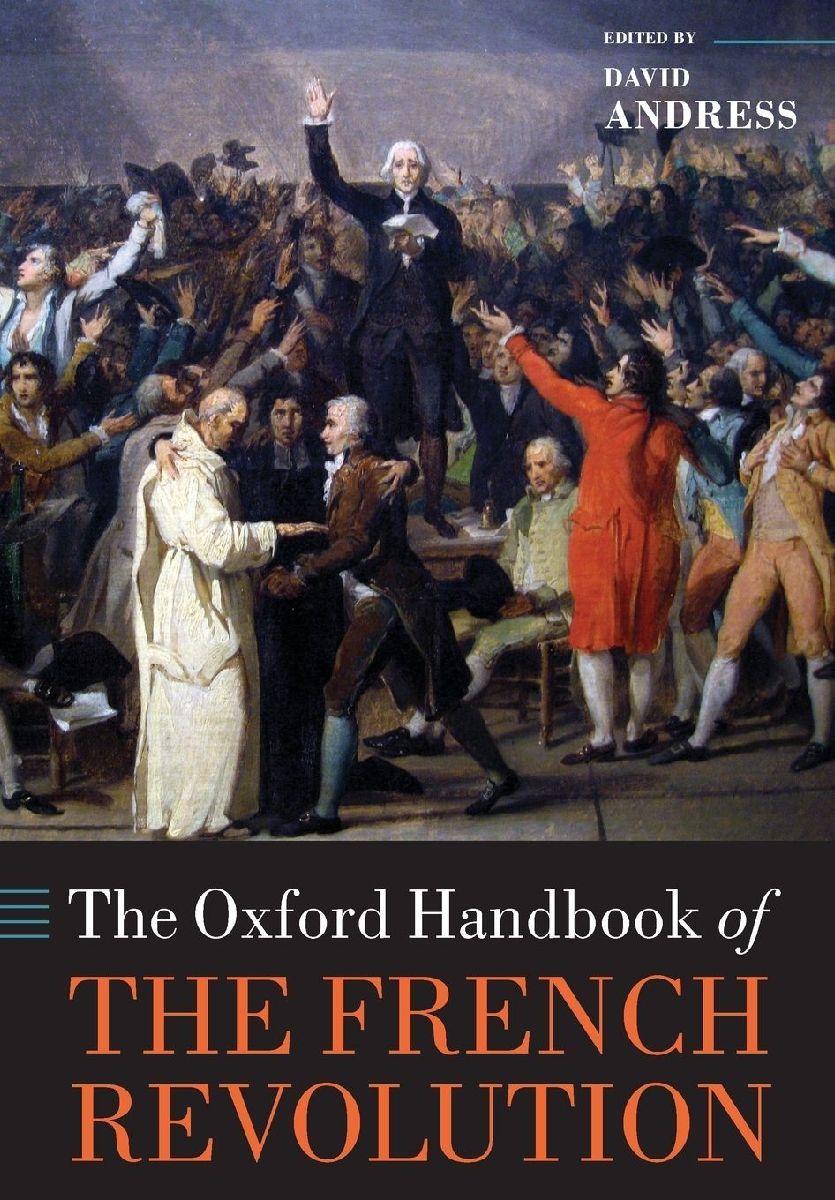
The Oxford Handbook of the French Revolution
Herausgegeben von: David Andress
- Einband
- Kartoniert
- Seiten
- 702
- Sprache
- Englisch
- Erschienen
- Juni 2019
- Verlag
- OUP Oxford
Buchbeschreibung
The Oxford Handbook of the French Revolution brings together a sweeping range of expert and innovative contributions to offer engaging and thought-provoking insights into the history and historiography of this epochal event. Each chapter presents the foremost summations of academic thinking on key topics, along with stimulating and provocative interpretations and suggestions for future research directions.
Ganze Beschreibung lesenWeniger anzeigen
Placing core dimensions of the history of the French Revolution in their transnational and global contexts, the contributors demonstrate that revolutionary times demand close analysis of sometimes tiny groups of key political actors - whether the king and his ministers or the besieged leaders of the Jacobin republic - and attention to the deeply local politics of both rural and urban populations.
Identities of class, gender and ethnicity are interrogated, but so too are conceptions and practices linked to citizenship, community, order, security, and freedom: each in their way just as central to revolutionary experiences, and equally amenable to critical analysis and reflection.
This Handbook covers the structural and political contexts that build up to give new views on the classic question of the 'origins of revolution'; the different dimensions of personal and social experience that illuminate the political moment of 1789 itself; the goals and dilemmas of the period of constitutional monarchy; the processes of destabilisation and ongoing conflict that ended that experiment; the key issues surrounding the emergence and experience of 'terror'; and the short- and long-term legacies, for both good and ill, of the revolutionary trauma - for France, and for global politics.
Inhaltsverzeichnis
- Part 1: Origins
- 1: Silvia Marzagalli: Economic and Demographic Developments
- 2: Lauren R. Clay: The Bourgeoisie, Capitalism, and the Origins of the French Revolution
- 3: Jay M. Smith: Nobility
- 4: Joël Félix: The monarchy
- 5: Simon Burrows: Books, Philosophy, Enlightenment
- 6: Annie Jourdan: Tumultuous Contexts and Radical Ideas (1783-89). The 'Pre-Revolution' in a Transnational Perspective
- 7: Thomas E. Kaiser: The Diplomatic Origins of the French Revolution
Ganzes Inhaltsverzeichnis anzeigen (43 Einträge)Weniger anzeigen
- Part 2: The Coming of Revolution
- 8: John Hardman: The View from Above
- 9: Pierre-Yves Beaurepaire: The View from Below: the 1789 cahiers de doléances
- 10: Peter McPhee: A Social Revolution? Rethinking Popular Insurrection in 1789
- 11: Micah Alpaugh: A Personal Revolution: National Assembly Deputies and the Politics of 1789
- Part 3: Revolution and Constitution
- 12: Michael P. Fitzsimmons: Sovereignty and Constitutional Power
- 13: Malcolm Crook: The New Regime: Political Institutions and Democratic Practices under the Constitutional Monarchy, 1789-91
- 14: Jeremy D. Popkin: Revolution and Changing Identities in France, 1787-1799
- 15: Edward J. Woell: Religion and Revolution
- 16: D. M. G. Sutherland: Urban Violence in 1789
- 17: Manuel Covo: Revolution, race and slavery
- Part 4: Counter-revolution and collapse
- 18: Ambrogio Caiani: Louis XVI and Marie Antoinette
- 19: Kirsty Carpenter: Emigration in Politics and Imaginations
- 20: Noelle Plack: Challenges in the Countryside, 1790-2
- 21: Charles Walton: Club, Party and Faction
- 22: Alan Forrest: Military Trauma
- Part 5: The New Republic
- 23: David Andress: Politics and Insurrection: The Sans-culottes, The 'Popular Movement' and the People of Paris
- 24: Marc Belissa: War and Diplomacy (1792-1795)
- 25: Paul Hanson: From Faction to Revolt
- 26: Dan Edelstein: What was the Terror?
- 27: Marisa Linton: Terror and Politics
- 28: Ronen Steinberg: Reckoning with Terror: Retribution, Redress, and Remembrance in Post-Revolutionary France
- 29: Mike Rapport: Jacobinism from Outside
- Part 6: After Thermidor
- 30: Laura Mason: Thermidor and the Myth of Rupture
- 31: Howard G. Brown: The Politics of Public Order, 1795-1802
- 32: Jean-Luc Chappey: The New Elites: Questions about political, social and cultural reconstruction after the Terror
- 33: Philip Dwyer: Napoleon, The Revolution, and The Empire
- 34: Isser Woloch: Lasting Political Structures
- 35: Jeff Horn: Lasting Economic Structures: Successes, Failures, and Revolutionary Political Economy
- 36: Jennifer Heuer: Did Everything Change? Rethinking Revolutionary Legacies
- 37: David A. Bell: Global Conceptual Legacies
Details
- Erscheinungstermin
- Juni 2019
- Kategorie
- Fremdsprachige Bücher
- Einband
- Kartoniert
- Seiten
- 702
- Sprache
- Englisch
- Verlag
- OUP Oxford
- Format
- 24,4 × 17,0 cm
- Dicke
- 3,8 cm
- Gewicht
- 1.190 g
- EAN / ISBN-13
- 9780198845942
Über David Andress (Hrsg.)
David Andress received his DPhil from the University of York in 1995, and has worked at the University of Portsmouth for the last twenty years.
Mehr über David Andress (Hrsg.)Weniger anzeigen
He has published widely on the French Revolution, from micro-studies of Parisian responses in 1789-91 to introductory textbooks, and from monographs to major syntheses and works of comparative history.
Versand und Rückgabe
Standardversand: 1 bis 3 Werktage, 3,99 €, kostenlos ab 35 €
Liefergebiet: Deutschland
Rücksendung: 14 Tage Widerrufsrecht. Bei einem Widerruf tragen Sie die Kosten der Rücksendung. Bei einer Falschlieferung oder einem Fehler von uns erstatten wir Ihnen das Rückporto. Den Widerruf erklären Sie über den Knopf „Vertrag widerrufen“ im Fuß der Seite.
Hersteller und ProduktsicherheitOUP Oxford
OUP Oxford
Europaallee 1
36244 Bad Hersfeld
Deutschland
gpsr@libri.de
Verantwortliche Person in der EU
Libri GmbHEuropaallee 1
36244 Bad Hersfeld
Deutschland
gpsr@libri.de
Mehr von David Andress




The Routledge Handbook of French History
David Andress (Hrsg.)
Kartoniert, Englisch, 2 Ausgaben
ab 83,40 €
Ähnliche Titel



Bewertungen
Zu diesem Titel gibt es noch keine Bewertung. Bewerten kann, wer ihn bei uns gekauft hat.
So prüfen wir Bewertungen
Eine Bewertung kann bei uns nur abgeben, wer den Titel über sein Kundenkonto bei uns gekauft hat. Jede Bewertung ist fest mit der zugehörigen Bestellung verknüpft; anders kommt sie technisch gar nicht zustande. Deshalb trägt jede angezeigte Bewertung den Hinweis „Verifizierter Kauf". Wir zeigen positive wie negative Bewertungen und löschen nur bei Rechtsverstößen. Für Bewertungen gibt es keine Gegenleistung.
66,20 €Voraussichtlich 3. bis 7. Dez.