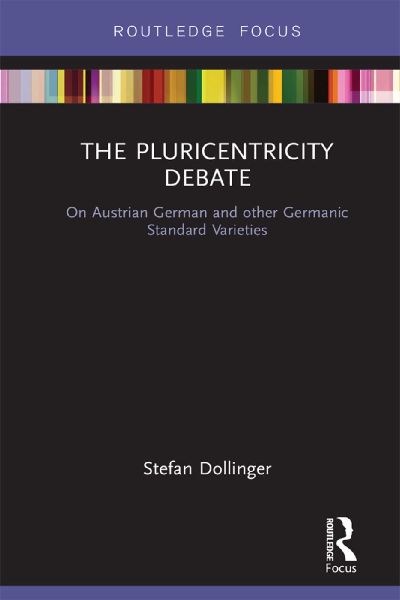
The Pluricentricity Debate
On Austrian German and other Germanic Standard Varieties
von Stefan Dollinger
- Einband
- Gebunden
- Seiten
- 152
- Sprache
- Englisch
- Erschienen
- Juni 2019
- Verlag
- Routledge
Buchbeschreibung
This book unpacks ongoing debates on pluricentricity, an idea implicit to the study of World Englishes which considers differing standards or local norms in a language's national varieties, with a focus on the emergent counter-perspective of "pluri-areality" as exemplified in the German language.
Inhaltsverzeichnis
- Table of Contents
- List of tables List of illustrations Preface Acknowledgements Terminological Note
- 1 The problem 1.1 What is pluricentricity? 1.2 What is pluri-areality? 1.3 Pluricentricity in the world 1.4 Pluricentricity in the Germanic languages 1.5 An outline of the book
- 2 Standardizing German: concepts and background 2.1 Contiguous borders vs. sea borders 2.2 What's in a name? 2.3 The standardization of written German 2.4 Abstand, ausbau language and "roofing"
- 3 The international pluricentric model 3.1 English 3.2 Northern Germanic 3.3 Belgian Dutch (Flemish) and Dutch Dutch 3.4 Luxembourgish
- 4 The German "pluri-areal" model 4.1 Dialectological context 4.2 Pluricentric and monocentric models of German 4.3 The Upper Austrian - Bavarian border 4.4 A pluricentrist turned pluri-arealist
- 5 The case against pluricentricity 5.1 Pluricentricity and the Österreichisches Wörterbuch (ÖWB) 5.2 The charge of ideology vs. enregistering ideology 5.3 The pluri-arealist bias 5.4 Reinterpreting Auer (2005) 5.5 Pluricentricity: outdated in a borderless Europe vs. homo nationalis?
- 6 The case against "pluri-areality" 6.1 Demystifying pluri-areality = "geographical variation" 6.2 A-theoretical empiricism 6.3 The Axiom of Categoricity 6.4 Type vs. tokens and social salience 6.5 Formulae in a black box
Ganzes Inhaltsverzeichnis anzeigen (12 Einträge)Weniger anzeigen
- 7 The lynchpin: speaker attitudes 7.1 State Nation Austria vs. Nation State Germany 7.2 Linguistic insecurity7.3 German mother-tongue language instruction 7.4 Language planning and pedagogy
- 8 Examples: trends, not categoricity 8.1 An undetected Austrianism: Anpatzen 'make disreputable' 8.2 An unlikely Austrianism: der Tormann 'goal tender' 8.3 An even unlikelier Austrianism: hudeln 8.4 An enregistered Austrianism: es geht sich (nicht) aus 8.5 A typology of Austrianisms
- 9 Safeguards in the Modelling of Standard Varieties 9.1 The Uniformitarian Principle: "vertical" and "horizontal" 9.2 Explicit and falsifiable theories 9.3 "The speaker is always right": pedagogical implications 9.4 The language political angle of "pluri-areality" 9.5 Considering political borders
- 10 Bibliography General Index
Details
- Erscheinungstermin
- Juni 2019
- Kategorie
- Fremdsprachige Bücher
- Einband
- Gebunden
- Seiten
- 152
- Sprache
- Englisch
- Verlag
- Routledge
- Format
- 22,2 × 14,5 cm
- Dicke
- 1,2 cm
- Gewicht
- 271 g
- EAN / ISBN-13
- 9780367143572
Über Stefan Dollinger
Stefan Dollinger is Associate Professor at UBC Vancouver, specializing in historical linguistics, sociolinguistics and linguistic border studies.
Mehr über Stefan DollingerWeniger anzeigen
He is the author of New-Dialect Formation in Canada (2008) and The Written Questionnaire in Social Dialectology (2015), and Chief Editor of the Dictionary of Canadianisms on Historical Principles - www.dchp.ca/dchp2 (2017).
Versand und Rückgabe
Standardversand: 1 bis 3 Werktage, 3,99 €, kostenlos ab 35 €
Liefergebiet: Deutschland
Rücksendung: 14 Tage Widerrufsrecht. Bei einem Widerruf tragen Sie die Kosten der Rücksendung. Bei einer Falschlieferung oder einem Fehler von uns erstatten wir Ihnen das Rückporto. Den Widerruf erklären Sie über den Knopf „Vertrag widerrufen“ im Fuß der Seite.
Hersteller und ProduktsicherheitRoutledge
Routledge
Europaallee 1
36244 Bad Hersfeld
Deutschland
gpsr@libri.de
Verantwortliche Person in der EU
Libri GmbHEuropaallee 1
36244 Bad Hersfeld
Deutschland
gpsr@libri.de
Mehr von Stefan Dollinger


Ähnliche Titel

Bewertungen
Zu diesem Titel gibt es noch keine Bewertung. Bewerten kann, wer ihn bei uns gekauft hat.
So prüfen wir Bewertungen
Eine Bewertung kann bei uns nur abgeben, wer den Titel über sein Kundenkonto bei uns gekauft hat. Jede Bewertung ist fest mit der zugehörigen Bestellung verknüpft; anders kommt sie technisch gar nicht zustande. Deshalb trägt jede angezeigte Bewertung den Hinweis „Verifizierter Kauf". Wir zeigen positive wie negative Bewertungen und löschen nur bei Rechtsverstößen. Für Bewertungen gibt es keine Gegenleistung.
99,90 €Voraussichtlich 4. bis 8. Dez.