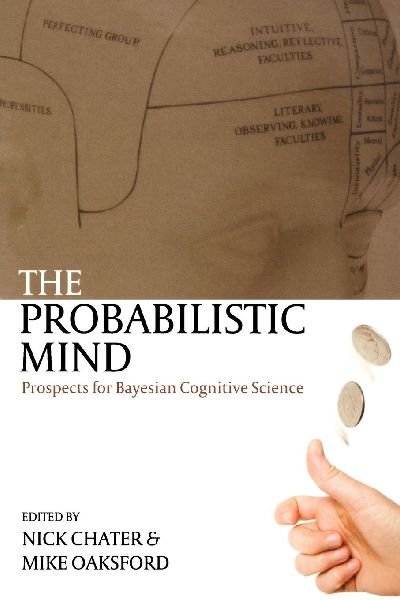
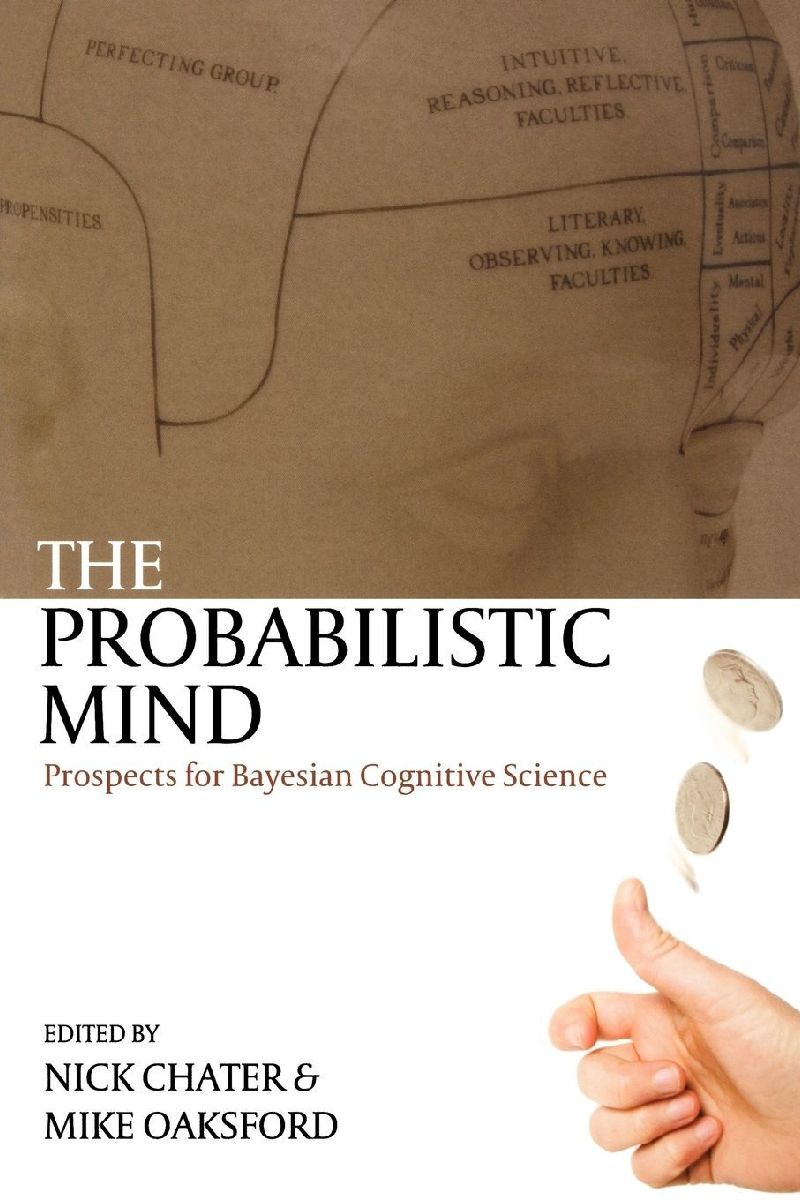
The Probabilistic Mind
Prospects for Bayesian Cognitive Science
Herausgegeben von: Nick Chater, Herausgegeben von: Mike Oaksford
- Einband
- Kartoniert
- Seiten
- 534
- Sprache
- Englisch
- Erschienen
- März 2008
- Verlag
- OUP Oxford
Buchbeschreibung
The rational analysis method, first proposed by John R. Anderson, has been enormously influential in helping us understand high-level cognitive processes.
'The Probabilistic Mind' is a follow-up to the influential and highly cited 'Rational Models of Cognition' (OUP, 1998). It brings together developments in understanding how, and how far, high-level cognitive processes can be understood in rational terms, and particularly using probabilistic Bayesian methods.
Ganze Beschreibung lesenWeniger anzeigen
It synthesizes and evaluates the progress in the past decade, taking into account developments in Bayesian statistics, statistical analysis of the cognitive 'environment' and a variety of theoretical and experimental lines of research. The scope of the book is broad, covering important recent work in reasoning, decision making, categorization, and memory. Including chapters from many of the leading figures in this field,
'The Probabilistic Mind' will be valuable for psychologists and philosophers interested in cognition.
Inhaltsverzeichnis
- Part I - Foundations
- 1: Nick Chater and Mike Oaksford: The probabilistic mind: prospects for a Bayesian cognitive science
- 2: Thomas L Griffiths and Alan Yuille: Technical introduction: a primer on probabilistic inference
- 3: David Danks: Rational analyses, instrumentalism, and implementations
- Part II - Inference and Argument
- 4: Shlomi Sher and Craig R M McKenzie: Framing effects and rationality
- 5: Mike Oaksford and Nick Chater: Probability logic and the 'Modus Ponens - Modus Tollens' asymmetry
- 6: Ulrike Hahn and Mike Oaksford: Inference from absence in language and thought
Ganzes Inhaltsverzeichnis anzeigen (27 Einträge)Weniger anzeigen
- 7: Jonathan Nelson: Towards a rational theory of human information acquisition
- 8: Klaus Fiedler: Pseudocontingencies: a key paradigm for understanding adaptive cognition
- Part III - Judgement and Decision-making
- 9: Henry Brighton and Gerd Gigerenzer: Probabilistic minds, Bayesian brains, and cognitive mechanisms: harmony or dissonance
- 10: Ralph Hertwig and Timothy J Pleskac: The game of life: how small samples render choice simple
- 11: Patrik Hansson, Peter Juslin and Anders Winman: The naive intuitive statistician: organism-environment relations from yet another angle
- 12: Neil Stewart and Keith Simpson: A decision-by-sampling account of decision under risk
- 13: Marius Usher, Anat Elhalal and James L McClelland: The neurodynamics of choice, value-based decisions and preference reversal
- Part IV - Categorization and Memory
- 14: Thomas L Griffiths, Adam N Sanborn, Kevin R Canini and Daniel J Navarro: Categorization as nonparametric Bayesian density estimation
- 15: Mark Steyvers and Thomas L Griffiths: Rational analysis as a link between human memory and information retrieval
- 16: David E Huber: Causality in time: explaining away the future and the past
- 17: Noah D Goodman, Joshua B Tenenbaum, Thomas L Griffiths and Jacob Feldman: Compositionality in rational analysis: grammar-based induction for concept learning
- Part V - Learning about Contingency and Causality
- 18: Maarten Speekenbrink and David R Shanks: Through the looking-glass: a dynamic lens model approach to learning in MCPL tasks
- 19: Nathaniel D Daw, Aaron C Courville and Peter Dayan: Semi-rational models of conditioning: the case of trial order
- 20: Michael R Waldmann, Patricia W Cheng, York Hagmeyer and Aaron P Blaisdell: Causal learning in rats and humans: a minimal rational model
- 21: Steven Sloman and Philip M Fernbach: The value of rational analysis: an assessment of causal reasoning and learning
- 22: Nick Chater and Mike Oaksford: Conclusion: where next?
Details
- Erscheinungstermin
- März 2008
- Kategorie
- Fremdsprachige Bücher
- Einband
- Kartoniert
- Seiten
- 534
- Sprache
- Englisch
- Verlag
- OUP Oxford
- Format
- 23,4 × 15,6 cm
- Dicke
- 2,9 cm
- Gewicht
- 802 g
- EAN / ISBN-13
- 9780199216093
Über Nick Chater (Hrsg.)
Nick Chater is Professor of Cognitive and Decision Sciences at University College London. He has an M.A. in Psychology from Cambridge University, and a PhD in Cognitive Science from Edinburgh.
Mehr über Nick Chater (Hrsg.)Weniger anzeigen
He has held academic appointments at Edinburgh, Oxford, and Warwick Universities. His research focussed on attempting to find general principles that may be applicable across many cognitive domains, ranging from reasoning and decision making, to language acquisition and processing, to perception and categorization. Since the late 1980s, in collaboration with Mike Oaksford, he has been interested in the application of probabilistic and information-theoretic methods for understanding human reasoning.
Mike Oaksford is Professor of Psychology and Head of School at Birkbeck College London. He was a research fellow at the Centre for Cognitive Science, University of Edinburgh, he was then lecturer at the University of Wales, Bangor, and senior lecturer at the University of Warwick, before moving to Cardiff University in 1996 as Professor of Experimental Psychology, a post he held until 2005. His research interests are in the area of human reasoning and decision making. In particular, with his colleague Nick Chater, he has been developing a Bayesian probabilistic approach to deductive reasoning tasks. According to this approach reasoning "biases" are the result of applying the wrong normative model and failing to take account of people's normal environment. He also studies the way the emotions affect and interact with reasoning and decision making processes.
Versand und Rückgabe
Standardversand: 1 bis 3 Werktage, 3,99 €, kostenlos ab 35 €
Liefergebiet: Deutschland
Rücksendung: 14 Tage Widerrufsrecht. Bei einem Widerruf tragen Sie die Kosten der Rücksendung. Bei einer Falschlieferung oder einem Fehler von uns erstatten wir Ihnen das Rückporto. Den Widerruf erklären Sie über den Knopf „Vertrag widerrufen“ im Fuß der Seite.
Hersteller und ProduktsicherheitOUP Oxford
OUP Oxford
Europaallee 1
36244 Bad Hersfeld
Deutschland
gpsr@libri.de
Verantwortliche Person in der EU
Libri GmbHEuropaallee 1
36244 Bad Hersfeld
Deutschland
gpsr@libri.de
Mehr von Nick Chater
Ähnliche Titel


Bewertungen
Zu diesem Titel gibt es noch keine Bewertung. Bewerten kann, wer ihn bei uns gekauft hat.
So prüfen wir Bewertungen
Eine Bewertung kann bei uns nur abgeben, wer den Titel über sein Kundenkonto bei uns gekauft hat. Jede Bewertung ist fest mit der zugehörigen Bestellung verknüpft; anders kommt sie technisch gar nicht zustande. Deshalb trägt jede angezeigte Bewertung den Hinweis „Verifizierter Kauf". Wir zeigen positive wie negative Bewertungen und löschen nur bei Rechtsverstößen. Für Bewertungen gibt es keine Gegenleistung.
112,80 €Voraussichtlich 2. bis 4. Dez.