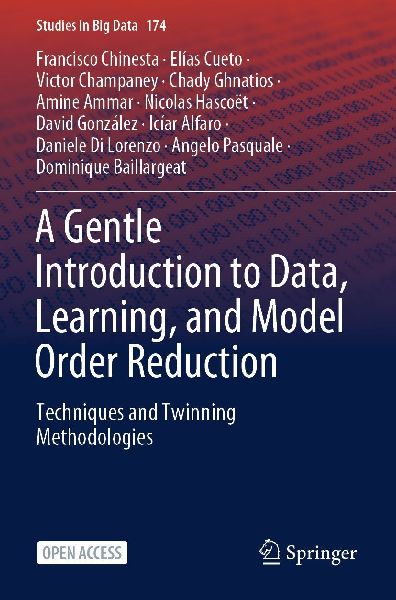
A Gentle Introduction to Data, Learning, and Model Order Reduction
Francisco Chinesta
Kartoniert, Englisch, 2 Ausgaben
ab 42,79 €
A Primer
von Francisco Chinesta, Roland Keunings und Adrien Leygue
Aus der Reihe SpringerBriefs in Applied Sciences and Technology
Many problems in scientific computing are intractable with classical numerical techniques.
These fail, for example, in the solution of high-dimensional models due to the exponential increase of the number of degrees of freedom.
Recently, the authors of this book and their collaborators have developed a novel technique, called Proper Generalized Decomposition (PGD) that has proven to be a significant step forward.
The PGD builds by means of a successive enrichment strategy a numerical approximation of the unknown fields in a separated form.
Although first introduced and successfully demonstrated in the context of high-dimensional problems, the PGD allows for a completely new approach for addressing more standard problems in science and engineering. Indeed, many challenging problems can be efficiently cast into a multi-dimensional framework, thus opening entirely new solution strategies in the PGD framework.
For instance, the material parameters and boundary conditions appearing in a particular mathematical model can be regarded as extra-coordinates of the problem in addition to the usual coordinates such as space and time. In the PGD framework, this enriched model is solved only once to yield a parametric solution that includes all particular solutions for specific values of the parameters.
The PGD has now attracted the attention of a large number of research groups worldwide. The present text is the first available book describing the PGD. It provides a very readable and practical introduction that allows the reader to quickly grasp the main features of the method.
Throughout the book, the PGD is applied to problems of increasing complexity, and the methodology is illustrated by means of carefully selected numerical examples. Moreover, the reader has free access to the Matlab(c) software used to generate these examples.
Francisco Chinesta – Professor of Computational Physics at Arts et Métiers Institute of Technology, Paris and programme director at CNRS@CREATE, Singapore.
His research focuses on computational physics, model order reduction, and hybrid artificial intelligence.
Elias Cueto – Professor of Continuum Mechanics at Universidad de Zaragoza. His research covers model order reduction, artificial intelligence and computational mechanics.
Victor Champaney – Researcher at Arts et Métiers Institute of Technology, Paris. His work specializes in model order reduction, hybrid modeling and frugal AI techniques.
Chady Ghnatios – Professor of Mechanical Engineering at University of North Florida, USA. His research focuses on model order reduction, advanced simulation, machine learning and hybrid modeling.
Amine Ammar – Professor of Computational Mechanics at Arts et Métiers Institute of Technology, Angers. His expertise lies in kinetic theory models, model reduction, and computational material forming.
Nicolas Hascoët – Associate Professor at Arts et Métiers Institute of Technology, Paris. His research focuses on machine learning and data science for industrial applications.
David Gonzalez – Professor of Continuum Mechanics at Universidad de Zaragoza. His research interests include model reduction, real-time computational simulations, and physics-informed AI.Icíar Alfaro – Associate Professor at Universidad de Zaragoza. She specializes in numerical methods, solid mechanics, and physics-informed neural networks.
Daniele Di Lorenzo – Researcher at Arts et Métiers Institute of Technology, Paris. His research focuses on inverse analysis, hybrid modeling, and digital twins for structural health monitoring.
Angelo Pasquale – Researcher in Computational Mechanics at Arts et Métiers Institute of Technology, Paris. He specializes in AI-enhanced simulations, model order reduction and multiscale modeling.
Dominique Baillargeat – Professor at the University of Limoges and Director of CNRS@CREATE at Singapore. His research focuses on high-frequency electronics, nanotechnologies, and advanced modeling and simulation techniques using Hybrid-AI.
Standardversand: 1 bis 3 Werktage, 3,99 €, kostenlos ab 35 €
Liefergebiet: Deutschland
Rücksendung: 14 Tage Widerrufsrecht. Bei einem Widerruf tragen Sie die Kosten der Rücksendung. Bei einer Falschlieferung oder einem Fehler von uns erstatten wir Ihnen das Rückporto. Den Widerruf erklären Sie über den Knopf „Vertrag widerrufen“ im Fuß der Seite.
Francisco Chinesta
Kartoniert, Englisch, 2 Ausgaben
ab 42,79 €
Francisco Chinesta
Gebunden, Englisch, 2 Ausgaben
ab 106,99 €
Francisco Chinesta (Hrsg.)
Gebunden, Englisch
106,99 €
Xiaozhu Lin
Kartoniert, Englisch
58,84 €
Andreas Öchsner
Kartoniert, Englisch, 2 Ausgaben
ab 171,19 €
David Greiner (Hrsg.)
Gebunden, Englisch
160,49 €
Nikos D. Lagaros (Hrsg.)
Gebunden, Englisch, 2 Ausgaben
ab 160,49 €
Zu diesem Titel gibt es noch keine Bewertung. Bewerten kann, wer ihn bei uns gekauft hat.