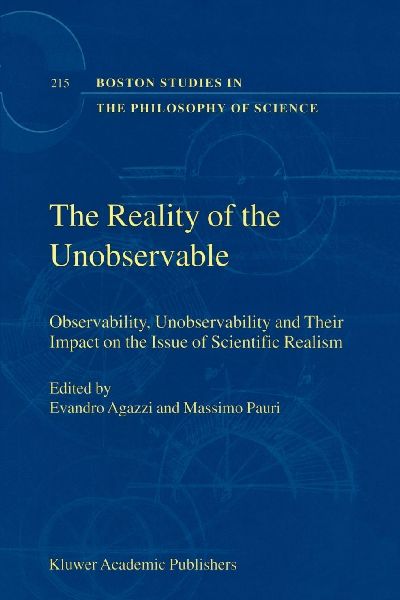
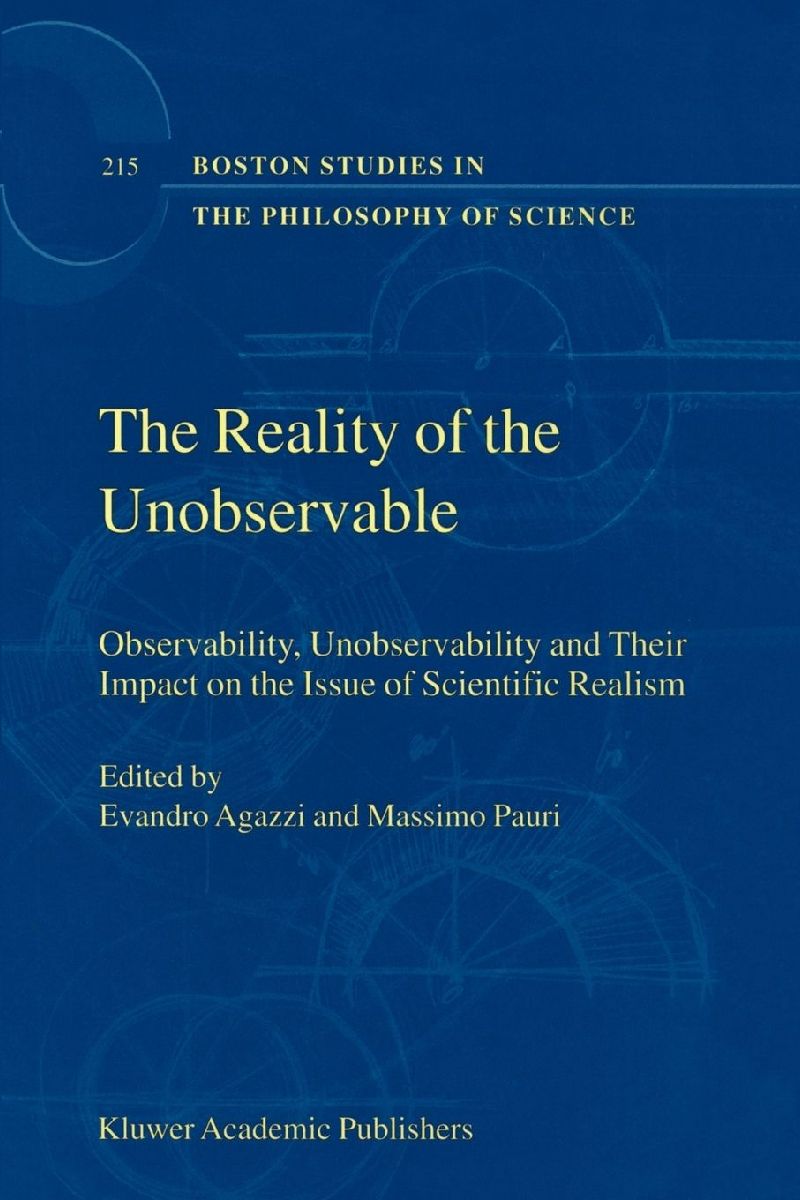
The Reality of the Unobservable
Observability, Unobservability and Their Impact on the Issue of Scientific Realism
Herausgegeben von: E. Agazzi, Herausgegeben von: M. Pauri
Aus der Reihe Boston Studies in the Philosophy and History of Science
- Einband
- Kartoniert
- Seiten
- 388
- Sprache
- Englisch
- Erschienen
- Dezember 2010
- Verlag
- Springer
Buchbeschreibung
Observability and Scientific Realism It is commonly thought that the birth of modern natural science was made possible by an intellectual shift from a mainly abstract and specuJative conception of the world to a carefully elaborated image based on observations. There is some grain of truth in this claim, but this grain depends very much on what one takes observation to be.
Ganze Beschreibung lesenWeniger anzeigen
In the philosophy of science of our century, observation has been practically equated with sense perception. This is understandable if we think of the attitude of radical empiricism that inspired Ernst Mach and the philosophers of the Vienna Circle, who powerfully influenced our century's philosophy of science.
However, this was not the atti tude of the f ounders of modern science: Galileo, f or example, expressed in a f amous passage of the Assayer the conviction that perceptual features of the world are merely subjective, and are produced in the 'anima!' by the motion and impacts of unobservable particles that are endowed uniquely with mathematically expressible properties, and which are therefore the real features of the world.
Moreover, on other occasions, when defending the Copernican theory, he explicitly remarked that in admitting that the Sun is static and the Earth turns on its own axis, 'reason must do violence to the sense' , and that it is thanks to this violence that one can know the tme constitution of the universe.
Inhaltsverzeichnis
- Introduction
- Observability and Scientific Realism Section Summaries
- E. Agazzi, M. Pauri
- History
- The Origin of Scientific Realism: Boltzmann, Planck, Einstein
- General Philosophy, Scientific Realism
- Observability and Referentiality
- E. Agazzi
Ganzes Inhaltsverzeichnis anzeigen (56 Einträge)Weniger anzeigen
- A new Approach to Human Cognition and its Significance for the Philosophy of Science
- P.M. Churchland
- Abduction and Non-Observability - Some Examples from Language Science and the Cognitive Science
- J.P. Desclés. `Scientific Realism' and Scientific Practice
- R. Torretti
- Random Philosophy
- P. Galison
- Formal Representation and the Subjective Side of Scientific Realism
- M. Casartelli
- Convention and Observability - Poincaré Once Again
- G. Heinzmann
- Scientific Realism, Objectivity, and `Technological Realism'
- R. Queraltó
- Philosophy of Observation
- Testability and Empiricism
- D. Shapere
- Observing the Unobservable
- J. Faye
- What Does it Mean to Observe Physical Reality? G. Boniolo
- Realism, and the Case of Rival Theories without Observable Differences
- A. Cordero
- Measurability, Computability and the Existence of Theoretical Entities
- M. Dorato
- Observation, Construction and Speculation in Cosmology
- J. Mosterín
- Where did the Notion that Forces are Unobservable Come From? M. Wilson
- Philosophy of Quantum Theory
- Quantum Mechanics without the Observables
- N. Cartwright
- Observation, Contextuality and Realism
- B. D'Espagnat
- Leibniz, Kant and the Quantum - A Provocative Point of View about Observation, Space-Time, and the Mind-Body Issue
- M. Pauri
- Efficient and Final Causes as CPT Reciprocals
- O. Costa de Beauregard
- Specific Issues of Observability in Quantum Theory
- Observability and Realism inModern Experiments with Correlated Quantum Systems
- C.P. Enz
- Quantum Mechanics, Realism and the Ultimate Observer
- B. Kanitscheider
- Individualistic and Statistical Interpretation of Quantum Mechanics
- P. Mittelstaedt
- How to Observe Quarks
- B. Falkenburg
- Common Experience and Quantum Theory – Observables and Beables
- G.M. Prosperi
- On the Relationships between Classical and Quantum Mechanics
- E.G. Beltrametti, S. Bugajski
Details
- Erscheinungstermin
- Dezember 2010
- Kategorie
- Fremdsprachige Bücher
- Einband
- Kartoniert
- Seiten
- 388
- Sprache
- Englisch
- Verlag
- Springer
- Reihe
- Boston Studies in the Philosophy and History of Science
- Format
- 23,5 × 15,5 cm
- Dicke
- 2,1 cm
- Gewicht
- 587 g
- EAN / ISBN-13
- 9789048154586
Versand und Rückgabe
Standardversand: 1 bis 3 Werktage, 3,99 €, kostenlos ab 35 €
Liefergebiet: Deutschland
Rücksendung: 14 Tage Widerrufsrecht. Bei einem Widerruf tragen Sie die Kosten der Rücksendung. Bei einer Falschlieferung oder einem Fehler von uns erstatten wir Ihnen das Rückporto. Den Widerruf erklären Sie über den Knopf „Vertrag widerrufen“ im Fuß der Seite.
Hersteller und ProduktsicherheitSpringer Nature Customer Service Center GmbH
Springer Nature Customer Service Center GmbH
Europaplatz 3
69115 Heidelberg
Deutschland
ProductSafety@springernature.com
Mehr von E. Agazzi
Philosophy and the Origin and Evolution of the Universe
E. Agazzi (Hrsg.)
Kartoniert, Englisch, 2 Ausgaben
ab 53,49 €
Mehr aus der Reihe Boston Studies in the Philosophy and History of Science
The Perils and Promises of Prediction in the Natural Sciences
Theodore Arabatzis (Hrsg.)
Gebunden, Englisch
149,79 €
Values, Pluralism, and Pragmatism: Themes from the Work of Matthew J. Brown
Jonathan Y. Tsou (Hrsg.)
Gebunden, Englisch, 2 Ausgaben
ab 160,49 €
Ähnliche Titel



Bewertungen
Zu diesem Titel gibt es noch keine Bewertung. Bewerten kann, wer ihn bei uns gekauft hat.
So prüfen wir Bewertungen
Eine Bewertung kann bei uns nur abgeben, wer den Titel über sein Kundenkonto bei uns gekauft hat. Jede Bewertung ist fest mit der zugehörigen Bestellung verknüpft; anders kommt sie technisch gar nicht zustande. Deshalb trägt jede angezeigte Bewertung den Hinweis „Verifizierter Kauf". Wir zeigen positive wie negative Bewertungen und löschen nur bei Rechtsverstößen. Für Bewertungen gibt es keine Gegenleistung.
160,49 €Voraussichtlich 2. bis 4. Dez.