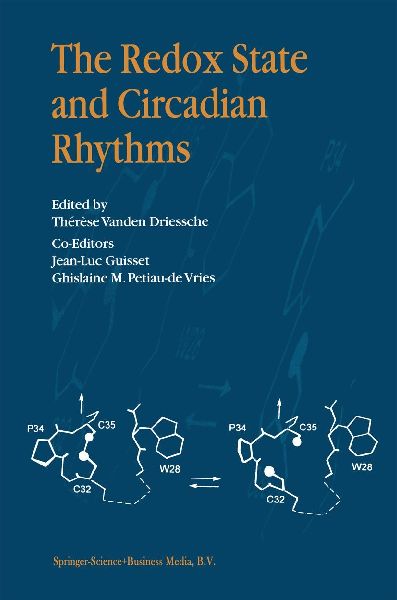
The Redox State and Circadian Rhythms
von Thérèse Vanden Driessche (Hrsg.)
Herausgegeben von: Thérèse Vanden Driessche, Herausgegeben von: J. L. Guisset, Herausgegeben von: G. M. Petiau-De Vries
- Einband
- Gebunden
- Seiten
- 300
- Sprache
- Englisch
- Erschienen
- August 2000
- Verlag
- Springer
Buchbeschreibung
Although the term redox covers an important number of chemical reactions, biochemists are more familiar with reactions involving the reactions mediated by electron transfer chains associated with respiration, the thiol-disulfide exchanges and the reactions occurring in the presence of free radicals.
Ganze Beschreibung lesenWeniger anzeigen
More recently, the importance of these reactions in the living world and in medicine has been recognized by biochemists, biologists, physiologists, physicians, etc. The importance of the subject in both fundamental and is reflected by the abundance of interesting reviews applied science concerning the subject (Cadenas, 1989, Del Maestro, 1991) and books (Dreosti, 1991; Rice-Evans and Burdon, 1994; Armstrong, 1994) The aim of this chapter is to describe basic reactions known with references to reviews covering special subjects related to redox reactions.
Transformation of energy in living organisms is mediated by complex biological systems such as electron transfer chains where the succession of redox reactions provides energy to the organisms. Molecular oxygen or dioxygen is an essential molecule and is the terminal acceptor of electrons during respiration in eukaryotes.
In these organisms, the electron transfer chain is located in the mitochondrial membranes and produces adenosine triphosphate (ATP). In anaerobes, the electron acceptor is C0, S, sulphate or nitrate ions 2 instead of 02.
Inhaltsverzeichnis
- An Ancient Cellular Mechanism in the Tension Field between Energy Requirements and Destruction Avoidance
- Overview
- The Biochemistry Of Redox Reactions
- Light-Dark and Thioredoxin-Mediated Metabolic Redox Control in Plant Cells
- Redox Cycling of Intracellular Thiols: State Variables for Ultradian, Cell Division Cycle and Circadian Cycles?
- Occurrence and comparative physiology of melatonin in evolutionary diverse organisms
- Circadian Rhythms and Oxidative Stress in Non-vertebrate Organisms
- Circadian Aspects of the Cellular Redox State: Melatonin Actions and Implications for Oncogenesis
Ganzes Inhaltsverzeichnis anzeigen (14 Einträge)Weniger anzeigen
- Plasma membrane electron transport and the control of cellular redox status and circadian rhythms
- Fluctuation of Reactive Oxygen Species Released by Inflammatory Cells*
- Circadian variations in toxic liver injury and the hepatic P-450 monooxygenase system
- Apoptotic Signals: Possible Implication Of Circadian Rhythms
- Redox capacities of in vitro cultured plant tissues: the case of hyperhydricity
- Redox state and phosphorylation potential as macroparameters in rhythmic control of metabolism - a molecular basis for seasonal adaptation of development
Details
- Erscheinungstermin
- August 2000
- Kategorie
- Fremdsprachige Bücher
- Einband
- Gebunden
- Seiten
- 300
- Sprache
- Englisch
- Verlag
- Springer
- Format
- 24,1 × 16,0 cm
- Dicke
- 2,1 cm
- Gewicht
- 565 g
- EAN / ISBN-13
- 9780792364535
Versand und Rückgabe
Standardversand: 1 bis 3 Werktage, 3,99 €, kostenlos ab 35 €
Liefergebiet: Deutschland
Rücksendung: 14 Tage Widerrufsrecht. Bei einem Widerruf tragen Sie die Kosten der Rücksendung. Bei einer Falschlieferung oder einem Fehler von uns erstatten wir Ihnen das Rückporto. Den Widerruf erklären Sie über den Knopf „Vertrag widerrufen“ im Fuß der Seite.
Hersteller und ProduktsicherheitSpringer Nature Customer Service Center GmbH
Springer Nature Customer Service Center GmbH
Europaplatz 3
69115 Heidelberg
Deutschland
ProductSafety@springernature.com
Ähnliche Titel



Bewertungen
Zu diesem Titel gibt es noch keine Bewertung. Bewerten kann, wer ihn bei uns gekauft hat.
So prüfen wir Bewertungen
Eine Bewertung kann bei uns nur abgeben, wer den Titel über sein Kundenkonto bei uns gekauft hat. Jede Bewertung ist fest mit der zugehörigen Bestellung verknüpft; anders kommt sie technisch gar nicht zustande. Deshalb trägt jede angezeigte Bewertung den Hinweis „Verifizierter Kauf". Wir zeigen positive wie negative Bewertungen und löschen nur bei Rechtsverstößen. Für Bewertungen gibt es keine Gegenleistung.
160,49 €Voraussichtlich 4. bis 8. Dez.