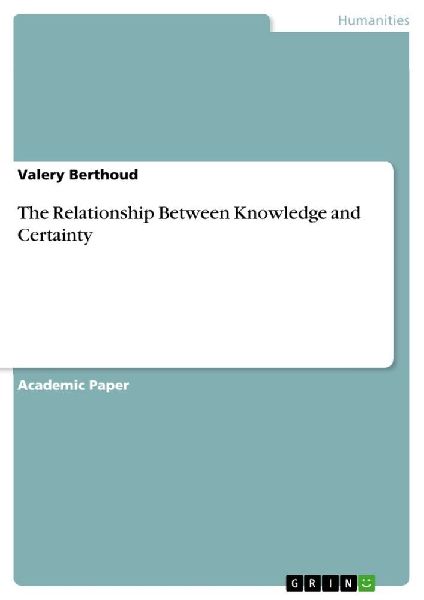
The Relationship Between Knowledge and Certainty
von Valery Berthoud
- Einband
- Kartoniert
- Seiten
- 20
- Sprache
- Englisch
- Erschienen
- Dezember 2018
- Verlag
- GRIN Verlag
Buchbeschreibung
Academic Paper from the year 2018 in the subject Philosophy - Miscellaneous, grade: 2,3, Humboldt-University of Berlin, course: Wittgenstein's Über Gewissheit, language: English, abstract: The relationship between knowledge and certainty varies according to conception. I argue that knowledge and certainty are usually equivalent, but there are cases in which certainty is possible without knowledge and knowledge is possible without certainty.
Ganze Beschreibung lesenWeniger anzeigen
The connection between knowledge and certainty does not change much when considering René Descartes' philosophy because methodological skepticism consists of doubting beliefs that are uncertain. That there exist external objects is uncertain because a malicious demon could be deceiving us by creating the illusion of an external world.
Although Descartes suggests that we can doubt all of our beliefs, his conception of science consists of secure insight: "Omnis scientia est cognitio certa et evidens" (Descartes 1907). This means that all science is certain and evident knowledge, or a high degree of certainty. Three centuries later, G. E.Moore had another reasoning when writing "A Defense of Common Sense" and "Proof of an External World."
He suggests that doubting that the world exists is unnecessary; we must trust that the universe exists. He is against George Berkeley's suggestion that matter does not exist; everything is just ideas of the mind of God, and to be is to perceive. This is similar to propositions from Gottfried Wilhelm Leibniz, who was an idealist because he claimed that all possible worlds lie in God, and we are substances observing the best alternative (Leibniz 2014, §43-46).Moore suggests that it is irrational to believe such premises.
He held intuitions that a person has in everyday life, the common sense philosophy. We cannot be certain yet we claim to know many things. Moore also purports that the external world is real and he tried to prove it (Moore 1993a).His argument goes as follows: P1: Here is one hand.
P2: Here is another. C1: There are at least two external objects in the world. C2: Therefore, an external world exists.
He argues that he had the experience of observing his hands and reiterates that at least his hands offer the sum of two objects, which at a specified time existed (Ibid.).
Details
- Erscheinungstermin
- Dezember 2018
- Kategorie
- Fremdsprachige Bücher
- Einband
- Kartoniert
- Seiten
- 20
- Sprache
- Englisch
- Verlag
- GRIN Verlag
- Format
- 21,0 × 14,8 cm
- Dicke
- 0,2 cm
- Gewicht
- 45 g
- EAN / ISBN-13
- 9783668839472
Versand und Rückgabe
Standardversand: 1 bis 3 Werktage, 3,99 €, kostenlos ab 35 €
Liefergebiet: Deutschland
Rücksendung: 14 Tage Widerrufsrecht. Bei einem Widerruf tragen Sie die Kosten der Rücksendung. Bei einer Falschlieferung oder einem Fehler von uns erstatten wir Ihnen das Rückporto. Den Widerruf erklären Sie über den Knopf „Vertrag widerrufen“ im Fuß der Seite.
Hersteller und ProduktsicherheitGRIN Publishing GmbH
Mehr von Valery Berthoud

Inequality and Power in the Ground of the Mexican Republic
Valery Berthoud
Kartoniert, Englisch
14,99 €
Das Phänomen der Verdinglichung. Was meint Adorno wenn er den Begriff der "Verdinglichung" benutzt?
Valery Berthoud
Kartoniert
15,95 €
Ähnliche Titel
Bewertungen
Zu diesem Titel gibt es noch keine Bewertung. Bewerten kann, wer ihn bei uns gekauft hat.
So prüfen wir Bewertungen
Eine Bewertung kann bei uns nur abgeben, wer den Titel über sein Kundenkonto bei uns gekauft hat. Jede Bewertung ist fest mit der zugehörigen Bestellung verknüpft; anders kommt sie technisch gar nicht zustande. Deshalb trägt jede angezeigte Bewertung den Hinweis „Verifizierter Kauf". Wir zeigen positive wie negative Bewertungen und löschen nur bei Rechtsverstößen. Für Bewertungen gibt es keine Gegenleistung.
15,95 €Voraussichtlich 2. bis 4. Dez.