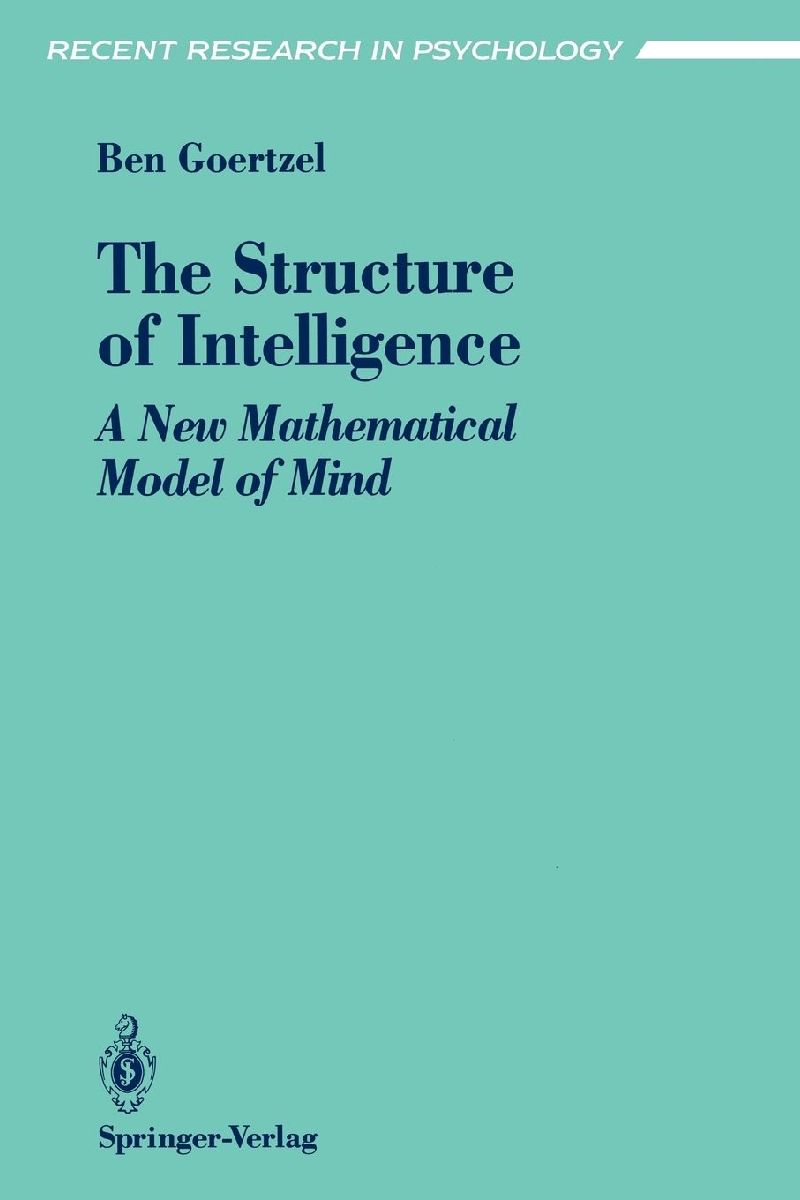
The Structure of Intelligence
A New Mathematical Model of Mind
von Ben Goertzel
Aus der Reihe Recent Research in Psychology
- Einband
- Kartoniert
- Seiten
- 240
- Sprache
- Englisch
- Erschienen
- Juni 1993
- Verlag
- Springer
Buchbeschreibung
0. 0 Psychology versus Complex Systems Science Over the last century, psychology has become much less of an art and much more of a science.
Philosophical speculation is out; data collection is in. In many ways this has been a very positive trend. Cognitive science (Mandler, 1985) has given us scientific analyses of a variety of intelligent behaviors: short-term memory, language processing, vision processing, etc.
Ganze Beschreibung lesenWeniger anzeigen
And thanks to molecular psychology (Franklin, 1985), we now have a rudimentary understanding of the chemical processes underlying personality and mental illness.
However, there is a growing feeling-particularly among non-psychologists (see e. g. Sommerhoff, 1990) - that, with the new emphasis on data collection, something important has been lost. Very little attention is paid to the question of how it all fits together. The early psychologists, and the classical philosophers of mind, were concerned with the general nature of mentality as much as with the mechanisms underlying specific phenomena.
But the new, scientific psychology has made disappointingly little progress toward the resolution of these more general questions. One way to deal with this complaint is to dismiss the questions themselves. After all, one might argue, a scientific psychology cannot be expected to deal with fuzzy philosophical questions that probably have little empirical signifi cance.
It is interesting that behaviorists and cognitive scientists tend to be in agreement regarding the question of the overall structure of the mind.
Inhaltsverzeichnis
- 0. Introduction
- 0.0 Psychology versus Complex Systems Science
- 0.1 Mind and Computation
- 0.2 Synopsis
- 0.3 Mathematics, Philosophy, and Science
- 1. Mind and Computation
- 1.0 Rules
- 1.1 Stochastic and Quantum Computation
Ganzes Inhaltsverzeichnis anzeigen (69 Einträge)Weniger anzeigen
- 1.2 Computational Complexity
- 1.3 Network, Program, or Network of Programs?
- 2. Optimization
- 2.0 Thought as Optimization
- 2.1 Monte Carlo and Multistart
- 2.2 Simulated Annealing
- 2.3 Multilevel Optimization
- 3. Quantifying Structure
- 3.0 Algorithmic Complexity
- 3.1 Randomness
- 3.2 Pattern
- 3.3 Meaningful Complexity
- 3.4 Structural Complexity
- 4. Intelligence and Mind
- 4.0 The Triarchic Theory of Intelligence
- 4.1 Intelligence as Flexible Optimization
- 4.2 Unpredictability
- 4.3 Intelligence as Flexible Optimization, Revisited
- 4.4 Mind and Behavior
- 5. Induction
- 5.0 Justifying Induction
- 5.1 The Tendency to Take Habits
- 5.2 Toward a General Induction Algorithm
- 5.3 Induction, Probability, and Intelligence
- 6. Analogy
- 6.0 The Structure-Mapping Theory of Analogy
- 6.1 A Typology of Analogy
- 6.2 Analogy and Induction
- 6.3 Hierarchical Analogy
- 6.4 Structural Analogy in the Brain
- 7. Long-Term Memory
- 7.0 Structurally Associative Memory
- 7.1 Quillian Networks
- 7.2 Implications of Structurally Associative Memory
- 7.3 Image and Process
- 8. Deduction
- 8.0 Deduction and Analogy in Mathematics
- 8.1 The Structure of Deduction
- 8.2 Paraconsistency
- 8.3 Deduction Cannot Stand Alone
- 9. Perception
- 9.0 The Perceptual Hierarchy
- 9.1 Probability Theory
- 9.2 The Maximum Entropy Principle
- 9.3 The Logic of Perception
- 10. Motor Learning
- 10.0 Generating Motions
- 10.1 Parameter Adaptation
- 10.2 The Motor Control Hierarchy
- 10.3 A Neural-Darwinist Perceptual-Motor Hierarchy
- 11. Consciousness and Computation
- 11.0 Toward a Quantum Theory of Consciousness
- 11.1 Implications of the Quantum Theory of Consciousness
- 11.2 Consciousness and Emotion
- 12. The Master Network
- 12.0 The Structure of Intelligence
- 12.1 Design for a Thinking Machine
- Appendix 1. Components of the Master Network
- Appendix 2. Automata Networks
- Appendix 3. A Quick Review of Boolean Logic
- References
Details
- Erscheinungstermin
- Juni 1993
- Kategorie
- Fremdsprachige Bücher
- Einband
- Kartoniert
- Seiten
- 240
- Sprache
- Englisch
- Verlag
- Springer
- Reihe
- Recent Research in Psychology
- Format
- 23,5 × 15,5 cm
- Dicke
- 1,4 cm
- Gewicht
- 371 g
- EAN / ISBN-13
- 9780387940045
Versand und Rückgabe
Standardversand: 1 bis 3 Werktage, 3,99 €, kostenlos ab 35 €
Liefergebiet: Deutschland
Rücksendung: 14 Tage Widerrufsrecht. Bei einem Widerruf tragen Sie die Kosten der Rücksendung. Bei einer Falschlieferung oder einem Fehler von uns erstatten wir Ihnen das Rückporto. Den Widerruf erklären Sie über den Knopf „Vertrag widerrufen“ im Fuß der Seite.
Hersteller und ProduktsicherheitSpringer Nature Customer Service Center GmbH
Springer Nature Customer Service Center GmbH
Europaplatz 3
69115 Heidelberg
Deutschland
ProductSafety@springernature.com
Mehr von Ben Goertzel




Mehr aus der Reihe Recent Research in Psychology


Contributions to Mathematical Psychology, Psychometrics, and Methodology
Gerhard H. Fischer (Hrsg.)
Kartoniert, Englisch
160,49 €


Ähnliche Titel


Discourse, Interaction and Communication
X. Arrazola (Hrsg.)
Gebunden, Englisch, 2 Ausgaben
ab 106,99 €
Bewertungen
Zu diesem Titel gibt es noch keine Bewertung. Bewerten kann, wer ihn bei uns gekauft hat.
So prüfen wir Bewertungen
Eine Bewertung kann bei uns nur abgeben, wer den Titel über sein Kundenkonto bei uns gekauft hat. Jede Bewertung ist fest mit der zugehörigen Bestellung verknüpft; anders kommt sie technisch gar nicht zustande. Deshalb trägt jede angezeigte Bewertung den Hinweis „Verifizierter Kauf". Wir zeigen positive wie negative Bewertungen und löschen nur bei Rechtsverstößen. Für Bewertungen gibt es keine Gegenleistung.
128,39 €Voraussichtlich 1. bis 3. Dez.