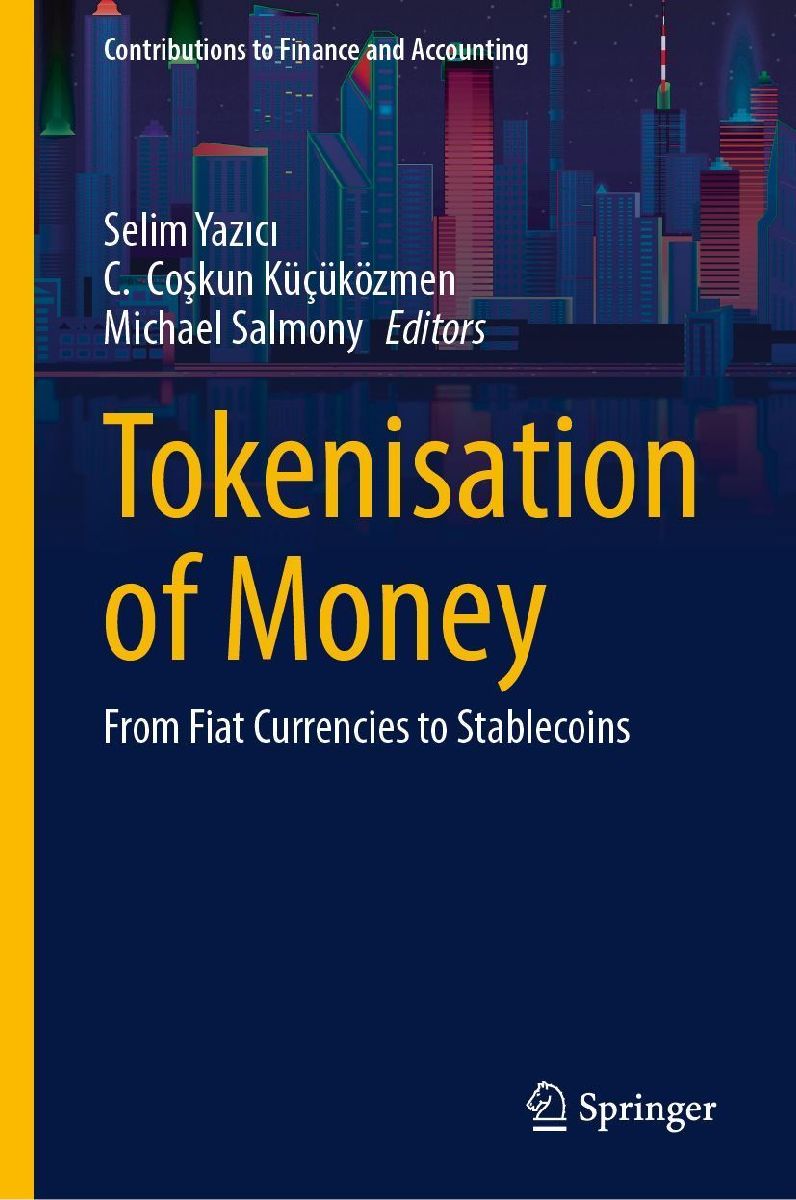
Tokenisation of Money
From Fiat Currencies to Stablecoins
Herausgegeben von: Selim Yaz¿c¿, Herausgegeben von: C. Co¿kun Küçüközmen, Herausgegeben von: Michael Salmony
Aus der Reihe Contributions to Finance and Accounting
- Einband
- Gebunden
- Seiten
- 536
- Sprache
- Englisch
- Erschienen
- Juli 2026
- Verlag
- Springer
Buchbeschreibung
This book offers a holistic approach to understanding the "Why," "What," and "How" of tokenized money, examining its necessity, functionality, and implementation strategies.
It covers a wide range of topics, from Central Bank Digital Currencies (CBDCs) to private stablecoins, decentralized finance (DeFi), and regulatory frameworks.
Ganze Beschreibung lesenWeniger anzeigen
Global perspectives are analyzed through case studies, pilot projects, and early adoption trends worldwide, evaluating the role of tokenized money in financial inclusion, cross-border payments, and the future of global trade.
Critical insights are provided, including opposing views, risks, and the broader impact of digital money on financial stability, sovereignty, and innovation.
The book is tailored for financial professionals and industry leaders, highlighting practical use cases, adoption trends, and strategies for leveraging tokenized money. Policy makers and regulators will gain insights into governance, legal frameworks, and global regulatory practices. Academics and students will find a structured framework for courses on fintech, monetary policy, and digital finance.
Inhaltsverzeichnis
- Chapter 1. Introduction
- Part I: Why Do We Need Another Form of Money?
- Chapter 2. The Main Stages in the History of Money
- Chapter 3. Tokenised Deposits: The Commercial Bank Money Upgrade in a Digital Economy
- Chapter 4. Tokenization of Securities
- Chapter 5. Tokenization of Liquid Investable Assets - Equities, Bonds & Funds
- Chapter 6. Tokenisation of Illiquid Assets
- Part II: What Is Tokenised Money?
Ganzes Inhaltsverzeichnis anzeigen (36 Einträge)Weniger anzeigen
- Chapter 7. CBDC – A Solution Looking for a Problem?
- Chapter 8. The Retail Central Bank Digital Currency (CBDC) Landscape
- Chapter 9. Taler as a Synthetic Central Bank Digital Currency
- Chapter 10. Retail Central Bank Digital Currencies: An Inevitable Innovation for the Stability of the Monetary System in the Digital Age
- Chapter 11. Commercial Bank Money Token (CBMT)
- Chapter 12. Stablecoin Use Cases and Adoption From the End-User Point of View
- Part III: How to Implement Tokenised Money?
- Chapter 13. Mapping the Stablecoin Ecosystem: Taxonomy, Stakeholders, and Systemic Interdependencies
- Chapter 14. Stablecoin Business Models: Current and Future Analysis
- Chapter 15. Offline-Capable Central Bank Digital Currencies as a Key Enabler of a Resilient Digital Payment System
- Chapter 16. The Legal and Governance Framework of Stablecoins: International Standards and Jurisdictional Divergences
- Chapter 17. Regulatory Approaches of Stablecoins
- Chapter 18. Will Tokenized Money Transform Wholesale and B2B Payments?
- Chapter 19. The “Productization” of Money and Its Impact at the Point of Sale
- Chapter 20. The Case for a Stablecoin Clearing System: Enabling Ubiquity Through Market Structure Evolution
- Chapter 21. Adoption by Design for Digital Currency Systems
- Chapter 22. From Stability Guardians to Innovation Architects: The Transformation of Monetary Authorities in the Digital Age
- Part IV: Global Digital Money Landscape: Current Developments Over the World
- Chapter 23. Public and Private Developments Around the World
- Chapter 24. The Pursuit of Resilience in European Retail Payments
- Chapter 25. China’s e-CNY: From Wallet Wars to a National Payments Operating System
- Chapter 26. Tokenization and the Future Monetary System: DCJPY as Tokenized Deposits in Japan
- Chapter 27. Blockchain and QR Codes: Revolutionizing Cross-Border Payments and Financial Inclusion in Southeast Asia – A Case Study of Cambodia’s Bakong Project
- Part V: Critical Views on Tokeised Money
- Chapter 28. Will Tokenised Money Overthrow Existing Financial Infrastructures? TradFi vs DeFi – Who Will Win?
- Chapter 29. Stablecoins, CBDCs, and the New Geopolitics of Money: From Global Competition to Risks
- Chapter 30. The Stablecoin Paradox: From Decentralized Ideals to Re-Intermediation and Financial Engineering
- Chapter 31. Concluding Synthesis: Probabilistic Scenarios for the Future of Money
Details
- Erscheinungstermin
- Juli 2026
- Kategorie
- Fremdsprachige Bücher
- Einband
- Gebunden
- Seiten
- 536
- Sprache
- Englisch
- Verlag
- Springer
- Reihe
- Contributions to Finance and Accounting
- Format
- 24,1 × 16,0 cm
- Dicke
- 3,5 cm
- Gewicht
- 911 g
- EAN / ISBN-13
- 9783032229458
Versand und Rückgabe
Standardversand: 1 bis 3 Werktage, 3,99 €, kostenlos ab 35 €
Liefergebiet: Deutschland
Rücksendung: 14 Tage Widerrufsrecht. Bei einem Widerruf tragen Sie die Kosten der Rücksendung. Bei einer Falschlieferung oder einem Fehler von uns erstatten wir Ihnen das Rückporto. Den Widerruf erklären Sie über den Knopf „Vertrag widerrufen“ im Fuß der Seite.
Hersteller und ProduktsicherheitSpringer Nature Customer Service Center GmbH
Springer Nature Customer Service Center GmbH
Europaplatz 3
69115 Heidelberg
Deutschland
ProductSafety@springernature.com
Mehr aus der Reihe Contributions to Finance and Accounting




Central Bank Capital in Turbulent Times
Dirk Broeders (Hrsg.)
Kartoniert, Englisch, 2 Ausgaben
ab 42,79 €
Ähnliche Titel

Foreign-Exchange-Rate Forecasting with Artificial Neural Networks
Lean Yu
Gebunden, Englisch, 2 Ausgaben
ab 106,99 €


Smart Healthcare Engineering Management and Risk Analytics
Shuai Ding
Gebunden, Englisch, 2 Ausgaben
ab 53,49 €

Bewertungen
Zu diesem Titel gibt es noch keine Bewertung. Bewerten kann, wer ihn bei uns gekauft hat.
So prüfen wir Bewertungen
Eine Bewertung kann bei uns nur abgeben, wer den Titel über sein Kundenkonto bei uns gekauft hat. Jede Bewertung ist fest mit der zugehörigen Bestellung verknüpft; anders kommt sie technisch gar nicht zustande. Deshalb trägt jede angezeigte Bewertung den Hinweis „Verifizierter Kauf". Wir zeigen positive wie negative Bewertungen und löschen nur bei Rechtsverstößen. Für Bewertungen gibt es keine Gegenleistung.
96,29 €Voraussichtlich 4. bis 8. Dez.