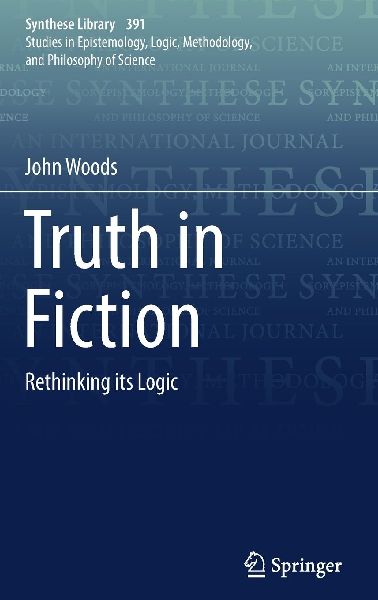
Truth in Fiction
Rethinking its Logic
von John Woods
Aus der Reihe Synthese Library
- Einband
- Gebunden
- Seiten
- 256
- Sprache
- Englisch
- Erschienen
- März 2018
- Verlag
- Springer
Buchbeschreibung
This monograph examines truth in fiction by applying the techniques of a naturalized logic of human cognitive practices.
The author structures his project around two focal questions. What would it take to write a book about truth in literary discourse with reasonable promise of getting it right? What would it take to write a book about truth in fiction as true to the facts of lived literary experience as objectivity allows?
Ganze Beschreibung lesenWeniger anzeigen
It is argued that the most semantically distinctive feature of the sentences of fiction is that they areunambiguously true and false together. It is true that Sherlock Holmes lived at 221B Baker Street and also concurrently false that he did. A second distinctive feature of fiction is that the reader at large knows of this inconsistency and isn't in the least cognitively molested by it. Why, it is asked, would this be so? What would explain it?
Two answers are developed. According to the no-contradiction thesis, the semantically tangled sentences of fiction are indeed logically inconsistent but not logically contradictory. According to the no-bother thesis, if the inconsistencies of fiction were contradictory, a properly contrived logic for the rational management of inconsistency would explain why readers at large are not thrown off cognitive stride by their embrace of those contradictions.
As developed here, the account of fiction suggests the presence of an underlying three - or four-valued dialethic logic. The author shows this to be a mistaken impression. There are only two truth-values in his logic of fiction.
The naturalized logic of Truth in Fiction jettisons some of the standard assumptions and analytical tools of contemporary philosophy, chiefly because the neurotypical linguistic and cognitive behaviour of humanity at large is at variance with them.
Using the resources of a causal response epistemology in tandem with the naturalized logic, the theory produced here is data-driven, empirically sensitive, and open to a circumspect collaboration with the empirical sciences of language and cognition.
Inhaltsverzeichnis
- 1. Misconception and Pretence
- 2. A Research Programme for Fiction
- 3. What Readers Know
- 4. Truth-Making
- 5. Sherlock
- 6. Models and Formal Representations
- 7. "Sherlock"
- 8. Salty Tears and Racing Hearts
- 9. Other Things Sherlock Isn't
- 10. Putting Inconsistency to Rest
Details
- Erscheinungstermin
- März 2018
- Kategorie
- Fremdsprachige Bücher
- Einband
- Gebunden
- Seiten
- 256
- Sprache
- Englisch
- Verlag
- Springer
- Reihe
- Synthese Library
- Format
- 24,1 × 16,0 cm
- Dicke
- 2,0 cm
- Gewicht
- 501 g
- EAN / ISBN-13
- 9783319726571
Über John Woods
The UBC Honorary Professor of Logic and Director of The Abductive Systems Group. Fellow of the Royal Society of Canada. Author of The Logic of Fiction (1974), Fallacies: Selected Papers 1972-1982 (with Douglas Walton in 1989).
Mehr über John WoodsWeniger anzeigen
Author of Paradox and Paraconsistency (2003) and, with Dov Gabbay, of Agenda Relevance (2003) and The Reach of Abduction (2005). Author of the Death of Argument (2004), Aristotle's Earlier Logic (2001), Errors of Reasoning: Naturalizing the Logic of Inference (2013) and Is Legal Reasoning Irrational? An Introduction to the Epistemology of Law (2015).
Versand und Rückgabe
Standardversand: 1 bis 3 Werktage, 3,99 €, kostenlos ab 35 €
Liefergebiet: Deutschland
Rücksendung: 14 Tage Widerrufsrecht. Bei einem Widerruf tragen Sie die Kosten der Rücksendung. Bei einer Falschlieferung oder einem Fehler von uns erstatten wir Ihnen das Rückporto. Den Widerruf erklären Sie über den Knopf „Vertrag widerrufen“ im Fuß der Seite.
Hersteller und ProduktsicherheitSpringer Nature Customer Service Center GmbH
Springer Nature Customer Service Center GmbH
Europaplatz 3
69115 Heidelberg
Deutschland
ProductSafety@springernature.com
Mehr von John Woods

Mehr aus der Reihe Synthese Library
Reals by Abstraction. An Inquiry about Epistemic Economy in Mathematics: Volume II
Marco Panza
Gebunden, Englisch
128,39 €
Proofs and Research Programmes: Lakatos at 100
Roman Frigg (Hrsg.)
Kartoniert, Englisch, 2 Ausgaben
ab 42,79 €
Bewertungen
Zu diesem Titel gibt es noch keine Bewertung. Bewerten kann, wer ihn bei uns gekauft hat.
So prüfen wir Bewertungen
Eine Bewertung kann bei uns nur abgeben, wer den Titel über sein Kundenkonto bei uns gekauft hat. Jede Bewertung ist fest mit der zugehörigen Bestellung verknüpft; anders kommt sie technisch gar nicht zustande. Deshalb trägt jede angezeigte Bewertung den Hinweis „Verifizierter Kauf". Wir zeigen positive wie negative Bewertungen und löschen nur bei Rechtsverstößen. Für Bewertungen gibt es keine Gegenleistung.
106,99 €Voraussichtlich 4. bis 8. Dez.