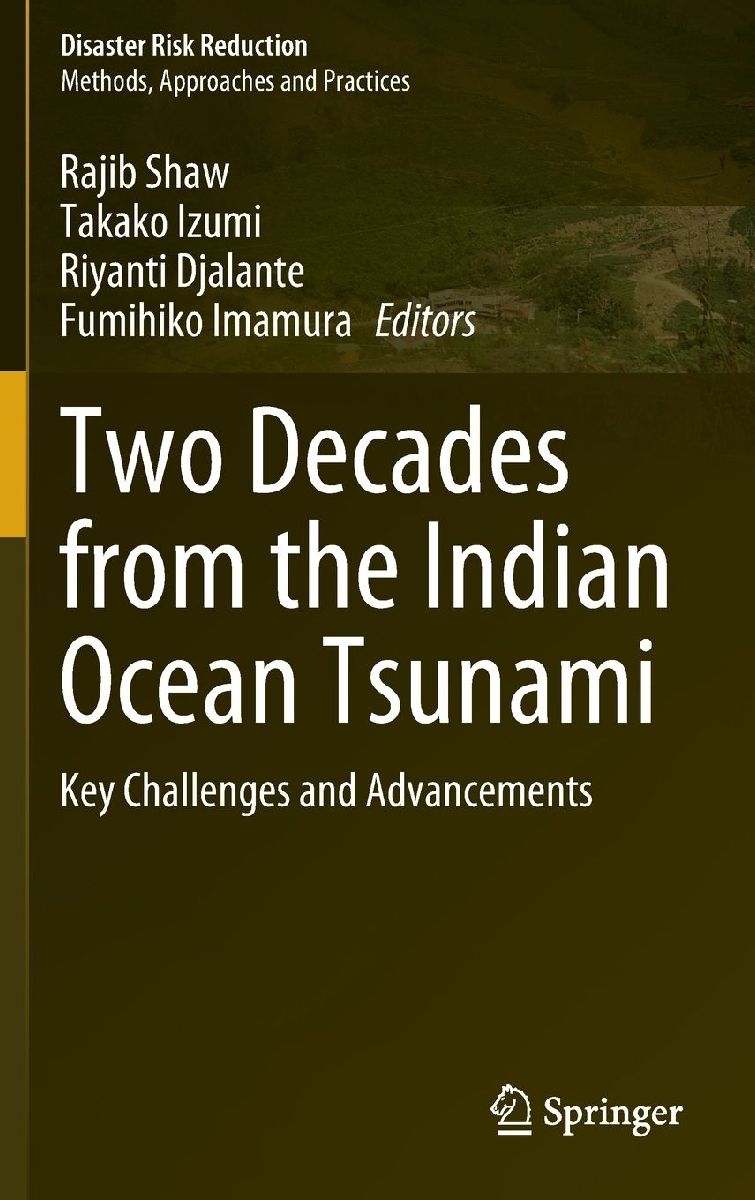
Two Decades from the Indian Ocean Tsunami
Key Challenges and Advancements
Herausgegeben von: Rajib Shaw, Herausgegeben von: Takako Izumi, Herausgegeben von: Riyanti Djalante, und weitere
Aus der Reihe Disaster Risk Reduction
- Einband
- Gebunden
- Seiten
- 452
- Sprache
- Englisch
- Erschienen
- April 2025
- Verlag
- Springer
Buchbeschreibung
This book presents the advancements in the disaster risk reduction and resilience building in the countries affected by the Indian Ocean Tsunami countries.
The book includes a few cross-cutting issues related to governance, technology, and communities, with two major parts: (1) cross-cutting issues and (2) regional and country level experiences.
Ganze Beschreibung lesenWeniger anzeigen
At the threshold of twenty years from Indian Ocean Tsunami, the concept of disaster risk reduction field has evolved significantly in the affected countries as well as around the world. Globally, several mega disasters happened in the last 20 years, and risk landscape has become more complex. In addition, technology, governance, and people's resilience have gained positive momentum.
We had two world conferences on disaster risk reduction, resulting in two global disaster risk reduction frameworks, which aligned with development frameworks as well as climate change agreements. COVID-19 and post COVID risk landscape has brought the new dimension of compound and complex disasters and need for all hazards' approach.
Inhaltsverzeichnis
- Chapter 1. Introduction and overview of disaster risk landscape: Perspectives of twenty years from the Indian Ocean Tsunami of 2004
- Chapter 2. Transforming Disaster Risk Governance: Towards More Collaborative and Inclusive Approach for Tsunami Risk Reduction
- Chapter 3. All hazards approach and its importance in the risk reduction
- Chapter 4. The Evolution of Global Tsunami Warning and Mitigation System in Indian Ocean Basin in Twenty Years
- Chapter 5. Systemic, Complex and Compound Hazards and Its Consideration in Risk Reduction Framework
- Chapter 6. Multicultural Nursing Approach on Primary Health Care to Enhancing Globalized Community Resilience in Japan
- Chapter 7. Understanding the mechanism of the 2004 Indian Ocean tsunami as a complex disaster
- Chapter 8. Science Technology and Innovation in Disaster Risk Reduction: A Review of 20 years
Ganzes Inhaltsverzeichnis anzeigen (22 Einträge)Weniger anzeigen
- Chapter 9. Progress in Ecosystem-based Approach for Disaster Risk Reduction over the Last 20 Years
- Chapter 10. The shelter sector two decades after the Indian Ocean Tsunami
- Chapter 11. Enhancing Community Resilience: Lessons from Disaster Responses and Policies for Effective Community-Based Disaster Risk Reduction
- Chapter 12. Evolution of Disaster Education in the Schools: The Experience of Asia and the Pacific Region
- Chapter 13. Key Progress and Challenges in Tsunami Risk Reduction in the ASEAN Region
- Chapter 14. Urban planning in tsunami prone areas: A comparative study on integration of urban planning strategies in tsunami preparedness planning
- Chapter 15. Disaster Risk Reduction in Indonesia: 20 Years After Aceh Tsunami
- Chapter 16. Two Decades from the Indian Ocean Tsunami: Key challenges and advancements In Thailand
- Chapter 17. Development and Progress of Community-based Disaster Risk Reduction in Malaysia
- Chapter 18. India's Progress on Disaster Risk Reduction Over Last 20 Years
- Chapter 19. Bangladesh's progress on disaster risk reduction over the last 20 years
- Chapter 20. Echoes of the Indian Ocean Tsunami in Sri Lanka: Two Decades of Lessons Learnt and Future Challenges in Disaster Management
- Chapter 21. Determination of Constraints in Existing DRR Coordination Mechanisms among Different Humanitarian Actors of Coastal Bangladesh
- Chapter 22. 20 years After: A Snapshot of Affected Communities in the Aftermath of the 2004 Indian Ocean Tsunami in Sri Lanka
Details
- Erscheinungstermin
- April 2025
- Kategorie
- Fremdsprachige Bücher
- Einband
- Gebunden
- Seiten
- 452
- Sprache
- Englisch
- Verlag
- Springer
- Reihe
- Disaster Risk Reduction
- Format
- 24,1 × 16,0 cm
- Dicke
- 3,0 cm
- Gewicht
- 788 g
- EAN / ISBN-13
- 9789819626687
Versand und Rückgabe
Standardversand: 1 bis 3 Werktage, 3,99 €, kostenlos ab 35 €
Liefergebiet: Deutschland
Rücksendung: 14 Tage Widerrufsrecht. Bei einem Widerruf tragen Sie die Kosten der Rücksendung. Bei einer Falschlieferung oder einem Fehler von uns erstatten wir Ihnen das Rückporto. Den Widerruf erklären Sie über den Knopf „Vertrag widerrufen“ im Fuß der Seite.
Hersteller und ProduktsicherheitSpringer Nature Customer Service Center GmbH
Springer Nature Customer Service Center GmbH
Europaplatz 3
69115 Heidelberg
Deutschland
ProductSafety@springernature.com
Mehr von Rajib Shaw

Disaster Risk Reduction Approaches in Bangladesh
Rajib Shaw (Hrsg.)
Gebunden, Englisch, 2 Ausgaben
ab 181,89 €


Climate Change Adaptation Actions in Bangladesh
Rajib Shaw (Hrsg.)
Gebunden, Englisch, 2 Ausgaben
ab 106,99 €
Mehr aus der Reihe Disaster Risk Reduction
The Application of Artificial Intelligence for Sustainability and a Zero Carbon Society
Rubee Singh (Hrsg.)
Gebunden, Englisch
171,19 €
Transformative Innovations for Climate and Disaster Resilience
Rajib Shaw (Hrsg.)
Gebunden, Englisch
160,49 €
Ähnliche Titel

Urban Blue-Green Infrastructure Approach for Food Security and Climate Disaster Resilience
Mohammad Golam Kibria (Hrsg.)
Gebunden, Englisch, 2 Ausgaben
ab 171,19 €

Extreme Climate Events, Loss and Damage in Africa
Ayansina Ayanlade (Hrsg.)
Gebunden, Englisch
213,99 €

Application of Remote Sensing and GIS in Natural Resources and Built Infrastructure Management
Vijay P. Singh (Hrsg.)
Gebunden, Englisch, 2 Ausgaben
ab 160,49 €
Bewertungen
Zu diesem Titel gibt es noch keine Bewertung. Bewerten kann, wer ihn bei uns gekauft hat.
So prüfen wir Bewertungen
Eine Bewertung kann bei uns nur abgeben, wer den Titel über sein Kundenkonto bei uns gekauft hat. Jede Bewertung ist fest mit der zugehörigen Bestellung verknüpft; anders kommt sie technisch gar nicht zustande. Deshalb trägt jede angezeigte Bewertung den Hinweis „Verifizierter Kauf". Wir zeigen positive wie negative Bewertungen und löschen nur bei Rechtsverstößen. Für Bewertungen gibt es keine Gegenleistung.
160,49 €Voraussichtlich 4. bis 8. Dez.