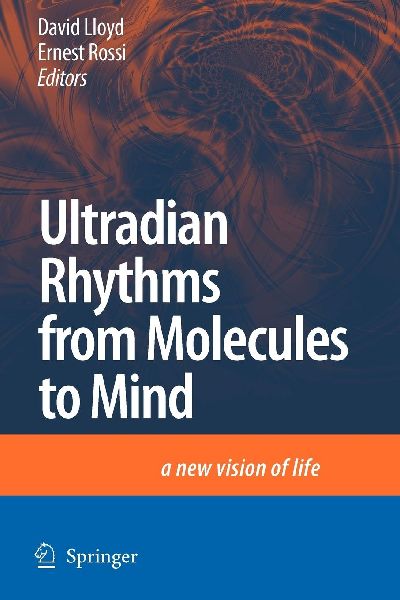
Ultradian Rhythms from Molecules to Mind
A New Vision of Life
Herausgegeben von: David Lloyd, Herausgegeben von: Ernest Rossi
- Einband
- Kartoniert
- Seiten
- 464
- Sprache
- Englisch
- Erschienen
- Oktober 2010
- Verlag
- Springer
Buchbeschreibung
5. 1. 1 Biological Rhythms and Clocks From an evolutionary perspective, the adaptation of an organism's behavior to its environment has depended on one of life's fundamental traits: biological rhythm generation.
In virtually all light-sensitive organisms from cyanobacteria to humans, biological clocks adapt cyclic physiology to geophysical time with time-keeping properties in the circadian (24 h), ultradian (24 h) domains (Edmunds, 1988; Lloyd, 1998; Lloyd et al.
Ganze Beschreibung lesenWeniger anzeigen
, 2001; Lloyd and Murray, 2006; Lloyd, 2007; Pittendrigh, 1993; Sweeney and Hastings, 1960) By definition, all rhythms exhibit regular periodicities since they constitute a mechanism of timing.
Timing exerted by oscillatory mechanisms are found throughout the biological world and their periods span a wide range from milliseconds, as in the action potential of n- rons and the myocytes, to the slow evolutionary changes that require thousands of generations. In this context, to understand the synchronization of a population of coupled oscillators is an important problem for the dynamics of physiology in living systems (Aon et al. , 2007a, b; Kuramoto, 1984; Strogatz, 2003; Winfree, 1967). Circadian rhythms, the most intensively studied, are devoted to measuring daily 24 h cycles.
A variety of physiological processes in a wide range of eukaryotic organisms display circadian rhythmicity which is characterized by the following major properties (Anderson et al. , 1985; Edmunds, 1988): (i) stable, autonomous (self-sustaining) oscillations having a free-running period under constant envir- mental conditions of ca.
Inhaltsverzeichnis
- Introduction: The Temporal organization of living systems from molecules to mind, D. Lloyd, E.L. Rossi, M.R. Roussel
- Part 1 The Molecular-Genetic-Cellular Level
- 1. The Ultradian Clock (period about 40 min) in Saccharomyces cerevisiae, D. Lloyd, D.B. Murray, R.R. Klevecz, J. Wolf, H. Kuriyama
- 2 ENOX proteins: copper hexahydrate-based ultradian oscillators of the cell’s biological clock, D.J.Morré, D.M. Morré
- 3. Self-organized intracellular ultradian rhythms provide direct cell-cell communication, V.Y. Brodsky, D. Lloyd
- 4. Phosphorylation dynamics in mammalian cells, D.A. Gilbert, K.D. Hammond
- 5. Is there a mitochondrial clock?, M.A. Aon, S. Cortassa, B. O¿Rourke
- Part 2 Invertebrate Systems
Ganzes Inhaltsverzeichnis anzeigen (22 Einträge)Weniger anzeigen
- 6. Ultradian and circadian rhythms: experiments and models, B. Fuentes-Pardo, Carolina Barriga-Montoya, M.Lara Aparicio
- 7. Ultradian lovesong rhythms in Drosophila, C.P. Kyriacou
- 8. Mid-range ultradian rhythms in Drosophila and the circadian clock problem, H.B.Dowse
- 9. Tidal rhythms, M.K. Chandrashekaran, V.K. Sharma
- Part 3 The Neuroendocrineal and Developmental Level
- 10. Pulsatile hormonal signalling secretion: mechanisms, significance and evaluation, J.D.Veldhuis
- 11. Ultradian rhythms as the dynamic signature of life, F.E. Yates, L.B. Yates
- 12. Central and peripheral circadian oscillators: how the brain talks to the liver, U. Schibler
- Part 4 Ultradian and Circadian Rhythms in Human Experience13 Total sleep deprivation and cognitive performance: the case for multiple sources of variance, H. Babkoff, A. Goldstein, Z. Gil
- 14. Ultradian Cognitive performance rhythms during sleep deprivation, C. LaJambe, F. Brown
- 15. High Frequency EEG and Its Relationship to Cognitive Function, H. C. Sing
- 16. Genes, sleep and dreams, S. Ribeiro
- 17. A New Vision of Creative Experience: The Ultradian and Circadian Rhythms of Art, Beauty, and Truth, E. Rossi, K. Rossi
- 18. Epilogue: A newvision of life, D. Lloyd, E. Rossi
Details
- Erscheinungstermin
- Oktober 2010
- Kategorie
- Fremdsprachige Bücher
- Einband
- Kartoniert
- Seiten
- 464
- Sprache
- Englisch
- Verlag
- Springer
- Format
- 23,5 × 15,5 cm
- Dicke
- 2,5 cm
- Gewicht
- 698 g
- EAN / ISBN-13
- 9789048178520
Versand und Rückgabe
Standardversand: 1 bis 3 Werktage, 3,99 €, kostenlos ab 35 €
Liefergebiet: Deutschland
Rücksendung: 14 Tage Widerrufsrecht. Bei einem Widerruf tragen Sie die Kosten der Rücksendung. Bei einer Falschlieferung oder einem Fehler von uns erstatten wir Ihnen das Rückporto. Den Widerruf erklären Sie über den Knopf „Vertrag widerrufen“ im Fuß der Seite.
Hersteller und ProduktsicherheitSpringer Nature Customer Service Center GmbH
Springer Nature Customer Service Center GmbH
Europaplatz 3
69115 Heidelberg
Deutschland
ProductSafety@springernature.com
Mehr von David Lloyd


Ähnliche Titel
Bewertungen
Zu diesem Titel gibt es noch keine Bewertung. Bewerten kann, wer ihn bei uns gekauft hat.
So prüfen wir Bewertungen
Eine Bewertung kann bei uns nur abgeben, wer den Titel über sein Kundenkonto bei uns gekauft hat. Jede Bewertung ist fest mit der zugehörigen Bestellung verknüpft; anders kommt sie technisch gar nicht zustande. Deshalb trägt jede angezeigte Bewertung den Hinweis „Verifizierter Kauf". Wir zeigen positive wie negative Bewertungen und löschen nur bei Rechtsverstößen. Für Bewertungen gibt es keine Gegenleistung.
160,49 €Voraussichtlich 1. bis 3. Dez.