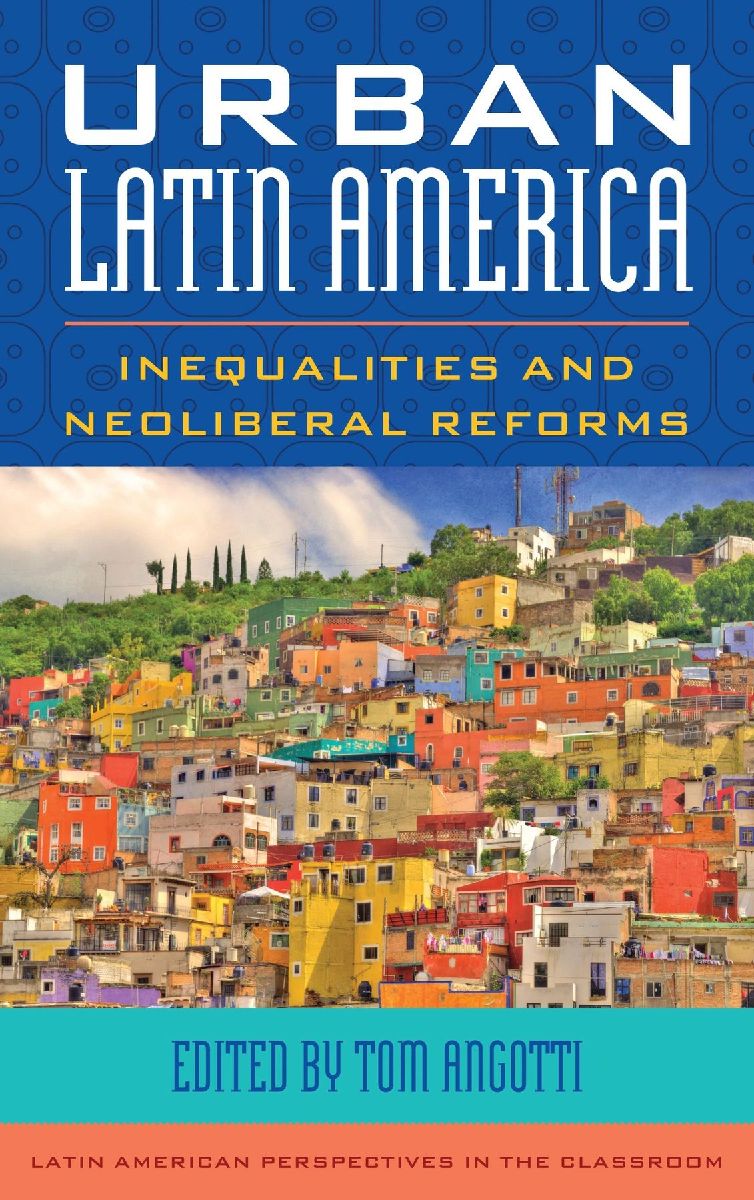
Urban Latin America
Inequalities and Neoliberal Reforms
Herausgegeben von: Tom Angotti
Aus der Reihe Latin American Perspectives in the Classroom
- Einband
- Kartoniert
- Seiten
- 306
- Sprache
- Englisch
- Erschienen
- August 2017
- Verlag
- Rowman & Littlefield Publishers
Buchbeschreibung
Latin America, one of the most urbanized regions of the world, can only be fully understood by exploring its urban-rural divide, inequalities within urban areas, and the prospects for change.
This thoughtful text explores Latin American cities; their history, similarities, and differences; and the current problems they face.
Inhaltsverzeichnis
- Part I: Poverty, Informality, and Peripheral Cities
- Chapter 1: Urban Latin America: Periphery, Informality, and Inequality
- Tom Angotti
- Chapter 2: Poverty, Inequality, and Informality in the Latin American City
- Alan Gilbert
- Chapter 3: They Are Not Informal Settlements: They Are Habitats Made by People
- Lorena Zárate
- Chapter 4: The Future of Global Peripheral Cities
Ganzes Inhaltsverzeichnis anzeigen (40 Einträge)Weniger anzeigen
- Erminia Maricato
- Part II: The Metropolis in Latin America: São Paulo and Mexico City
- Chapter 5: São Paulo: City of Industry, Misery, and Resistance
- William W. Goldsmith and Rogerio Acca
- Chapter 6: Globalization, Governance, and the Collision of Forces in Mexico City's Historic Center
- Diane E. Davis
- Part III: Urban Policies, Neoliberal Reforms, and Best Practices
- Chapter 7: Failed Markets: The Crisis in the Private Production of Social Housing in Mexico
- Alfonso Valenzuela Aguilera
- Chapter 8: Participatory Budgeting in Latin American Cities
- Benjamin Goldfrank
- Chapter 9: Urban Governance and Economic Development in Medellín: An "Urban Miracle"?
- Tobias Franz
- Chapter 10: Conflict and Convergence between Experts and Citizens: Bogotá's Trans
- Milenio
- Stacey Hunt
- Chapter 11: Barra da Tijuca: The Political Economy of a Global Suburb in Rio de Janeiro, Brazil
- Lawrence A. Herzog
- Part IV: Exceptions to the Rules
- Chapter 12: Housing and Urban Development in the Cuban Revolution
- Jill Hamberg
- Chapter 13: Uruguay's Housing Cooperatives: Alternative to the Private Market
- Tom Angotti
- Part V: Urban Struggles, Citizenship, and Public Space
- Chapter 14: Citizenship, Democracy, and Public Space in Latin America
- Clara Irazábal
- Chapter 15: Struggles against Territorial Disqualification: Mobilization for
- Dignified Housing and Defense of Heritage in Santiago
- Nicolás Angelcos and María Luisa Méndez
- Chapter 16: "We Are Not Marginals": The Cultural Politics of Lead Poisoning in Montevideo, Uruguay
- Daniel Renfrew
- References
Details
- Erscheinungstermin
- August 2017
- Kategorie
- Fremdsprachige Bücher
- Einband
- Kartoniert
- Seiten
- 306
- Sprache
- Englisch
- Verlag
- Rowman & Littlefield Publishers
- Reihe
- Latin American Perspectives in the Classroom
- Format
- 22,9 × 15,2 cm
- Dicke
- 1,9 cm
- Gewicht
- 500 g
- EAN / ISBN-13
- 9781442274488
Über Tom Angotti (Hrsg.)
Tom Angotti is professor emeritus of urban policy and planning at Hunter College and the graduate center, City University of New York.
Versand und Rückgabe
Standardversand: 1 bis 3 Werktage, 3,99 €, kostenlos ab 35 €
Liefergebiet: Deutschland
Rücksendung: 14 Tage Widerrufsrecht. Bei einem Widerruf tragen Sie die Kosten der Rücksendung. Bei einer Falschlieferung oder einem Fehler von uns erstatten wir Ihnen das Rückporto. Den Widerruf erklären Sie über den Knopf „Vertrag widerrufen“ im Fuß der Seite.
Hersteller und ProduktsicherheitRowman & Littlefield Publishers
Rowman & Littlefield Publishers
Europaallee 1
36244 Bad Hersfeld
Deutschland
gpsr@libri.de
Verantwortliche Person in der EU
Libri GmbHEuropaallee 1
36244 Bad Hersfeld
Deutschland
gpsr@libri.de
Mehr aus der Reihe Latin American Perspectives in the Classroom


Memory, Truth, and Justice in Contemporary Latin America
Roberta Villalón (Hrsg.)
Kartoniert, Englisch, 2 Ausgaben
ab 55,50 €


Rethinking Latin American Social Movements
Richard Stahler-Sholk (Hrsg.)
Kartoniert, Englisch, 2 Ausgaben
ab 71,60 €
Ähnliche Titel

Bewertungen
Zu diesem Titel gibt es noch keine Bewertung. Bewerten kann, wer ihn bei uns gekauft hat.
So prüfen wir Bewertungen
Eine Bewertung kann bei uns nur abgeben, wer den Titel über sein Kundenkonto bei uns gekauft hat. Jede Bewertung ist fest mit der zugehörigen Bestellung verknüpft; anders kommt sie technisch gar nicht zustande. Deshalb trägt jede angezeigte Bewertung den Hinweis „Verifizierter Kauf". Wir zeigen positive wie negative Bewertungen und löschen nur bei Rechtsverstößen. Für Bewertungen gibt es keine Gegenleistung.
52,60 €Voraussichtlich 2. bis 4. Dez.