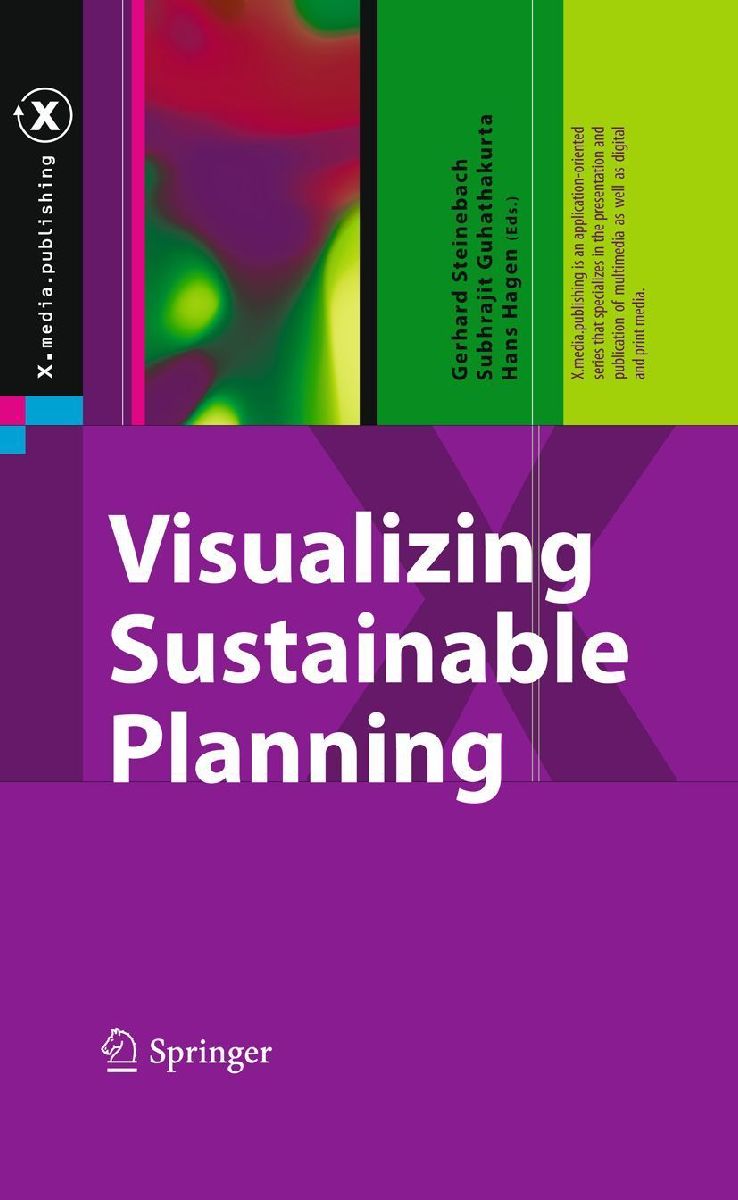
Visualizing Sustainable Planning
von Gerhard Steinebach (Hrsg.)
Herausgegeben von: Gerhard Steinebach, Herausgegeben von: Subhrajit Guhathakurta, Herausgegeben von: Hans Hagen
Aus der Reihe X.media.publishing
- Einband
- Kartoniert
- Seiten
- 276
- Sprache
- Englisch
- Erschienen
- August 2016
- Verlag
- Springer
Buchbeschreibung
we are a part of, the current discussions of global recession in the media alerts us to the occasional perils of the globalized economic system.
The globally dispersed, intricately integrated, and hyper-complex socio-economic-ecological system is d- ficult to analyze, comprehend and communicate without effective visualization tools.
Ganze Beschreibung lesenWeniger anzeigen
Given that planners are at the frontlines in the effort to prepare as well as build res- ience in the impacted communities, appropriate visualization tools are indispensable for effective planning.
Second, planners have largely been slow to incorporate the advances in visuali- tion research emerging from other domains of inquiry. The research on visualizing 3-dimensional environments have now entered the mainstream of computer science with a number of highly cited articles. Other disciplines, such as graphic design, geography and cartography have also lead in the development of new forms of vi- alization and communication, both conceptually and technologically.
In contrast, the literature on modeling and visualization in planning has relied heavily on g- graphic information systems (GIS) tools that continue to provide two-dimensional spatial maps in formats not significantly different from those of a decade ago. This is not to suggest that research on planning support systems and GIS have been stagnant.
Integrated models of transportation-land use-environment have become more sophisticated and several operational models are currently in use. Regardless, visualization research in planning has not kept pace with these developments. This volume attempts to redress this gap in the planning literature.
Inhaltsverzeichnis
- Planning
- Planning Sustainable Living
- Visualizing Planning for a Sustainable World
- GIS-based Applications and the English Planning System: Modeling Town Centers and Housing Potential
- Monitoring the Effective and Efficient Use of Land: The English Approach
- Augmented Reality and Immersive Scenarios in Urban Planning
- Environmental Issues
- Urban Meteorological Modeling
Ganzes Inhaltsverzeichnis anzeigen (20 Einträge)Weniger anzeigen
- Urban Drainage Modeling and Flood Risk Management
- Environmental Noise
- Work-Facilitating Information Visualization Techniques for Complex Wastewater Systems
- Simulation and Visualization of Indoor Acoustics Using Phonon Tracing
- Case Study
- Digital Phoenix Project: A Multidimensional Journey through Time
- PhD-Theses
- Estimating Residential Building Types from Demographic Information at a Neighborhood Scale
- Visualization of Sustainability Indicators: A Conceptual Framework
- Modeling Dynamic Land-Use Transition for Transportation Sustainability
- Sustainable Phoenix: Lessons from the Dutch Model
- Toward Dynamic Real-Time Informative Warning Systems
Details
- Erscheinungstermin
- August 2016
- Kategorie
- Fremdsprachige Bücher
- Einband
- Kartoniert
- Seiten
- 276
- Sprache
- Englisch
- Verlag
- Springer
- Reihe
- X.media.publishing
- Format
- 23,5 × 15,5 cm
- Dicke
- 1,5 cm
- Gewicht
- 473 g
- EAN / ISBN-13
- 9783662518991
Über Gerhard Steinebach (Hrsg.)
Prof. Dr. Hans Hagen:
March 1982: PhD (Mathematics), University of Dortmund1983-1986: Assistant Professor at Arizona State University1986-1988: Professor (C3), TU Braunschweigsince 1988: Professor …
Mehr über Gerhard Steinebach (Hrsg.)Weniger anzeigen
March 1982: PhD (Mathematics), University of Dortmund1983-1986: Assistant Professor at Arizona State University1986-1988: Professor (C3), TU Braunschweigsince 1988: Professor (C4), University of Kaiserslautern Hans Hagen is heading the research group for Computer Graphics and Computer Geometry at University of Kaiserslautern, Germany. He is both national and international a pioneer in his research domains geometric modeling and scientific visualization.
Prof. Dr. Subhrajit Guhathakurta:1987: MCRP, Community and Regional Planning, Iowa State University, Ames, Iowa1991: Ph. D., City and Regional Planning, University of California, Berkeley1992-93: Visiting Assistant Professor of Community and Regional Planning, Iowa State University, Ames1993-94: Research Associate, Center for Real Estate and Urban Economics and Institute of Urban and Regional Development, UC Berkeley1994-2000: Assistant Professor, School of Planning and Landscape Architecture, Arizona State University
Mar-Jun 2000: Visiting Faculty, School of Geographical Sciences and Planning, University of Queensland, Brisbane, Australia
Oct 2000-Jan 2001: Visiting Faculty, Indian Institute of Information Technology, Bangalore, Indiasince 2000: Associate Professor, School of Planning and Landscape Architecture, Arizona State University
Prof. Guhathakurta has developed a keen interest in urban modeling since his involvement with Prof. John Landis at UC Berkeley and the California Urban Futures Modeling effort. Prof. Dr.-Ing. Gerhard Steinebach:1979: Received 'Diploma Spatial and Environmental Planning' (Dipl.-Ing. Raum- und Umweltplanung) at University of Kaiserslautern1979-1987: Research Assistant, University of Kaiserslautern1987: PhD (Dr.-Ing. Raum- und Umweltplanung), University of Kaiserslautern1988-2000: Co-Founder and Managing Director of 'Forschungs- und Informationsgesellschaft der Raum- und Umweltplanung (FIRU)'1997-1999: Visiting Professor, University of Kaiserslautern
Since 1999: Professor (C4), University of Kaiserslautern
Gerhard Steinebach is a recognized expert in his research domains: 'Urban ecology - focusing on the environmental impacts of development', 'Conversion of military and industrial brownfields' and 'Management of planning procedures'.
Versand und Rückgabe
Standardversand: 1 bis 3 Werktage, 3,99 €, kostenlos ab 35 €
Liefergebiet: Deutschland
Rücksendung: 14 Tage Widerrufsrecht. Bei einem Widerruf tragen Sie die Kosten der Rücksendung. Bei einer Falschlieferung oder einem Fehler von uns erstatten wir Ihnen das Rückporto. Den Widerruf erklären Sie über den Knopf „Vertrag widerrufen“ im Fuß der Seite.
Hersteller und ProduktsicherheitSpringer Nature Customer Service Center GmbH
Springer Nature Customer Service Center GmbH
Europaplatz 3
69115 Heidelberg
Deutschland
ProductSafety@springernature.com
Mehr aus der Reihe X.media.publishing




Bewertungen
Zu diesem Titel gibt es noch keine Bewertung. Bewerten kann, wer ihn bei uns gekauft hat.
So prüfen wir Bewertungen
Eine Bewertung kann bei uns nur abgeben, wer den Titel über sein Kundenkonto bei uns gekauft hat. Jede Bewertung ist fest mit der zugehörigen Bestellung verknüpft; anders kommt sie technisch gar nicht zustande. Deshalb trägt jede angezeigte Bewertung den Hinweis „Verifizierter Kauf". Wir zeigen positive wie negative Bewertungen und löschen nur bei Rechtsverstößen. Für Bewertungen gibt es keine Gegenleistung.
129,98 €Voraussichtlich 1. bis 3. Dez.