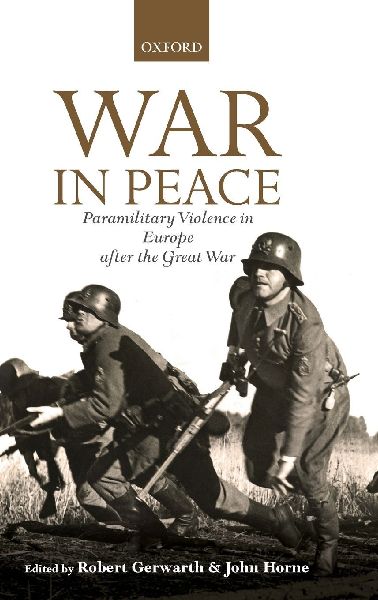
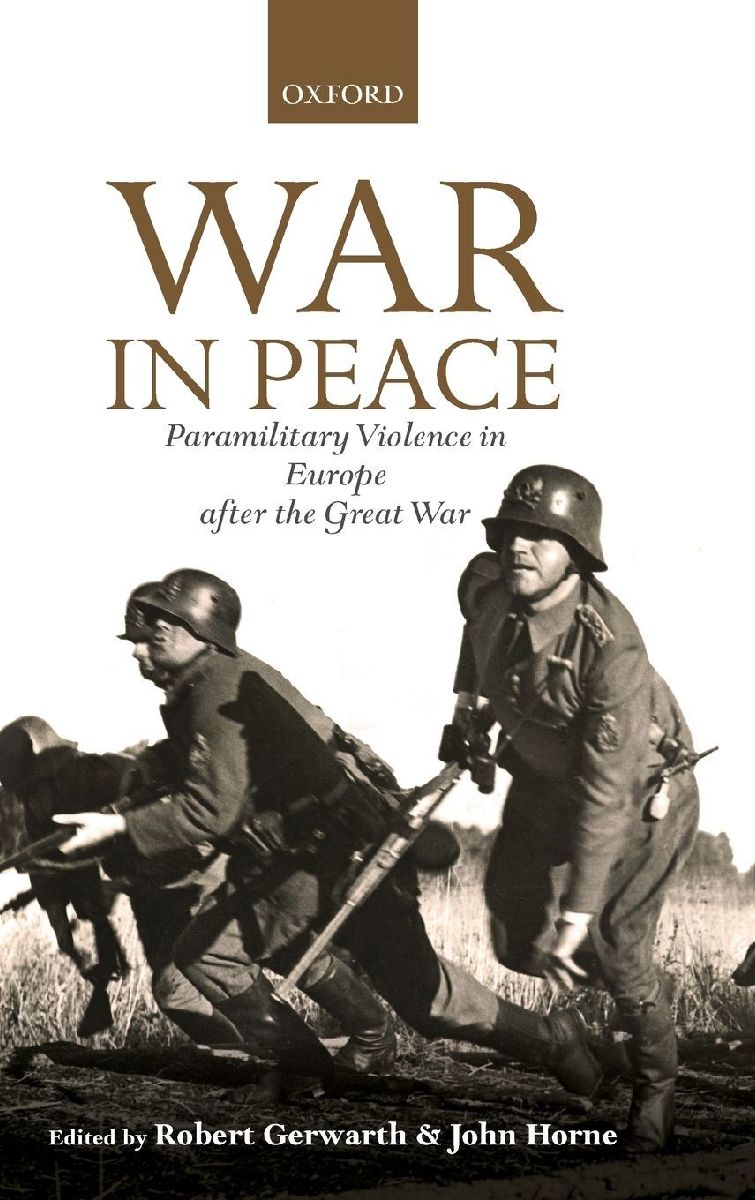
War in Peace
Paramilitary Violence in Europe After the Great War
Herausgegeben von: Robert Gerwarth, Herausgegeben von: John Horne
- Einband
- Gebunden
- Seiten
- 254
- Sprache
- Englisch
- Erschienen
- September 2012
- Verlag
- OUP Oxford
Buchbeschreibung
The First World War did not end in November 1918. In Russia and Eastern Europe it finished up to a year earlier, and both there and elsewhere in Europe it triggered conflicts that lasted down to 1923. Paramilitary formations were prominent in this continuation of the war.
Ganze Beschreibung lesenWeniger anzeigen
They had some features of formal military organizations, but were used in opposition to the regular military as an instrument of revolution or as an adjunct or substitute for military forces when these were unable by themselves to put down a revolution (whether class or national).
Paramilitary violence thus arose in different contexts. It was an important aspect of the violence unleashed by class revolution in Russia. It structured the counter-revolution in central and Eastern Europe, including Finland and Italy, which reacted against a mythic version of Bolshevik class violence in the name of order and authority.
It also shaped the struggles over borders and ethnicity in the new states that replaced the multi-national empires of Russia, Austria-Hungary and Ottoman Turkey. It was prominent on all sides in the wars for Irish independence. In many cases, paramilitary violence was charged with political significance and acquired a long-lasting symbolism and influence.
War in Peace explores the differences and similarities between these various kinds of paramilitary violence within one volume for the first time. It thereby contributes to our understanding of the difficult transitions from war to peace. It also helps to re-situate the Great War in a longer-term context and to explain its enduring impact.
Inhaltsverzeichnis
- 1: Robert Gerwarth and John Horne: Paramilitarism in Europe after the Great War: An Introduction
- Part I: Revolution and Counter-Revolution
- 2: William Rosenberg: Revolution and Counter-Revolution: The Syndrome of Violence in Russia's Civil Wars, 1918-1920
- 3: Robert Gerwarth and John Horne: Bolshevism as Fantasy: Fear of Revolution and Counter-Revolutionary Violence, 1917-23
- 4: Robert Gerwarth: Fighting the Red Beast: Counterrevolutionary Violence in the Defeated States of Central Europe
- 5: Marko Tikka and Pertty Haapala: Revolution, Civil War, and Terror in Finland in 1918
- 6: Emilio Gentile: Paramilitary Violence in Italy: the Rationale of Fascism and the Origins of Totalitarianism
- Part II: Nations, Borderlands, and Ethnic Violence
Ganzes Inhaltsverzeichnis anzeigen (15 Einträge)Weniger anzeigen
- 7: Serhy Yekelchyk: Bands of Nation Builders? Insurgency and Ideology in the Ukrainian Civil War
- 8: Tomas Balkelis: Turning Citizens into Soldiers: Baltic Paramilitary Movements after the Great War
- 9: John Paul Newman: Paramilitary Violence in the Balkans: Origins and Legacies
- 10: Ugur Ümit Üngör: Paramilitary Violence in the Collapsing Ottoman Empire
- 11: Julia Eichenberg: Soldiers to Civilians, Civilians to Soldiers: Poland and Ireland after the First World War
- 12: Anne Dolan: The British Culture of Paramilitary Violence in the Irish War of Independence
- 13: John Horne: Defending Victory: Paramilitary Politics in France, 1918-26. A Counter-example
Details
- Erscheinungstermin
- September 2012
- Kategorie
- Fremdsprachige Bücher
- Einband
- Gebunden
- Seiten
- 254
- Sprache
- Englisch
- Verlag
- OUP Oxford
- Format
- 24,0 × 16,1 cm
- Dicke
- 1,8 cm
- Gewicht
- 499 g
- EAN / ISBN-13
- 9780199654918
Über Robert Gerwarth (Hrsg.)
Robert Gerwarth was born in Berlin and educated at Oxford where he also held a British Academy Postdoctoral Fellowship. He has been Professor of Modern History at University College Dublin and Director of UCD's Centre for War Studies since 2009.
Mehr über Robert Gerwarth (Hrsg.)Weniger anzeigen
He is the author of several monographs and edited books on modern European history, most recently of a biography on Reinhard Heydrich.
John Horne was educated in Australia and Britain, and has taught modern European history for many years at Trinity College Dublin. He has published extensively on French history and on the comparative and transnational history of the Great War. He is a member of the board of the Centre for Research at the Historial de la Grande Guerre, Péronne, a founder member of EurohistXX, the research consortium in contemporary European history, and a member of the Royal Irish Academy.
Versand und Rückgabe
Standardversand: 1 bis 3 Werktage, 3,99 €, kostenlos ab 35 €
Liefergebiet: Deutschland
Rücksendung: 14 Tage Widerrufsrecht. Bei einem Widerruf tragen Sie die Kosten der Rücksendung. Bei einer Falschlieferung oder einem Fehler von uns erstatten wir Ihnen das Rückporto. Den Widerruf erklären Sie über den Knopf „Vertrag widerrufen“ im Fuß der Seite.
Hersteller und ProduktsicherheitOUP Oxford
OUP Oxford
Europaallee 1
36244 Bad Hersfeld
Deutschland
gpsr@libri.de
Verantwortliche Person in der EU
Libri GmbHEuropaallee 1
36244 Bad Hersfeld
Deutschland
gpsr@libri.de
Mehr von Robert Gerwarth
Ähnliche Titel
Bewertungen
Zu diesem Titel gibt es noch keine Bewertung. Bewerten kann, wer ihn bei uns gekauft hat.
So prüfen wir Bewertungen
Eine Bewertung kann bei uns nur abgeben, wer den Titel über sein Kundenkonto bei uns gekauft hat. Jede Bewertung ist fest mit der zugehörigen Bestellung verknüpft; anders kommt sie technisch gar nicht zustande. Deshalb trägt jede angezeigte Bewertung den Hinweis „Verifizierter Kauf". Wir zeigen positive wie negative Bewertungen und löschen nur bei Rechtsverstößen. Für Bewertungen gibt es keine Gegenleistung.
206,50 €Voraussichtlich 4. bis 8. Dez.