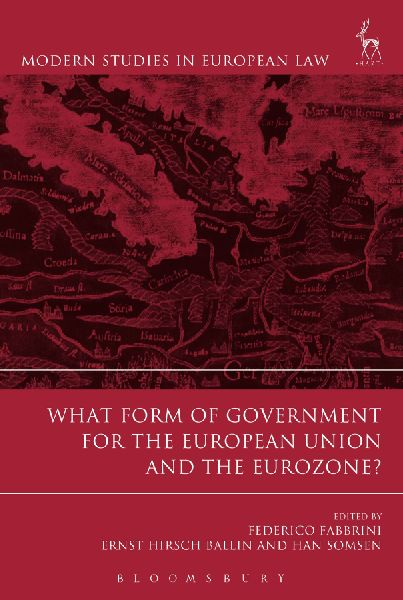
What Form of Government for the European Union and the Eurozone?
Herausgegeben von: Federico Fabbrini, Herausgegeben von: Ernst Hirsch Ballin, Herausgegeben von: Han Somsen
Aus der Reihe Modern Studies in European Law
- Einband
- Kartoniert
- Seiten
- 340
- Sprache
- Englisch
- Erschienen
- April 2017
- Verlag
- Bloomsbury 3PL
Buchbeschreibung
What is the form of government of the European Union (EU)?
And how is the institutional governance of the Eurozone evolving? These questions have become pressing during the last few years. On the one hand, the Euro-crisis and the legal and institutional responses to it have had major implications on the constitutional architecture of the EU and the Eurozone.
Ganze Beschreibung lesenWeniger anzeigen
On the other hand, the May 2014 elections for the European Parliament and the ensuing struggle to form the European Commission have brought to the fore new tensions in the EU political system. The purpose of this book, which brings together the contributions of EU lawyers, comparative constitutional lawyers and political scientists, from all over Europe and the United States, is to offer a new look at the form of government of the EU and the Eurozone and consider its potential for future development.
While offering a plurality of perspectives on the form of government of the EU and the Eurozone, this book emphasises how the Euro-crisis represents a watershed in the process of European integration, makes the case for a more legitimate and effective form of government for the EU and the Eurozone, and identifies possible windows of opportunity for future treaty reforms.
The volume will provide food for thought for scholars, policy-makers and the public at large as they continue debating the most apt form of government for the EU and the Eurozone.
Inhaltsverzeichnis
- 1. Introduction: A New Look at the Form of Government of the European Union and the Eurozone
- Federico Fabbrini, Ernst Hirsch Ballin and Han Somsen
- Part I: The Euro-crisis and Institutional Change
- 2. The Financial Crisis, the EU Institutional Order and Constitutional Responsibility 17
- Paul Craig
- 3. The Governance Framework of the Eurozone and the Need for a Treaty Reform
- Christian Calliess
- 4. Intergovernmentalism and the New Framework of EMU Governance
Ganzes Inhaltsverzeichnis anzeigen (38 Einträge)Weniger anzeigen
- Georgios Maris and Pantelis Sklias
- Part II: The Governance of Economic, Monetary and Financial Affairs
- 5. The Confusion of Tasks in the Decision-Making Process
- of the European Economic Governance
- Alexandre de Streel
- 6. Constitutional Changes in Euro Government and the Relationship Between the ECB and the Executive Power in the Union
- Thomas Beukers
- 7. The Single Supervisory Mechanism: Building the New Top-Down Cooperative Supervisory Governance in Europe
- Gianni LO Schiavo
- Part III: Democracy: Representation, Participation and Accountability
- 8. Is the EU a Representative Democracy ? The Normative Debate and the Impact of the Euro-crisis
- Simona Piattoni
- 9. Participatory Democracy in Europe: Article 11 TEU and the Legitimacy of the European Union
- Christian Marxsen
- 10. Democratic Accountability of EU Executive Power: A Reform Agenda for Parliaments
- Deirdre Curtin
- Part IV: The Parliamentarisation of the EU and its Critics
- 11. Towards a New Constitutional Architecture in the EU?
- R Daniel Kelemen
- 12. Enhancing European Democracy in Times of Crisis? - The Proposal to Politicise the Election of the European Commission's President
- Carlino Antpöhler
- 13. In the Image of State: Constitutional Complexities of Engineering a European Democracy
- Anna Kocharov
- Part V: New Institutional Developments
- 14. New Intergovernmentalism: The European Council and its President
- Uwe Puetter
- 15. Inter-Parliamentary Cooperation and its Challenges:The Case of Economic and Financial Governance
- Valentin Kreilinger
- 16. From Executive Federalism to Executive Government: Current Problems and Future Prospects in the Governance of EMU
- Federico Fabbrini
Details
- Erscheinungstermin
- April 2017
- Kategorie
- Fremdsprachige Bücher
- Einband
- Kartoniert
- Seiten
- 340
- Sprache
- Englisch
- Verlag
- Bloomsbury 3PL
- Reihe
- Modern Studies in European Law
- Format
- 23,4 × 15,6 cm
- Dicke
- 1,8 cm
- Gewicht
- 518 g
- EAN / ISBN-13
- 9781509916566
Über Federico Fabbrini (Hrsg.)
Federico Fabbrini is Associate Professor of European and International Law at the Faculty of Law, University of Copenhagen.
Mehr über Federico Fabbrini (Hrsg.)Weniger anzeigen
Ernst Hirsch Ballin is Professor of Dutch and European Constitutional Law at Tilburg University.
Han Somsen is Professor of European Law at Tilburg University.
Versand und Rückgabe
Standardversand: 1 bis 3 Werktage, 3,99 €, kostenlos ab 35 €
Liefergebiet: Deutschland
Rücksendung: 14 Tage Widerrufsrecht. Bei einem Widerruf tragen Sie die Kosten der Rücksendung. Bei einer Falschlieferung oder einem Fehler von uns erstatten wir Ihnen das Rückporto. Den Widerruf erklären Sie über den Knopf „Vertrag widerrufen“ im Fuß der Seite.
Hersteller und ProduktsicherheitBloomsbury 3PL
Bloomsbury 3PL
Europaallee 1
36244 Bad Hersfeld
Deutschland
gpsr@libri.de
Verantwortliche Person in der EU
Libri GmbHEuropaallee 1
36244 Bad Hersfeld
Deutschland
gpsr@libri.de
Mehr von Federico Fabbrini

Mehr aus der Reihe Modern Studies in European Law

Activating Human and Fundamental Rights Before the European Courts
Elise Muir (Hrsg.)
Gebunden, Englisch
140,00 €
Ähnliche Titel


Bewertungen
Zu diesem Titel gibt es noch keine Bewertung. Bewerten kann, wer ihn bei uns gekauft hat.
So prüfen wir Bewertungen
Eine Bewertung kann bei uns nur abgeben, wer den Titel über sein Kundenkonto bei uns gekauft hat. Jede Bewertung ist fest mit der zugehörigen Bestellung verknüpft; anders kommt sie technisch gar nicht zustande. Deshalb trägt jede angezeigte Bewertung den Hinweis „Verifizierter Kauf". Wir zeigen positive wie negative Bewertungen und löschen nur bei Rechtsverstößen. Für Bewertungen gibt es keine Gegenleistung.
57,50 €Voraussichtlich 3. bis 7. Dez.