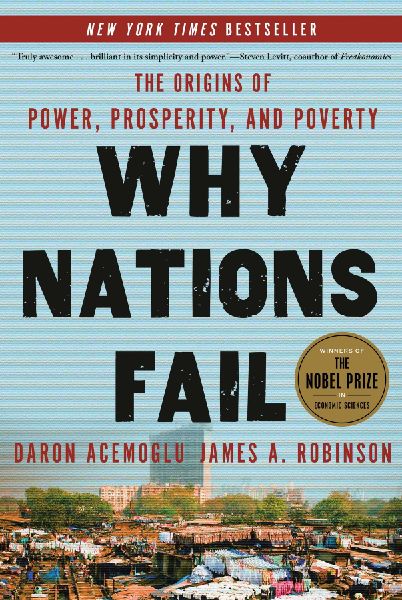
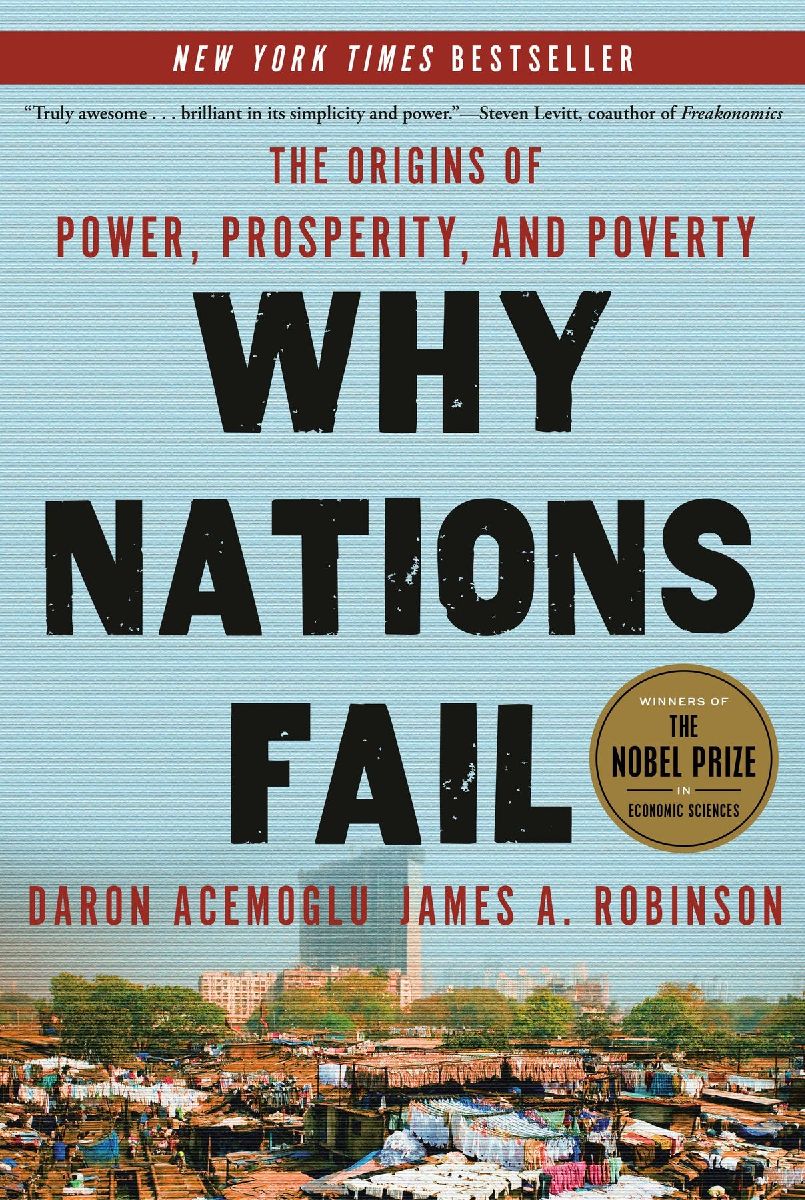
Why Nations Fail
The Origins of Power, Prosperity, and Poverty
von Daron Acemoglu und James A. Robinson
- Einband
- Gebunden
- Seiten
- 544
- Sprache
- Englisch
- Erschienen
- März 2012
- Verlag
- Random House LLC US
Buchbeschreibung
NEW YORK TIMES AND WALL STREET JOURNAL BESTSELLER
From two winners of the 2024 Nobel Prize in Economic Sciences, “who have demonstrated the importance of societal institutions for a country’s prosperity”
FINALIST: Financial Times and Goldman Sachs Business Book of the Year Award
Ganze Beschreibung lesenWeniger anzeigen
ONE OF THE BEST BOOKS OF THE YEAR: The Washington Post, Financial Times, The Economist, BusinessWeek, Bloomberg, The Christian Science Monitor, The Plain Dealer
Why are some nations rich and others poor, divided by wealth and poverty, health and sickness, food and famine? Is it culture, the weather, or geography that determines prosperity or poverty? As Why Nations Fail shows, none of these factors is either definitive or destiny.
Drawing on fifteen years of original research, Daron Acemoglu and James Robinson conclusively show that it is our man-made political and economic institutions that underlie economic success (or the lack of it). Korea, to take just one example, is a remarkably homogenous nation, yet the people of North Korea are among the poorest on earth while their brothers and sisters in South Korea are among the richest.
The differences between the Koreas is due to the politics that created those two different institutional trajectories. Acemoglu and Robinson marshal extraordinary historical evidence from the Roman Empire, the Mayan city-states, the Soviet Union, the United States, and Africa to build a new theory of political economy with great relevance for the big questions of today, among them:
- Will China’s economy continue to grow at such a high speed and ultimately overwhelm the West?
- Are America’s best days behind it? Are we creating a vicious cycle that enriches and empowers a small minority?
Pressestimmen
“A wildly ambitious work that hopscotches through history and around the world to answer the very big question of why some countries get rich and others don’t.”
“This book will change the way people think about the wealth and poverty of nations … as ambitious as Jared Diamond’s Guns, Germs, and Steel.”
Inhaltsverzeichnis
- Preface
- Why Egyptians filled Tahrir Square to bring down Hosni Mubarak
- and what it means for our understanding of the causes of
- prosperity and poverty
- 1. So Close and Yet So Different
- Nogales, Arizona, and Nogales, Sonora, have the same people
- culture, and geography. Why is one rich and one poor?
- 2. Theories That Don’t Work
Ganzes Inhaltsverzeichnis anzeigen (52 Einträge)Weniger anzeigen
- Poor countries are poor not because of their geographies or cultures
- or because their leaders do not know which policies will enrich
- their citizens
- 3. The Making of Prosperity and Poverty
- How prosperity and poverty are determined by the incentives
- created by institutions, and how politics determines what
- institutions a nation has
- 4. Small Differences and Critical Junctures: The Weight of History
- How institutions change through political conflict and how
- the past shapes the present
- 5. “I’ve Seen the Future, and It Works”: Growth Under Extractive Institutions
- What Stalin, King Shyaam, the Neolithic Revolution, and the
- Maya city-states all had in common and how this explains why
- China’s current economic growth cannot last
- 6. Drifting Apart
- How institutions evolve over time, often slowly drifting apart
- 7. The Turning Point
- How a political revolution in 1688 changed institutions in
- England and led to the Industrial Revolution
- 8. Not on Our Turf: Barriers to Development
- Why the politically powerful in many nations opposed the
- Industrial Revolution
- 9. Reversing Development
- How European colonialism impoverished large parts of the world
- 10. The Diffusion of Prosperity
- How some parts of the world took different paths to prosperity
- from that of Britain
- 11. The Virtuous Circle
- How institutions that encourage prosperity create positive feedback
- 12. The Vicious Circle
- How institutions that create poverty generate negative
- feedback loops and endure
- 13. Why Nations Fail Today
- Institutions, institutions, institutions
- 14. Breaking the Mold
- How a few countries changed their economic trajectory by
- changing their institutions
- 15. Understanding Prosperity and Poverty
- How the world could have been different and how understanding
- this can explain why most attempts to combat poverty have failed
- Acknowledgments
- Bibliographical Essay and Sources
- References
- Index
Details
- Erscheinungstermin
- März 2012
- Kategorie
- Fremdsprachige Bücher
- Einband
- Gebunden
- Seiten
- 544
- Sprache
- Englisch
- Verlag
- Random House LLC US
- Format
- 23,9 × 17,2 cm
- Dicke
- 4,7 cm
- Gewicht
- 784 g
- EAN / ISBN-13
- 9780307719218
Über Daron Acemoglu
Daron Acemoglu is the Killian Professor of Economics at MIT. In 2005 he received the John Bates Clark Medal awarded to economists under forty judged to have made the most significant contribution to economic thought and knowledge.
Mehr über Daron AcemogluWeniger anzeigen
He is also the co-author of The Narrow Corridor: States, Societies, and the Fate of Liberty.
James A. Robinson, a political scientist and an economist, is the David Florence Professor of Government at Harvard University. A world-renowned expert on Latin America and Africa, he has worked in Botswana, Mauritius, Sierra Leone, and South Africa. He is also the co-author of The Narrow Corridor: States, Societies, and the Fate of Liberty.
Versand und Rückgabe
Standardversand: 1 bis 3 Werktage, 3,99 €, kostenlos ab 35 €
Versandbeginn: in der Regel am selben oder am nächsten Werktag
Liefergebiet: Deutschland
Rücksendung: 14 Tage Widerrufsrecht. Bei einem Widerruf tragen Sie die Kosten der Rücksendung. Bei einer Falschlieferung oder einem Fehler von uns erstatten wir Ihnen das Rückporto. Den Widerruf erklären Sie über den Knopf „Vertrag widerrufen“ im Fuß der Seite.
Hersteller und ProduktsicherheitRandom House LLC US
Random House LLC US
Europaallee 1
36244 Bad Hersfeld
Deutschland
gpsr@libri.de
Verantwortliche Person in der EU
Libri GmbHEuropaallee 1
36244 Bad Hersfeld
Deutschland
gpsr@libri.de
Mehr von Daron Acemoglu



Bewertungen
Zu diesem Titel gibt es noch keine Bewertung. Bewerten kann, wer ihn bei uns gekauft hat.
So prüfen wir Bewertungen
Eine Bewertung kann bei uns nur abgeben, wer den Titel über sein Kundenkonto bei uns gekauft hat. Jede Bewertung ist fest mit der zugehörigen Bestellung verknüpft; anders kommt sie technisch gar nicht zustande. Deshalb trägt jede angezeigte Bewertung den Hinweis „Verifizierter Kauf". Wir zeigen positive wie negative Bewertungen und löschen nur bei Rechtsverstößen. Für Bewertungen gibt es keine Gegenleistung.
33,00 €Voraussichtlich 27. Nov. bis 1. Dez.