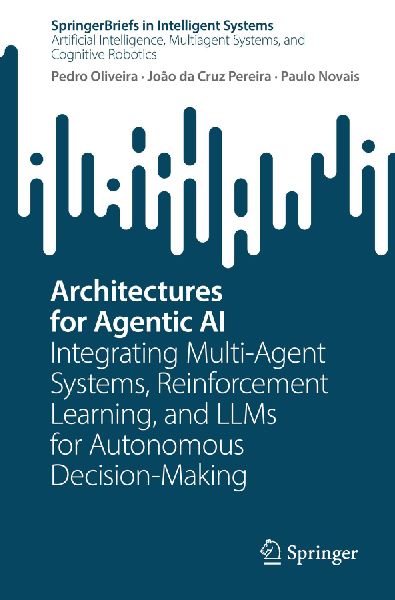
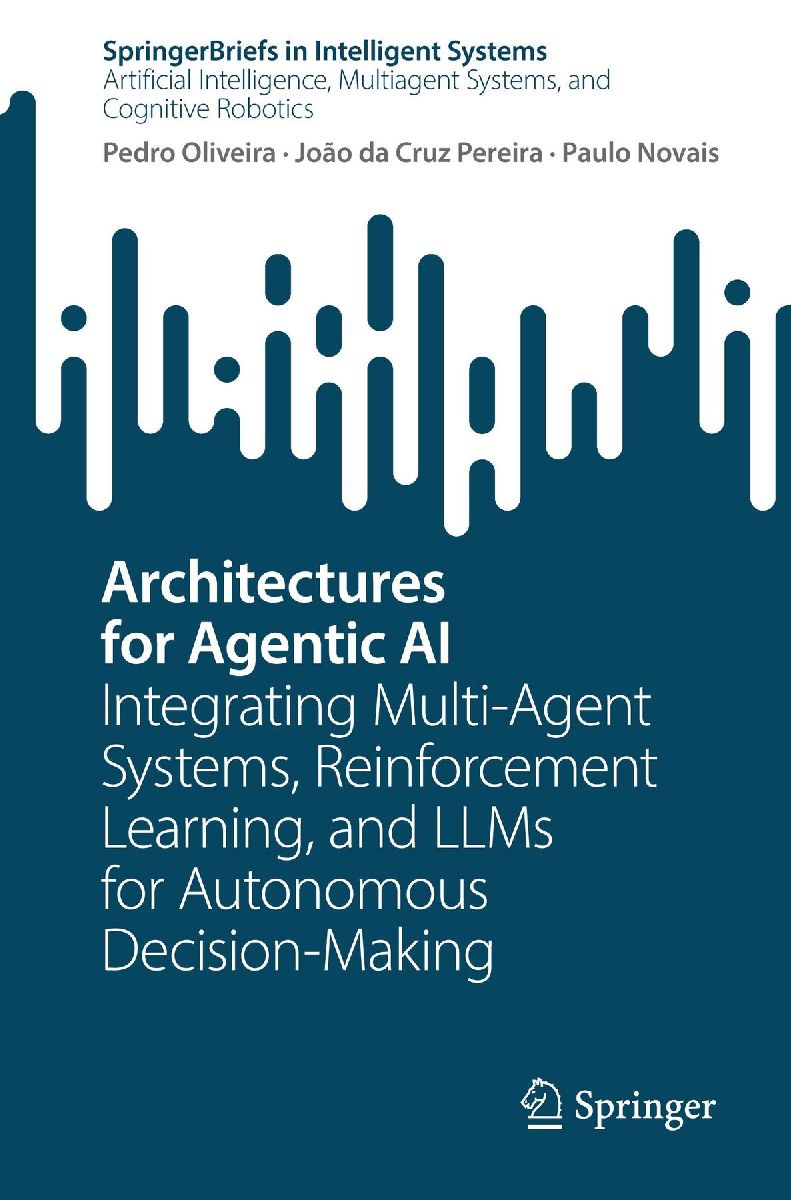
Architectures for Agentic AI
Integrating Multi-Agent Systems, Reinforcement Learning, and LLMs for Autonomous Decision-Making
von Pedro Oliveira, João Da Cruz Pereira und Paulo Novais
Aus der Reihe SpringerBriefs in Intelligent Systems
- Einband
- Kartoniert
- Seiten
- 112
- Sprache
- Englisch
- Erschienen
- Mai 2026
- Verlag
- Springer
Buchbeschreibung
This book explores the emerging paradigm of Agentic AI, where Large Language Models (LLMs) and Reinforcement Learning (RL) converge to create intelligent, autonomous, and adaptive systems.
It provides a unified theoretical foundation and connects it to practical implementation, offering readers a clear path from concept to execution. It will also provide an integrative approach of Agentic AI, Large Language Models, and Reinforcement Learning.
Ganze Beschreibung lesenWeniger anzeigen
While these topics are often studied separately, this book provides a coherent framework that unites them, filling a critical gap between AI theory, system design, and real-world application.
In an era of rapidly evolving AI technologies, understanding how Agentic AI systems operate, and how they differ from traditional AI, is essential. This book guides researchers, engineers, and AI practitioners through the architectural principles that empower agents to reason, cooperate, and learn from feedback.
It further demonstrates how RL can fine-tune LLMs to produce more focused, context-aware outputs, strengthening their role in multi-agent collaboration and autonomous decision-making. The content unfolds from the evolution of AI to Agentic AI, covering architectural design, learning mechanisms, and integration strategies for LLMs and RL.
A real-world case study anchors the theory in practice, illustrating how these technologies can be combined to build interpretable systems. Readers will discover adaptive orchestration strategies, methods for enhancing model interpretability, and design templates for developing intelligent agent ecosystems.
By the end, readers will not only understand the inner workings of Agentic AI but also gain the tools to design and implement their own agent-based frameworks. A working knowledge of Python is recommended to fully engage with the practical aspects.
Inhaltsverzeichnis
- Foreword
- Preface
- Acknowledgements
- Contents
- Acronyms
- 1. From Classical AI to Agentic Intelligence
- 2. Theoretical Foundations of Agentic AI
- 3. Architectural Design Principles
Ganzes Inhaltsverzeichnis anzeigen (12 Einträge)Weniger anzeigen
- 4. Language-Based Interpretability in Agentic Systems
- 5. Learning and Adaptation in Agentic AI
- 6. Practical Application of the Case Study
- 7. Conclusion
Details
- Erscheinungstermin
- Mai 2026
- Kategorie
- Fremdsprachige Bücher
- Einband
- Kartoniert
- Seiten
- 112
- Sprache
- Englisch
- Verlag
- Springer
- Reihe
- SpringerBriefs in Intelligent Systems
- Format
- 23,5 × 15,5 cm
- Dicke
- 0,7 cm
- Gewicht
- 184 g
- EAN / ISBN-13
- 9783032247803
Versand und Rückgabe
Standardversand: 1 bis 3 Werktage, 3,99 €, kostenlos ab 35 €
Liefergebiet: Deutschland
Rücksendung: 14 Tage Widerrufsrecht. Bei einem Widerruf tragen Sie die Kosten der Rücksendung. Bei einer Falschlieferung oder einem Fehler von uns erstatten wir Ihnen das Rückporto. Den Widerruf erklären Sie über den Knopf „Vertrag widerrufen“ im Fuß der Seite.
Hersteller und ProduktsicherheitSpringer Nature Customer Service Center GmbH
Springer Nature Customer Service Center GmbH
Europaplatz 3
69115 Heidelberg
Deutschland
ProductSafety@springernature.com
Mehr aus der Reihe SpringerBriefs in Intelligent Systems

Ähnliche Titel

Bewertungen
Zu diesem Titel gibt es noch keine Bewertung. Bewerten kann, wer ihn bei uns gekauft hat.
So prüfen wir Bewertungen
Eine Bewertung kann bei uns nur abgeben, wer den Titel über sein Kundenkonto bei uns gekauft hat. Jede Bewertung ist fest mit der zugehörigen Bestellung verknüpft; anders kommt sie technisch gar nicht zustande. Deshalb trägt jede angezeigte Bewertung den Hinweis „Verifizierter Kauf". Wir zeigen positive wie negative Bewertungen und löschen nur bei Rechtsverstößen. Für Bewertungen gibt es keine Gegenleistung.
53,49 €Voraussichtlich 1. bis 3. Dez.