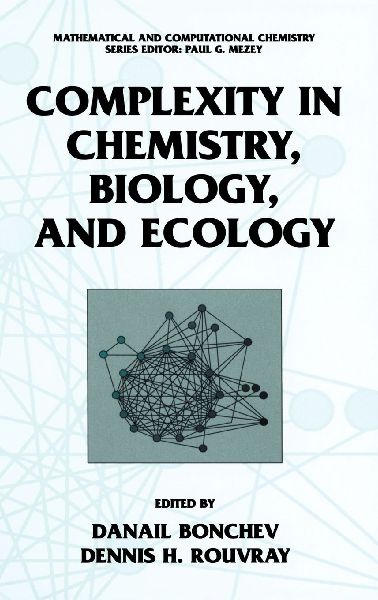
Complexity in Chemistry, Biology, and Ecology
Herausgegeben von: Danail D. Bonchev, Herausgegeben von: Dennis Rouvray
Aus der Reihe Mathematical and Computational Chemistry
- Einband
- Gebunden
- Seiten
- 372
- Sprache
- Englisch
- Erschienen
- Oktober 2005
- Verlag
- Springer
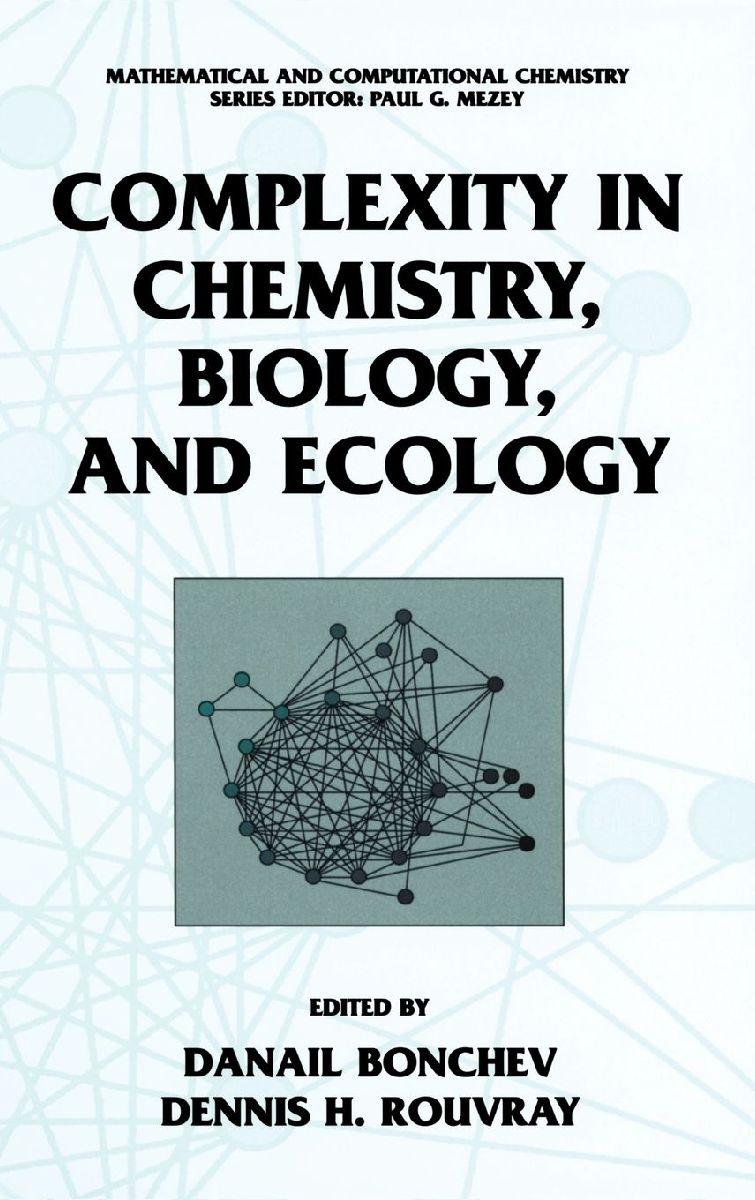
Buchbeschreibung
As we were at pains to point out in the companion volume to this mo- graph, entitled Complexity in Chemistry: Introduction and Fundamentals, complexity is to be encountered just about everywhere.
All that is needed forustoseeitisasuitablytrainedeyeanditthenappearsalmostmagically in all manner of guises. Because of its ubiquity, complexity has been and currentlystillisbeingde?nedinanumberofdifferentways.
Ganze Beschreibung lesenWeniger anzeigen
Someofthese de?nitions have led us to major and powerful new insights. Thus, even in the present monograph, the important distinction is drawn between the - terpretations of the concepts of complexity and complication and this is shown to have a signi?cant bearing on how systems are modeled.
Having said this, however, we should not fail to mention that the broad consensus that now gained acceptance is that all of the de?nitions of complexity are in the last analysis to be understood in essentially intuitive terms. Such de?nitions will therefore always have a certain degree of fuzziness as- ciated with them.
But this latter desideratum should in no way be viewed as diminishing the great usefulness of the concept in any of the many scienti?c disciplines to which it can be applied. In the chapters that are included in this monograph the fact that differing concepts of complexity can be utilized in a variety of disciplines is made explicit.
The speci?c d- ciplines that we embrace herein are chemistry, biochemistry, biology, and ecology. Chapter 1, "On the Complexity of Fullerenes and Nanotubes," is wr- ten by an international team of scientists led by Milan Randic.
Inhaltsverzeichnis
- On the Complexity of Fullerenes and Nanotubes
- Complexity and Self-Organization in Biological Development and Evolution
- The Circle That Never Ends: Can Complexity be Made Simple?
- Graphs as Models of Large-Scale Biochemical Organization
- Quantitative Measures of Network Complexity
- Cellular Automata Models of Complex Biochemical Systems
- The Complex Nature of Ecodynamics
Details
- Erscheinungstermin
- Oktober 2005
- Kategorie
- Fremdsprachige Bücher
- Einband
- Gebunden
- Seiten
- 372
- Sprache
- Englisch
- Verlag
- Springer
- Reihe
- Mathematical and Computational Chemistry
- Format
- 24,1 × 16,0 cm
- Dicke
- 2,5 cm
- Gewicht
- 671 g
- EAN / ISBN-13
- 9780387232645
Versand und Rückgabe
Standardversand: 1 bis 3 Werktage, 3,99 €, kostenlos ab 35 €
Liefergebiet: Deutschland
Rücksendung: 14 Tage Widerrufsrecht. Bei einem Widerruf tragen Sie die Kosten der Rücksendung. Bei einer Falschlieferung oder einem Fehler von uns erstatten wir Ihnen das Rückporto. Den Widerruf erklären Sie über den Knopf „Vertrag widerrufen“ im Fuß der Seite.
Hersteller und ProduktsicherheitSpringer Nature Customer Service Center GmbH
Springer Nature Customer Service Center GmbH
Europaplatz 3
69115 Heidelberg
Deutschland
ProductSafety@springernature.com
Mehr aus der Reihe Mathematical and Computational Chemistry

Simple Theorems, Proofs, and Derivations in Quantum Chemistry
Istvan Mayer
Kartoniert, Englisch, 2 Ausgaben
ab 213,99 €

Fundamentals of Molecular Similarity
Ramon Carbó-Dorca (Hrsg.)
Gebunden, Englisch, 2 Ausgaben
ab 106,99 €

Many-Electron Densities and Reduced Density Matrices
Jerzy Cioslowski (Hrsg.)
Gebunden, Englisch, 2 Ausgaben
ab 106,99 €
Bewertungen
Zu diesem Titel gibt es noch keine Bewertung. Bewerten kann, wer ihn bei uns gekauft hat.
So prüfen wir Bewertungen
Eine Bewertung kann bei uns nur abgeben, wer den Titel über sein Kundenkonto bei uns gekauft hat. Jede Bewertung ist fest mit der zugehörigen Bestellung verknüpft; anders kommt sie technisch gar nicht zustande. Deshalb trägt jede angezeigte Bewertung den Hinweis „Verifizierter Kauf". Wir zeigen positive wie negative Bewertungen und löschen nur bei Rechtsverstößen. Für Bewertungen gibt es keine Gegenleistung.
106,99 €Voraussichtlich 4. bis 8. Dez.