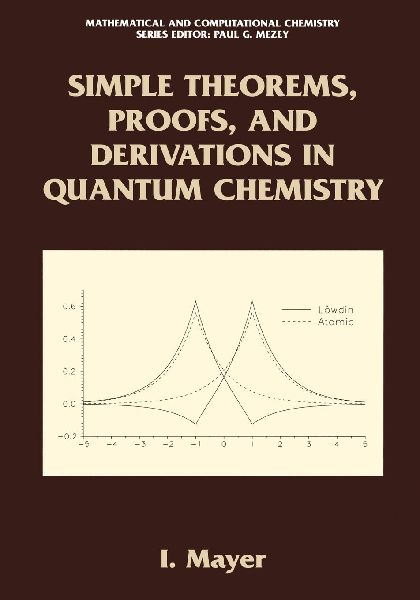
Simple Theorems, Proofs, and Derivations in Quantum Chemistry
von Istvan Mayer
Aus der Reihe Mathematical and Computational Chemistry
- Einband
- Kartoniert
- Seiten
- 352
- Sprache
- Englisch
- Erschienen
- Dezember 2010
- Verlag
- Springer
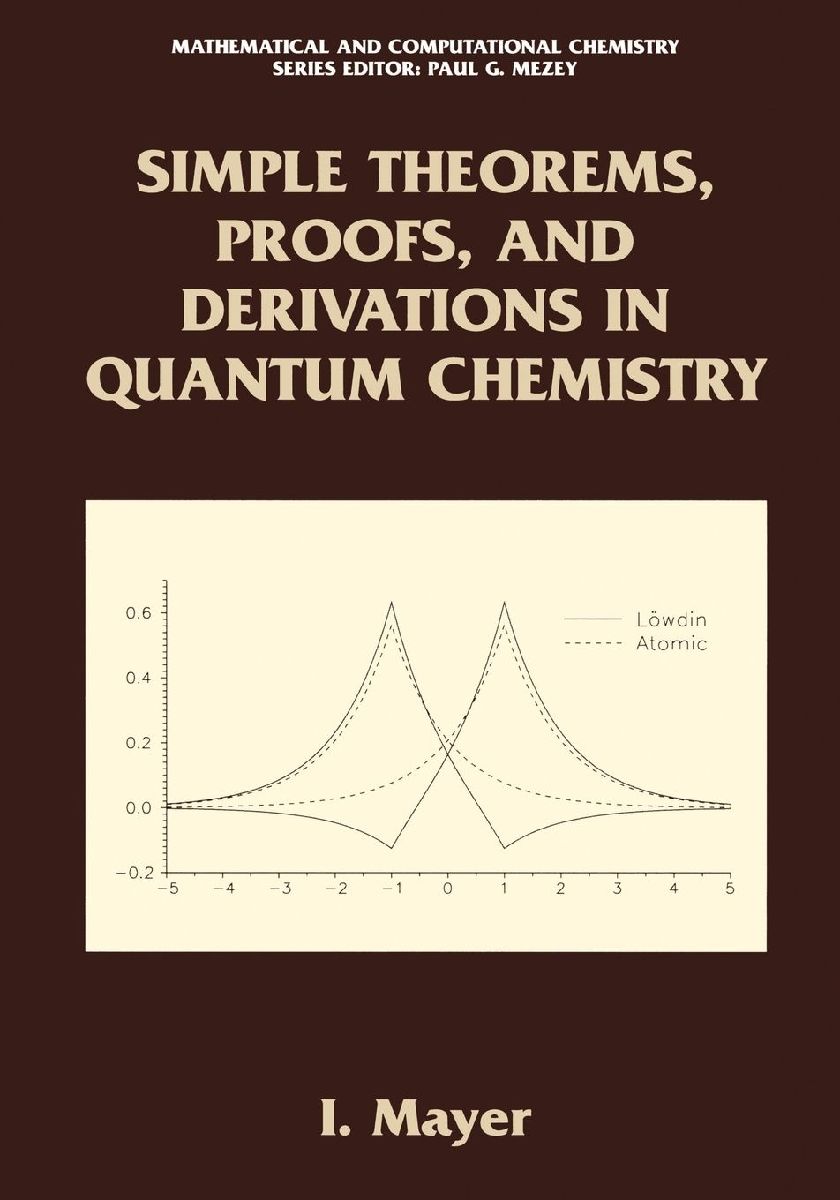
Buchbeschreibung
Since 1983 I have been delivering lectures at Budapest University that are mainly attended by chemistry students who have already studied quantum chem istry in the amount required by the (undergraduate) chemistry curriculum of the University, and wish to acquire deeper insight in the field, possibly in prepara tion of a master's or Ph. D. thesis in theoretical chemistry.
Ganze Beschreibung lesenWeniger anzeigen
In such a situation, I have the freedom to discuss, in detail, a limited number of topics which I feel are important for one reason or another. The exact coverage may vary from year to year, but I usually concentrate on the general principles and theorems and other basic theoretical results which I foresee will retain their importance despite the rapid development of quantum chemistry.
I commonly organize my lectures by treating the subject from the begin ning, without referring explicitly to any actual previous knowledge in quantum chemistry-only some familiarity with its goals, approaches and, to a lesser ex tent, techniques is supposed. I concentrate on the formulae and their derivation, assuming the audience essentially understands the reasons for deriving these results.
This book is basically derived from the material of my lectures. The spe cial feature, distinguishing it from most other textbooks, is that all results are explicitly proved or derived, and the derivations are presented completely, step by step. True understanding of a theoretical result can be achieved only if one has gone through its derivation.
Inhaltsverzeichnis
- I. The Born-Oppenheimer Hamiltonian
- 1. Separating the center of mass motion in quantum mechanics
- 1.1. Reducing the two-body problem to two one-body ones
- 1.2. The center of mass in quantum mechanics 1.3. Free atoms and atomcules
- 2. The Born--Oppenheimer approximation
- 2.1. Introductory remarks
- 2.2. The Born-Oppenheimer separation
- 2.3. Why the Born-Oppenheimer separation is not exact? 2.4. Approximate decoupling
Ganzes Inhaltsverzeichnis anzeigen (61 Einträge)Weniger anzeigen
- 2.5. A note on the Born-Oppenheimer separation
- II. General Theorems And Principles
- 1. The variation principle
- 1.1. The Rayleigh quotient
- 1.2. The variation principle for the ground state
- 1.3. The variation principle as an equivalent of the Schrodinger equation: a useful formulation of the variation principle
- 1.4. Eckart's inequality
- 1.5. Excited states
- 2. The Hellmann - Feynman theorem
- 2.1. The differential Hellmann - Feynman theorem
- 2.2. The integral Hellmann -Feynman theorem
- 3. The virial theorem in quantum mechanics
- 3.1. Time dependence of a physical quantity
- 3.2. The virial theorem
- 3.3. Scaling - a connection with the variation principle
- 3.4. The virial theorem in the Born-Oppenheimer approximation
- 3.5. The virial theorem and the chemical bonding
- III. The Linear Variational Method And Lowdin's Orthogonalization Schemes
- 1. The linear variational method (Ritz -method) 2. Lowdin's symmetric orthogonalization
- 2.1. Matrix SAND-1/
- 2. 2.2. The S¿-1/2 transformation
- 2.3. The Lowdin basis
- 2.4. The stationary property of Lowdin's symmetric orthogonalization scheme
- 2.5. Lowdin-orthogonalization: a two-dimensional example
- 3. Linear independence of the basis and Lowdin's canonic orthogonalization
- 3.1. Eigenvalues of the overlap matrix: a measure for the linear
- 3.2. Lowdin's canonic orthogonalization
- IV. Perturbational Methods
- 1. Non-degenerate Rayleigh-Schrodinger perturbation theory
- 1.1. The problem
- 1.2. `Algebraic' expansion
- 1.3. The use of the reduced resolvent in the Rayleigh-Schrodinger perturbation theory
- 1.4. Wigner's 2n+1 theorem
- 2. Variational-perturbational method: the Hylleraas-functional.3
- Degenerate Rayleigh-Schrodinger perturbation theory
- 4. Brillouin-Wigner perturbation theory
- 4.1. The size-consistency problem
- 5. Size consistency of the Rayleigh-Schrodinger perturbation
- 5.1. Formal considerations based on the properties of power series
- 5.2. Size consistency of the perturbational expansions
- 6. Lowdin's partitioning method
- V. Determinant Wave Functions
- 1. Spin-orbitals
- 2. Many-electron spin states
- 3. Slater determinants
- 3.1. Two-electron examples
- 4. The antisymmetrizing operator
- 4.1. The projection character of the antisymmetrizing operator
- 4.2. Commutation properties of the antisymmetrizing operator
- 5. Invariance of the determinant wave function with respect of. 6. Matrix elements between determinant wave functions
- 6.1. Overlap
- 6.2. One-electron operators
- 6.3.
Details
- Erscheinungstermin
- Dezember 2010
- Kategorie
- Fremdsprachige Bücher
- Einband
- Kartoniert
- Seiten
- 352
- Sprache
- Englisch
- Verlag
- Springer
- Reihe
- Mathematical and Computational Chemistry
- Format
- 25,4 × 17,8 cm
- Dicke
- 2,0 cm
- Gewicht
- 663 g
- EAN / ISBN-13
- 9781441933898
Versand und Rückgabe
Standardversand: 1 bis 3 Werktage, 3,99 €, kostenlos ab 35 €
Liefergebiet: Deutschland
Rücksendung: 14 Tage Widerrufsrecht. Bei einem Widerruf tragen Sie die Kosten der Rücksendung. Bei einer Falschlieferung oder einem Fehler von uns erstatten wir Ihnen das Rückporto. Den Widerruf erklären Sie über den Knopf „Vertrag widerrufen“ im Fuß der Seite.
Hersteller und ProduktsicherheitSpringer Nature Customer Service Center GmbH
Springer Nature Customer Service Center GmbH
Europaplatz 3
69115 Heidelberg
Deutschland
ProductSafety@springernature.com
Mehr aus der Reihe Mathematical and Computational Chemistry
Complexity in Chemistry, Biology, and Ecology
Danail D. Bonchev (Hrsg.)
Gebunden, Englisch, 2 Ausgaben
ab 106,99 €

Fundamentals of Molecular Similarity
Ramon Carbó-Dorca (Hrsg.)
Gebunden, Englisch, 2 Ausgaben
ab 106,99 €

Many-Electron Densities and Reduced Density Matrices
Jerzy Cioslowski (Hrsg.)
Gebunden, Englisch, 2 Ausgaben
ab 106,99 €
Ähnliche Titel



Topics in the Theory of Chemical and Physical Systems
Jean Maruani (Hrsg.)
Gebunden, Englisch, 2 Ausgaben
ab 160,49 €
Bewertungen
Zu diesem Titel gibt es noch keine Bewertung. Bewerten kann, wer ihn bei uns gekauft hat.
So prüfen wir Bewertungen
Eine Bewertung kann bei uns nur abgeben, wer den Titel über sein Kundenkonto bei uns gekauft hat. Jede Bewertung ist fest mit der zugehörigen Bestellung verknüpft; anders kommt sie technisch gar nicht zustande. Deshalb trägt jede angezeigte Bewertung den Hinweis „Verifizierter Kauf". Wir zeigen positive wie negative Bewertungen und löschen nur bei Rechtsverstößen. Für Bewertungen gibt es keine Gegenleistung.
213,99 €Voraussichtlich 1. bis 3. Dez.