
Buch-OWLOnline-Buchhandel

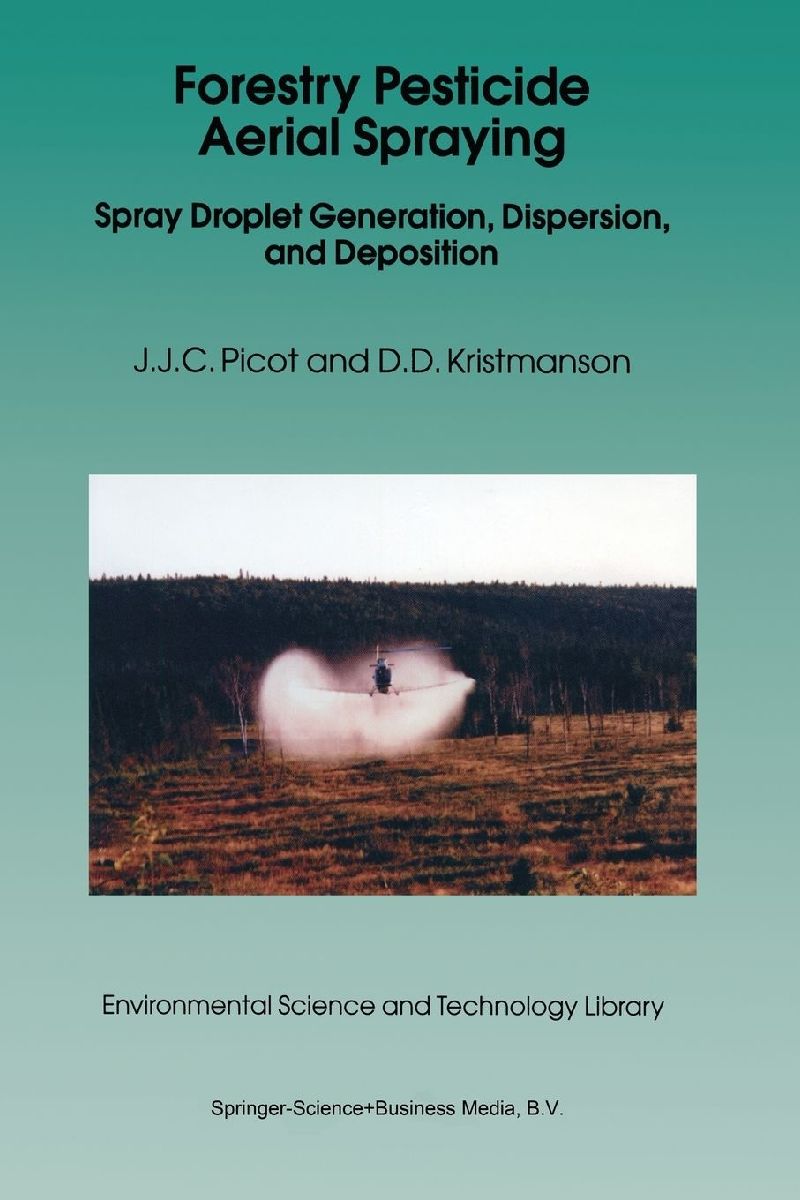
Forestry Pesticide Aerial Spraying

Spray Droplet Generation, Dispersion, and Deposition

von J. J. Picot und D. D. Kristmanson

Aus der Reihe Environmental Science and Technology Library

Einband
Kartoniert
Seiten
232
Sprache
Englisch
Erschienen
Oktober 2012
Verlag
Springer

Buchbeschreibung

Introduced to the technical aspects of forestry aerial spraying in the mid-1970's, we were immediately impressed by the complexity of the process of delivering pesticide to foliage.

At that time, there was a vigorous public debate in New Brunswick about the ecological and public h~alth impacts of the annual spray program for the control of defoliation of spruce and fir trees by the spruce budworm.

Ganze Beschreibung lesenWeniger anzeigen

The forest industry is important to the province and changes to the established procedures of budworm control could have major economic implications.

A rational debate required reliable information about the mechanics of the spraying process. There was a need to supply missing information as to required pesticide application rates, atomizer performance, off-target drift and deposit, and the effects of weather and aircraft operating factors. We were invited to initiate a research program in this domain by New Brunswick forest management officials, and what follows in this book is a logical and quantitative description of the overall process based on our own research and that of others over the intervening years.

After a short introduction to aerial spraying, we begin (Chapter 2) by describing forest stands in terms of their interaction with suspended atmospheric particulate material carried along by the wind and susceptible to deposition on foliage. We introduce foliage simulators and their use in measuring the deposit of sprayed pesticide on foliage, the "biological interface" between pest and pesticide.

Inhaltsverzeichnis

  • 1 Introduction
  • 1.1 Historical Perspective
  • 1.2 Scope and Orientation of Text
  • 2 Characterizing Forest Stands
  • 2.1 Foliage Density and Vertical Distribution
  • 2.2 Forest Micrometeorology
  • 2.3 Foliage as Filter for Atmospheric Particulates
  • 2.4 Foliage Simulators
Ganzes Inhaltsverzeichnis anzeigen (52 Einträge)Weniger anzeigen
  • 2.5 Importance of Properly Defining the Biological Interface
  • 3 Properties of Spray Formulations
  • 3.1 Biological Toxic Requirement and Droplet Size
  • 3.2 Effects of Viscosity, Surface Tension, and Volatility
  • 3.3 Summary
  • 4 Spray Aircraft and Atomizers
  • 4.1 Aircraft in Use
  • 4.2 Aircraft Wake Behaviour
  • 4.3 Droplet Generation and Atomizer Types
  • 4.4 Atomizer Characterization Methods
  • 4.5 Atomizer Droplet Spectrum Data
  • 4.6 Correlations for Atomizer Emission Characteristics
  • 4.7 Dry Material Dispensing Devices
  • 5 Research Field Trials
  • 5.1 Introduction
  • 5.2 Measurements and Analytical Methods
  • 5.3 The Mass Balance Test as a Measure of Accuracy In Field Trials
  • 5.4 Experimental Design, Management, and Costs
  • 6 Modeling Spray Application, Dispersion, and Deposition
  • 6.1 Introduction
  • 6.2 Details of the PKBW model
  • 6.3 Model Validations and Comparisons: PKBW Model
  • 6.4 Off-target Drift and Buffer Zone Estimation
  • 6.5 Simulation of Block Spraying, PKBW Model
  • 7 Spraying in Complex Terrain
  • 7.1 Introduction
  • 7.2 Air flows in Well-defined Mountain Valleys
  • 7.3 Implications with Respect to Pesticide Spraying
  • 7.4 Predicting Pesticide Dispersion and Deposition in Valleys
  • 7.5 Comment
  • 8 Spraying Innovations
  • 8.1 Introduction
  • 8.2 Drop Size Optimization
  • 8.3 Field Trials for Dose Efficacy Measurements
  • 8.4 Aircraft Navigation and Data Logging
  • 8.5 Investigating Possible Improvements in Application Methods with PKBW
  • 9 Pesticides and Government Regulations
  • 9.1 Introduction
  • 9.2 Federal and Provincial Regulations in Canada
  • 9.3 Specific Excerpts from FIFRA
  • 9.4 The Training of Pesticide Applicators and the Inspection of Application Equipment
  • Appendix I Spray Efficacy Research Group (Serg)
  • Appendix II Atomizer Charact Erization Data
  • Appendix III Details of Agdisp, Fscbg, and Pkbw Models

Details

Erscheinungstermin
Oktober 2012
Kategorie
Fremdsprachige Bücher
Einband
Kartoniert
Seiten
232
Sprache
Englisch
Verlag
Springer
Reihe
Environmental Science and Technology Library
Format
24,0 × 16,0 cm
Dicke
1,3 cm
Gewicht
378 g
EAN / ISBN-13
9789401063753
Maßstabsgetreu: Deckel und Buchrücken neben einer Hand (18 cm).
Versand und Rückgabe

Standardversand: 1 bis 3 Werktage, 3,99 €, kostenlos ab 35 €

Liefergebiet: Deutschland

Rücksendung: 14 Tage Widerrufsrecht. Bei einem Widerruf tragen Sie die Kosten der Rücksendung. Bei einer Falschlieferung oder einem Fehler von uns erstatten wir Ihnen das Rückporto. Den Widerruf erklären Sie über den Knopf „Vertrag widerrufen“ im Fuß der Seite.

Hersteller und ProduktsicherheitSpringer Nature Customer Service Center GmbH
Springer Nature Customer Service Center GmbH
Europaplatz 3
69115 Heidelberg
Deutschland
ProductSafety@springernature.com

Mehr aus der Reihe Environmental Science and Technology Library

Ähnliche Titel

Bewertungen

Zu diesem Titel gibt es noch keine Bewertung. Bewerten kann, wer ihn bei uns gekauft hat.

So prüfen wir Bewertungen
Eine Bewertung kann bei uns nur abgeben, wer den Titel über sein Kundenkonto bei uns gekauft hat. Jede Bewertung ist fest mit der zugehörigen Bestellung verknüpft; anders kommt sie technisch gar nicht zustande. Deshalb trägt jede angezeigte Bewertung den Hinweis „Verifizierter Kauf". Wir zeigen positive wie negative Bewertungen und löschen nur bei Rechtsverstößen. Für Bewertungen gibt es keine Gegenleistung.
106,99 €Voraussichtlich 1. bis 3. Dez.

Inhalte ab 18

Cover von Titeln für Erwachsene, etwa erotische Romane, Manga oder Comics, bleiben unscharf, bis Sie bestätigen. Die Bestätigung gilt für alle Seiten und Tabs, bis Sie den Browser schließen.

Zurück zum Katalog