
Buch-OWLOnline-Buchhandel

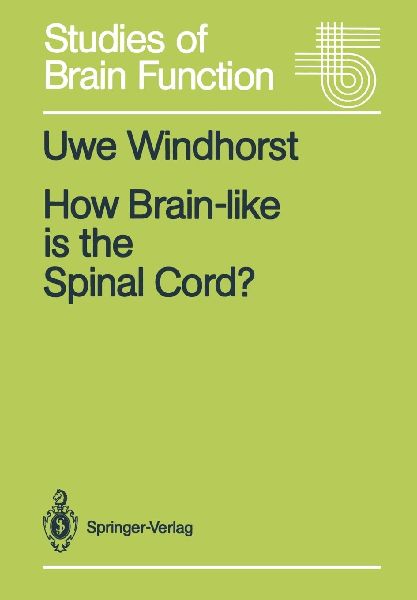
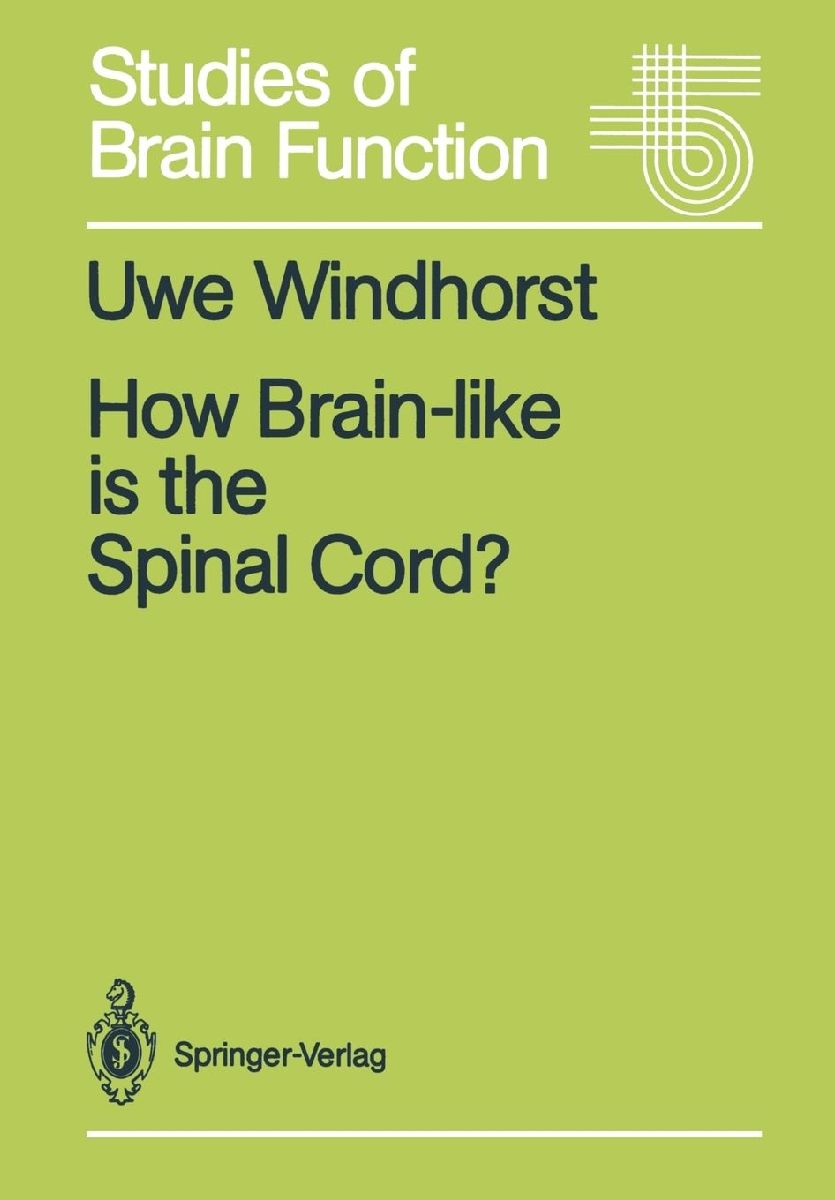
How Brain-like is the Spinal Cord?

Interacting Cell Assemblies in the Nervous System

von Uwe Windhorst

Aus der Reihe Studies of Brain Function

Einband
Kartoniert
Seiten
356
Sprache
Englisch
Erschienen
Mai 2012
Verlag
Springer

Buchbeschreibung

"Theorizing about brain functions is often considered slightly disreputable and anyhow a waste of time -perhaps even 'philoso- ical'" 1 P. S. CHURCHLAND At present there are no unanimously accepted general con­ cepts of brain operation and function. This is especially the case with regard to so-called "higher" functions such as per­ ception, memory or the coupling between sensory input and motor output.

Ganze Beschreibung lesenWeniger anzeigen

There are a number of different reasons for this. Some may be related to experimental limitations allowing the simultaneous recording of the activities of only a restricted number of neurones.

But there are also conceptual difficulties hindering the transition from "single-neurone" schemes, in which neurones are assigned relatively specific tasks (such as feature detection), to more complex schemes of nerve cell as­ semblies (for a discussion of some of the difficulties see Abeles 1982; von der Malsburg 1981; Kriiger 1983). Whilst much is known about the basic properties and functions of single neu­ rones, whose operations we hope to understand in the foresee­ able future, this does not hold true in the same way for the working of large assemblies of neurones.

Inhaltsverzeichnis

  • 1 Correlations Between Spike Trains of Supraspinal Neurones
  • 1.1 Correlations Between Discharge Patterns of Cortical Neurones
  • 1.2 The Basic Method of Cross-Correlating Spike Trains
  • 1.3 Correlations Between Discharge Patterns of Cortical Neurones and Their Role in Some Recent Models of Brain function
  • 1.4 Brainstem
  • 2 Correlations Between Spinal Neurones
  • 2.1 Correlations Between ?-Motoneurone Discharges
  • 2.2 Correlations Between ?-Motoneurone Discharges
Ganzes Inhaltsverzeichnis anzeigen (55 Einträge)Weniger anzeigen
  • 2.3 Correlations Between ?-Motoneurone Discharges
  • 2.4 Summary
  • 2.5 Correlations Between Muscle Afferent Discharges
  • 2.6 The Effect of Fusimotor Input on Spindle Afferent Correlations
  • 2.7 Summary
  • 2.8 Effects of Correlations Between Presynaptic Fibres on Spinal Neurones
  • 2.9 Interneuronal Circuits
  • 3 Tremor States
  • 3.1 Frequency-Displacement Amplitude Relations for Normal Hand Tremor
  • 3.2 Muscle Contraction as a Stochastic Process
  • 3.3 Localised Stretch Reflexes Acting as a Tremor-Suppressive Mechanism?
  • 3.4 Further Feedback Systems
  • 3.5 Plasticity in the Spinal Cord
  • 3.6 Summary
  • 4 Recurrent Inhibition and Proprioceptive Feedback
  • 4.1 Fundamental Functions of the Spinal Cord
  • 4.2 Specific Functions of Recurrent Inhibition and the Stretch Reflex
  • 4.3 Structural and Functional Analogies Between Spinal Recurrent Inhibition and Proprioceptive Feedback
  • 4.4 The Reafference Principle
  • 4.5 The Renshaw Cell System as an Efference Copy?
  • 4.6 Model-Reference Control Systems
  • 4.7 Adaptive Control Systems
  • 4.8 An Integrated Model Including Proprioceptive Feedback and Recurrent Inhibition
  • 4.9 Remarks on the Function of the Integrated System
  • 4.10 Are the Inputs to ?-Motoneurones and Renshaw Cells Matched to Each Other?
  • 4.11 Relation of Fusi- and Skeletomotor Activation Patterns: Task
  • Dependence
  • 4.12 ?-Motoneurones and Renshaw Cells as Integrative Centres
  • 4.13 Suggestions for Further Research
  • 4.14 Summary
  • 5 Problems in Motor Control
  • 5.1 On the Modules of Motor Control
  • 5.2 The Problem of the Variable(s) Controlled in Motor Acts
  • 5.3 Which Are the Measured Variables?
  • 5.4 Spatial Transformations
  • 5.5 Temporal Aspects
  • 5.6 Multimodal Organisation of Spinal Neural Assemblies
  • 5.7 Summary
  • 5.8 Concluding Remarks
  • Appendix A Auto- and Cross-Correlations
  • Appendix B Cross-Correlations Between Three Spike Trains
  • Appendix C Event-Related Cross-Correlations
  • Appendix D Statistical Analysis of Nonlinear Physiological Systems
  • Appendix E On Spurious Synchronisation of Two Semiregularly Firing Neurones
  • Appendix F Spectral Analysis
  • Appendix G A Remark on Correlation Patterns
  • References

Details

Erscheinungstermin
Mai 2012
Kategorie
Fremdsprachige Bücher
Einband
Kartoniert
Seiten
356
Sprache
Englisch
Verlag
Springer
Reihe
Studies of Brain Function
Format
24,4 × 17,0 cm
Dicke
2,0 cm
Gewicht
615 g
EAN / ISBN-13
9783642511226
Maßstabsgetreu: Deckel und Buchrücken neben einer Hand (18 cm).
Versand und Rückgabe

Standardversand: 1 bis 3 Werktage, 3,99 €, kostenlos ab 35 €

Liefergebiet: Deutschland

Rücksendung: 14 Tage Widerrufsrecht. Bei einem Widerruf tragen Sie die Kosten der Rücksendung. Bei einer Falschlieferung oder einem Fehler von uns erstatten wir Ihnen das Rückporto. Den Widerruf erklären Sie über den Knopf „Vertrag widerrufen“ im Fuß der Seite.

Hersteller und ProduktsicherheitSpringer Nature Customer Service Center GmbH
Springer Nature Customer Service Center GmbH
Europaplatz 3
69115 Heidelberg
Deutschland
ProductSafety@springernature.com

Mehr aus der Reihe Studies of Brain Function

Ähnliche Titel

Bewertungen

Zu diesem Titel gibt es noch keine Bewertung. Bewerten kann, wer ihn bei uns gekauft hat.
So prüfen wir Bewertungen
Eine Bewertung kann bei uns nur abgeben, wer den Titel über sein Kundenkonto bei uns gekauft hat. Jede Bewertung ist fest mit der zugehörigen Bestellung verknüpft; anders kommt sie technisch gar nicht zustande. Deshalb trägt jede angezeigte Bewertung den Hinweis „Verifizierter Kauf". Wir zeigen positive wie negative Bewertungen und löschen nur bei Rechtsverstößen. Für Bewertungen gibt es keine Gegenleistung.
53,49 €Voraussichtlich 1. bis 3. Dez.

Inhalte ab 18

Cover von Titeln für Erwachsene, etwa erotische Romane, Manga oder Comics, bleiben unscharf, bis Sie bestätigen. Die Bestätigung gilt für alle Seiten und Tabs, bis Sie den Browser schließen.

Zurück zum Katalog