
Buch-OWLOnline-Buchhandel

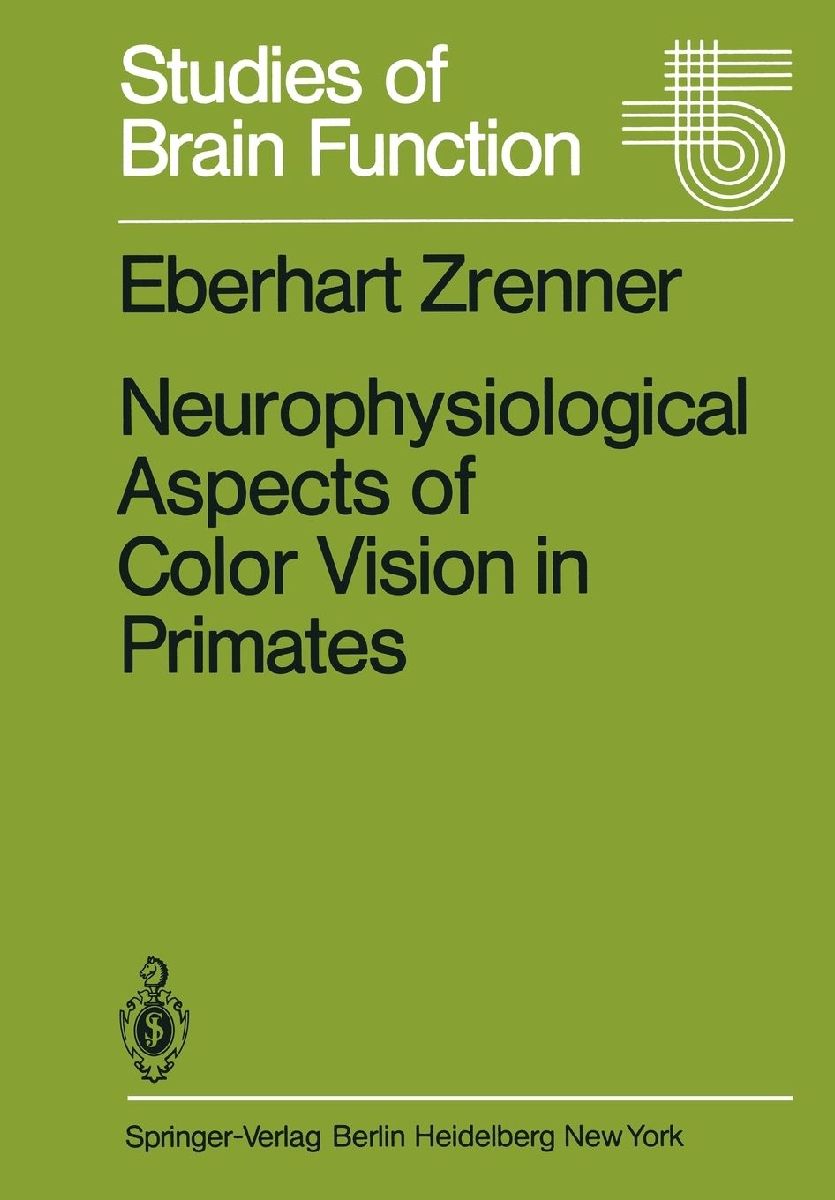
Neurophysiological Aspects of Color Vision in Primates

Comparative Studies on Simian Retinal Ganglion Cells and the Human Visual System

von E. Zrenner

Aus der Reihe Studies of Brain Function

Einband
Kartoniert
Seiten
240
Sprache
Englisch
Erschienen
April 2012
Verlag
Springer

Buchbeschreibung

"To explain all nature is too difficult a task for anyone man or even for anyone age. Tis much better to do a little with certainty, and leave the rest for others that come after you, than to explain all things …

Ganze Beschreibung lesenWeniger anzeigen

" Sir Isaac Newton (1642-1727) This book describes and discusses some new aspects of col­ or vision in primates which have emerged from a series of experiments conducted over the past 8 years both on single ganglion cells in monkey retina and on the visually evoked cortical potential in man: corresponding psychophysical mechanisms of human perception will be considered as well.

An attempt will be made to better understand the basic mechanisms of color vision using a more comprehensive approach which takes into account new mechanisms found in single cells and relates them to those found valid for the entire visual system. The processing of color signals was followed up from the retina to the visual cortex and to the percepq.tal centers, as far as the available techniques permitted.

Inhaltsverzeichnis

  • 1 Introduction
  • 1.1 Color Vision Theories. Historical Aspects
  • 1.2 Electrophysiological Studies Related to Color Vision
  • 2 Methods
  • 2.1 Methods of Single Cell Recording in Rhesus Monkeys
  • 2.2 Identification of Cone Inputs in Retinal Ganglion Cells
  • 3 Types of Retinal Ganglion Cells and Their Distribution
  • 3.1 Introductory Remarks
Ganzes Inhaltsverzeichnis anzeigen (41 Einträge)Weniger anzeigen
  • 3.2 The Concept of Color-Opponency
  • 3.3 The Various Types of Color-Opponent Cells
  • 3.4 Variations in Color-Opponency
  • 3.5 Spectrally Non-Opponent Ganglion Cells
  • 3.6 Distribution of Classes of Ganglion Cells Across the Retina
  • 3.7 A Simplified Classification Procedure
  • 3.8 Résumé: Some Implications for the Understanding of the Visual System's Function
  • 4 Special Properties of Blue-Sensitive Ganglion Cells
  • 4.1 Some Recent Electrophysiological and Psychophysical Data on the Blue-Sensitive Cone System
  • 4.2 Chromatic Adaptation and Spectral Sensitivity
  • 4.3 Paradoxical Phenomena Occurring During Light and Dark Adaptation in Blue-Sensitive Ganglion Cells
  • 4.4 A Model Describing the Interaction Between Cone Mechanisms in Blue-Sensitive, Color-Opponent Ganglion Cells
  • 4.5 Résumé: What is Special About the Blue Cone Mechanism?
  • 5 Temporal Properties of Color-Opponent Ganglion Cells
  • Flicker-Stimulation; Testing the "Channel" Hypothesis
  • 5.1 Critical Flicker Frequencies (CFF) in Tonic and Phasic Ganglion Cells
  • 5.2 Influence of Stimulation Frequency on the Spectral Sensitivity Function: Loss of Color-Opponency at Higher Flicker Rates
  • 5.3 The Basic Mechanism: Phase-Shift Between Center and Surround Responses
  • 5.4 Latency of Center and Surround Responses
  • 5.5 The Processing of Luminous and Chromatic Flicker
  • 5.6 Stimulus Duration Changes the Action Spectrum
  • 5.7 Résumé: Possible Implication of the Transition
  • Between Antagonism and Synergism in Color-Opponent Ganglion Cells
  • 6 The Spectral Properties of the Human Visual System as Revealed by Visually Evoked Cortical Potentials (VECP) and Psychophysical Investigations
  • 6.1 Methods as Applied in Human Observers
  • 6.2 Rods and Cones
  • 6.3 Fundamental Cone Functions
  • 6.4 Color-Opponency in the VECP and in Psychophysical Measurements
  • 6.5 The Influence of Flicker Frequency on Spectral Sensitivity
  • 6.6 Conclusion: To What Extent Can Visually Evoked Cortical Potentials Reveal the Function of Individual Receptor Mechanisms?
  • Epilogue
  • Summary
  • References

Details

Erscheinungstermin
April 2012
Kategorie
Fremdsprachige Bücher
Einband
Kartoniert
Seiten
240
Sprache
Englisch
Verlag
Springer
Reihe
Studies of Brain Function
Format
24,4 × 17,0 cm
Dicke
1,4 cm
Gewicht
422 g
EAN / ISBN-13
9783642876080
Maßstabsgetreu: Deckel und Buchrücken neben einer Hand (18 cm).
Versand und Rückgabe

Standardversand: 1 bis 3 Werktage, 3,99 €, kostenlos ab 35 €

Liefergebiet: Deutschland

Rücksendung: 14 Tage Widerrufsrecht. Bei einem Widerruf tragen Sie die Kosten der Rücksendung. Bei einer Falschlieferung oder einem Fehler von uns erstatten wir Ihnen das Rückporto. Den Widerruf erklären Sie über den Knopf „Vertrag widerrufen“ im Fuß der Seite.

Hersteller und ProduktsicherheitSpringer Nature Customer Service Center GmbH
Springer Nature Customer Service Center GmbH
Europaplatz 3
69115 Heidelberg
Deutschland
ProductSafety@springernature.com

Mehr aus der Reihe Studies of Brain Function

Ähnliche Titel

Bewertungen

Zu diesem Titel gibt es noch keine Bewertung. Bewerten kann, wer ihn bei uns gekauft hat.

So prüfen wir Bewertungen
Eine Bewertung kann bei uns nur abgeben, wer den Titel über sein Kundenkonto bei uns gekauft hat. Jede Bewertung ist fest mit der zugehörigen Bestellung verknüpft; anders kommt sie technisch gar nicht zustande. Deshalb trägt jede angezeigte Bewertung den Hinweis „Verifizierter Kauf". Wir zeigen positive wie negative Bewertungen und löschen nur bei Rechtsverstößen. Für Bewertungen gibt es keine Gegenleistung.
106,99 €Voraussichtlich 2. bis 4. Dez.

Inhalte ab 18

Cover von Titeln für Erwachsene, etwa erotische Romane, Manga oder Comics, bleiben unscharf, bis Sie bestätigen. Die Bestätigung gilt für alle Seiten und Tabs, bis Sie den Browser schließen.

Zurück zum Katalog