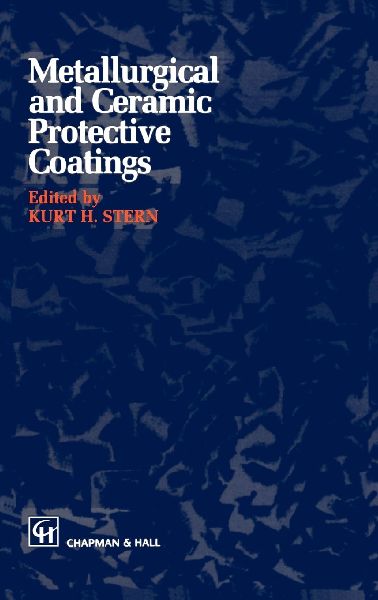
Metallurgical and Ceramic Protective Coatings
Herausgegeben von: K. H. Stern
- Einband
- Gebunden
- Seiten
- 356
- Sprache
- Englisch
- Erschienen
- August 1996
- Verlag
- Springer Netherlands
Buchbeschreibung
Surface engineering is an increasingly important field and consequently those involved need to be aware of the vast range of technologies available to modify surfaces.
This text provides an up-to-date, authoritative exposition of the major condensed phase methods used for producing metallurgical and ceramic coatings. Each method is discussed thoroughly by an expert in that field.
Ganze Beschreibung lesenWeniger anzeigen
In each chapter the principle of the method, its range of applications and technical aspects involved are described.
The book not only informs the reader about established technologies familiar only to specialists, but also details activity on the frontier of coating technology providing an insight into those potential technologies not yet fully developed but which should emerge in the near future.
Inhaltsverzeichnis
- 1 Introduction
- 1.1 Protective coatings
- 1.2 Stresses
- 1.3 Selection of coating materials
- 1.4 Methods of application
- 1.5 Electroplating - an example of a technology
- 1.6 Plan of this book
- References
Ganzes Inhaltsverzeichnis anzeigen (93 Einträge)Weniger anzeigen
- 2 Electrodeposition of refractory metals from molten salts
- 2.1 Introduction
- 2.2 Experimental techniques
- 2.3 The refractory metals
- References
- 3 Metalliding
- 3.1 Introduction
- 3.2 The metalliding process
- 3.3 Properties of metallided layers
- 3.4 Individual metalliders
- 3.5 Conclusions
- References
- 4 Electrodeposition of refractory compounds from molten salts - borides, carbides and suicides
- 4.1 Introduction
- 4.2 Methodology
- 4.3 Boron and the borides
- 4.4 Silicon and the silicides
- 4.5 Carbon and the carbides
- 4.6 Conclusions
- References
- 5 Laser assisted surface coatings
- 5.1 Laser surface alloying
- 5.2 Laser surface cladding
- 5.3 Laser chemical vapor deposition (LCVD)
- References
- 6 Sol-gel derived ceramic films - fundamentals and applications
- 6.1 Introduction
- 6.2 Sol-gel chemistry
- 6.3 Deposition by dip-coating
- 6.4 Deposition by spin-coating
- 6.5 Effects of entrained condensed phases
- 6.6 Drying of films
- 6.7 Control of film microstructure
- 6.8 Applications
- 6.9 Summary 148 Acknowledgments
- References
- 7 Solid phase cladding
- 7.1 Introduction
- 7.2 Explosive cladding
- 7.3 Roll bonding
- 7.4 Friction surfacing
- 7.5 Resistance cladding
- 7.6 Hot isostatic pressing
- 7.7 Summary 191 References
- 8 Thermal barrier coatings
- 8.1 Introduction
- 8.2 Material requirements
- 8.3 Stabilization of zirconia
- 8.4 Phase transformation reactions of stabilized zirconia
- 8.5 Identification of phases in stabilized zirconia
- 8.6 Zirconia thermal barrier coatings
- 8.7 Causes for failure of zirconia TBCs
- 8.8 Alleviation ofTBC hot corrosion
- 8.9 Future uses and trends for zirconia TBCs
- References
- 9 Pack cementation diffusion coatings
- 9.1 Principles and history
- 9.2 Range of applicability
- 9.3 Technical aspects
- 9.4 Possibilities for improvement
- 9.5 Summary 257 Acknowledgments
- References
- 10 Thermal spray coatings
- 10.1 Introduction
- 10.2 Thermal spray processes
- 10.3 Feed materials
- 10.4 Particle-plasma interaction and process control
- 10.5 Deposit formation dynamics
- 10.6 Materials science of thermal spray deposits
- 10.7 Thermal spray coating applications
- 10.8 Thermal spray and advanced manufacturing
- 10.9 Summary
- References
- 11 Degradation of coatings by high temperature atmospheric corrosion and molten salt deposits
- 11.1 Introduction
- 11.2 Metallic coatings
- 11.3 Ceramic coatings
- 11.4 Erosion 303 References
- 12 Measurement of coating adhesion
- 12.1 Introduction
- 12.2 Surface engineering
- 12.3 The requirements of an ideal adhesion test
- 12.4 Methods of adhesion evaluation
- 12.5 Summary
- References
Details
- Erscheinungstermin
- August 1996
- Kategorie
- Fremdsprachige Bücher
- Einband
- Gebunden
- Seiten
- 356
- Sprache
- Englisch
- Verlag
- Springer Netherlands
- Format
- 24,1 × 16,0 cm
- Dicke
- 2,4 cm
- Gewicht
- 648 g
- EAN / ISBN-13
- 9780412544408
Versand und Rückgabe
Standardversand: 1 bis 3 Werktage, 3,99 €, kostenlos ab 35 €
Liefergebiet: Deutschland
Rücksendung: 14 Tage Widerrufsrecht. Bei einem Widerruf tragen Sie die Kosten der Rücksendung. Bei einer Falschlieferung oder einem Fehler von uns erstatten wir Ihnen das Rückporto. Den Widerruf erklären Sie über den Knopf „Vertrag widerrufen“ im Fuß der Seite.
Hersteller und ProduktsicherheitSpringer Nature Customer Service Center GmbH
Springer Nature Customer Service Center GmbH
Europaplatz 3
69115 Heidelberg
Deutschland
ProductSafety@springernature.com
Ähnliche Titel


Thermal Physics and Thermal Analysis
Jaroslav ¿Esták (Hrsg.)
Gebunden, Englisch, 2 Ausgaben
ab 213,99 €

Phase Transitions and Self-Organization in Electronic and Molecular Networks
J. C. Phillips (Hrsg.)
Gebunden, Englisch, 2 Ausgaben
ab 160,49 €
Bewertungen
Zu diesem Titel gibt es noch keine Bewertung. Bewerten kann, wer ihn bei uns gekauft hat.
So prüfen wir Bewertungen
Eine Bewertung kann bei uns nur abgeben, wer den Titel über sein Kundenkonto bei uns gekauft hat. Jede Bewertung ist fest mit der zugehörigen Bestellung verknüpft; anders kommt sie technisch gar nicht zustande. Deshalb trägt jede angezeigte Bewertung den Hinweis „Verifizierter Kauf". Wir zeigen positive wie negative Bewertungen und löschen nur bei Rechtsverstößen. Für Bewertungen gibt es keine Gegenleistung.
213,99 €Voraussichtlich 7. bis 9. Dez.