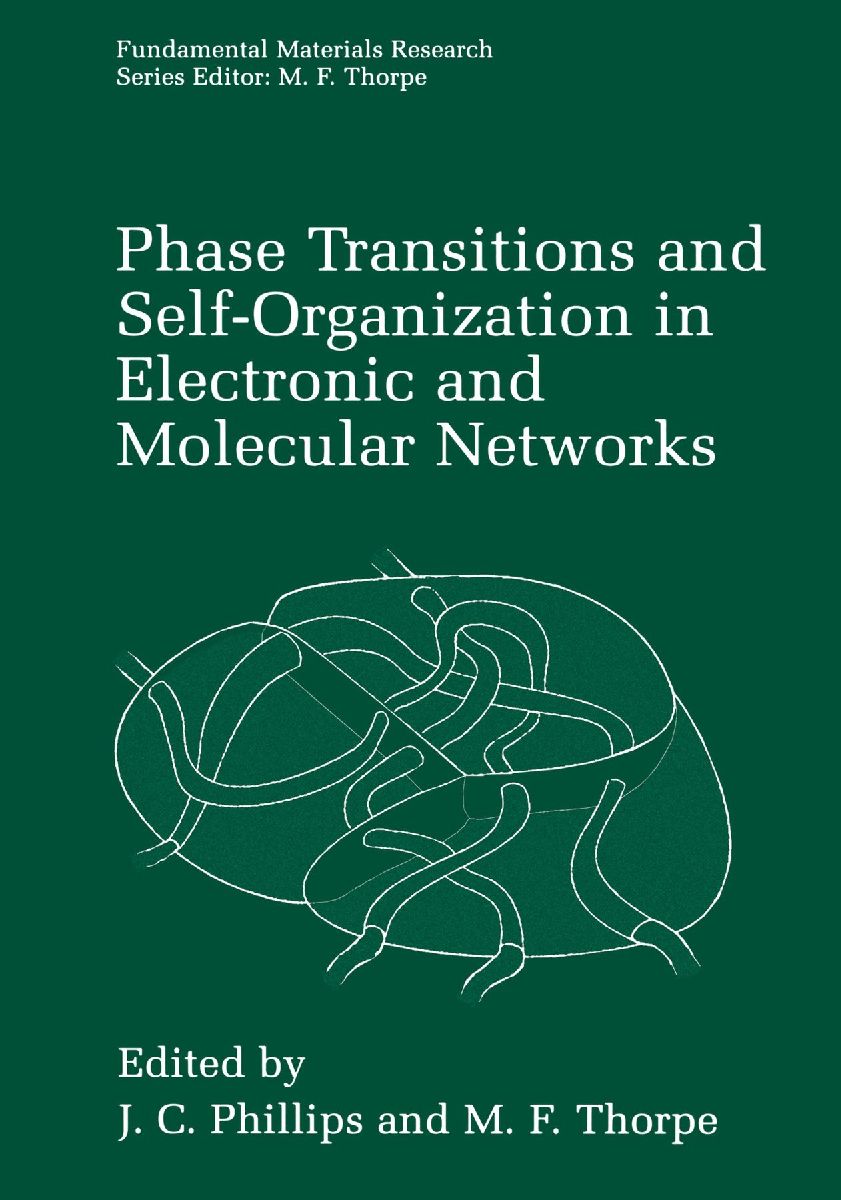
Phase Transitions and Self-Organization in Electronic and Molecular Networks
Herausgegeben von: J. C. Phillips, Herausgegeben von: M. F. Thorpe
- Einband
- Gebunden
- Seiten
- 472
- Sprache
- Englisch
- Erschienen
- Juli 2001
- Verlag
- Humana
Buchbeschreibung
Advances in nanoscale science show that the properties of many materials are dominated by internal structures.
In molecular cases, such as window glass and proteins, these internal structures obviously have a network character. However, in many partly disordered electronic materials, almost all attempts at understanding are based on traditional continuum models. This workshop focuses first on the phase diagrams and phase transitions of materials known to be composed of molecular networks.
Ganze Beschreibung lesenWeniger anzeigen
These phase properties characteristically contain remarkable features, such as intermediate phases that lead to reversibility windows in glass transitions as functions of composition. These features arise as a result of self-organization of the internal structures of the intermediate phases. In the protein case, this self-organization is the basis for protein folding.
The second focus is on partly disordered electronic materials whose phase properties exhibit the same remarkable features. In fact, the phenomenon of High Temperature Superconductivity, discovered by Bednorz and Mueller in 1986, and now the subject of 75,000 research papers, also arises from such an intermediate phase.
More recently discovered electronic phenomena, such as giant magnetoresistance, also are made possible only by the existence of such special phases. This book gives an overview of the methods and results obtained so far by studying the characteristics and properties of nanoscale self-organized networks. It demonstrates the universality of the network approach over a range of disciplines, from protein folding to the newest electronic materials.
Inhaltsverzeichnis
- Some Mathematics
- Mathematical Principles of Intermediate Phases in Disordered Systems
- Reduced Density Matrices and Correlation Matrix
- The Sixteen-Percent Solution: Critical Volume Fraction for Percolation
- The Intermediate Phase and Self-organization in Network Glasses
- Glasses and Supercooled Liquids
- Evidence for the Intermediate Phase in Chalcogenide Glasses
- Thermal Relaxation and Criticality of the Stiffness Transition
Ganzes Inhaltsverzeichnis anzeigen (34 Einträge)Weniger anzeigen
- Solidity of Viscous Liquids
- Non-Ergodic Dynamics in Supercooled Liquids
- Network Stiffening and Chemical Ordering in Chalcogenide Glasses: Compositional Trends of Tg in Relation to Structural Information From Solid and Liquid State NMR
- Glass Transition Temperature Variation as a Probe for Network Connectivity
- Floppy Modes Effects in the Thermodynamical Properties of Chalcogenide Glasses
- The Dalton-Maxwell-Pauling Recipe for Window Glass
- Local Bonding, Phase Stability and Interface Properties of Replacement Gate Dielectrics, Including Silicon Oxynitride Alloys and Nitrides, and Film 'Amphoteric' Elemental Oxides and Silicates
- Experimental Methods for Local Structure Determination on the Atomic Scale
- Zeolite Instability and Collapse
- Metal-Insulator Transitions
- Thermodynamics and Transport Properties of Interacting Systems with Localized Electrons
- The Metal-Insulator Transition in Doped Semiconductors: Transport Properties and Critical Behavior
- Metal-Insulator Transition in Homogeneously Doped Germanium
- High Temperature Super conductors
- Experimental Evidence for Ferroelastic Nanodomains in HTSC Cuprates and Related Oxides
- Role of Sr Dopants in the Inhomogeneous Ground State of La2-xSrxCuO4
- Universal Phase Diagrams and "Ideal" High Temperature Superconductors: HgBa2CuO4+?
- Coexistence ofSuperconductivity and Weak Ferromagnetism in Eu1.5Ce0.5RuSr2Cu2O10
- Quantum Percolation in High Tc Superconductors
- Superstripes
- Electron Strings in Oxides
- High-Temperature Superconductivity is Charge-Reservoir Superconductivity
- Electronic Inhomogeneities in High-Tc Superconductors Observed by NMR
- Tailoring the Properties of High-Tc and Related Oxides
- Self-Organization in Proteins
- Designing Protein Structures
Details
- Erscheinungstermin
- Juli 2001
- Kategorie
- Fremdsprachige Bücher
- Einband
- Gebunden
- Seiten
- 472
- Sprache
- Englisch
- Verlag
- Humana
- Format
- 26,0 × 18,3 cm
- Dicke
- 3,1 cm
- Gewicht
- 1.014 g
- EAN / ISBN-13
- 9780306465680
Versand und Rückgabe
Standardversand: 1 bis 3 Werktage, 3,99 €, kostenlos ab 35 €
Liefergebiet: Deutschland
Rücksendung: 14 Tage Widerrufsrecht. Bei einem Widerruf tragen Sie die Kosten der Rücksendung. Bei einer Falschlieferung oder einem Fehler von uns erstatten wir Ihnen das Rückporto. Den Widerruf erklären Sie über den Knopf „Vertrag widerrufen“ im Fuß der Seite.
Hersteller und ProduktsicherheitSpringer Nature Customer Service Center GmbH
Springer Nature Customer Service Center GmbH
Europaplatz 3
69115 Heidelberg
Deutschland
ProductSafety@springernature.com
Ähnliche Titel

Thermal Physics and Thermal Analysis
Jaroslav ¿Esták (Hrsg.)
Gebunden, Englisch, 2 Ausgaben
ab 213,99 €

Metallurgical and Ceramic Protective Coatings
K. H. Stern (Hrsg.)
Gebunden, Englisch, 2 Ausgaben
ab 213,99 €

Bewertungen
Zu diesem Titel gibt es noch keine Bewertung. Bewerten kann, wer ihn bei uns gekauft hat.
So prüfen wir Bewertungen
Eine Bewertung kann bei uns nur abgeben, wer den Titel über sein Kundenkonto bei uns gekauft hat. Jede Bewertung ist fest mit der zugehörigen Bestellung verknüpft; anders kommt sie technisch gar nicht zustande. Deshalb trägt jede angezeigte Bewertung den Hinweis „Verifizierter Kauf". Wir zeigen positive wie negative Bewertungen und löschen nur bei Rechtsverstößen. Für Bewertungen gibt es keine Gegenleistung.
160,49 €Voraussichtlich 7. bis 9. Dez.