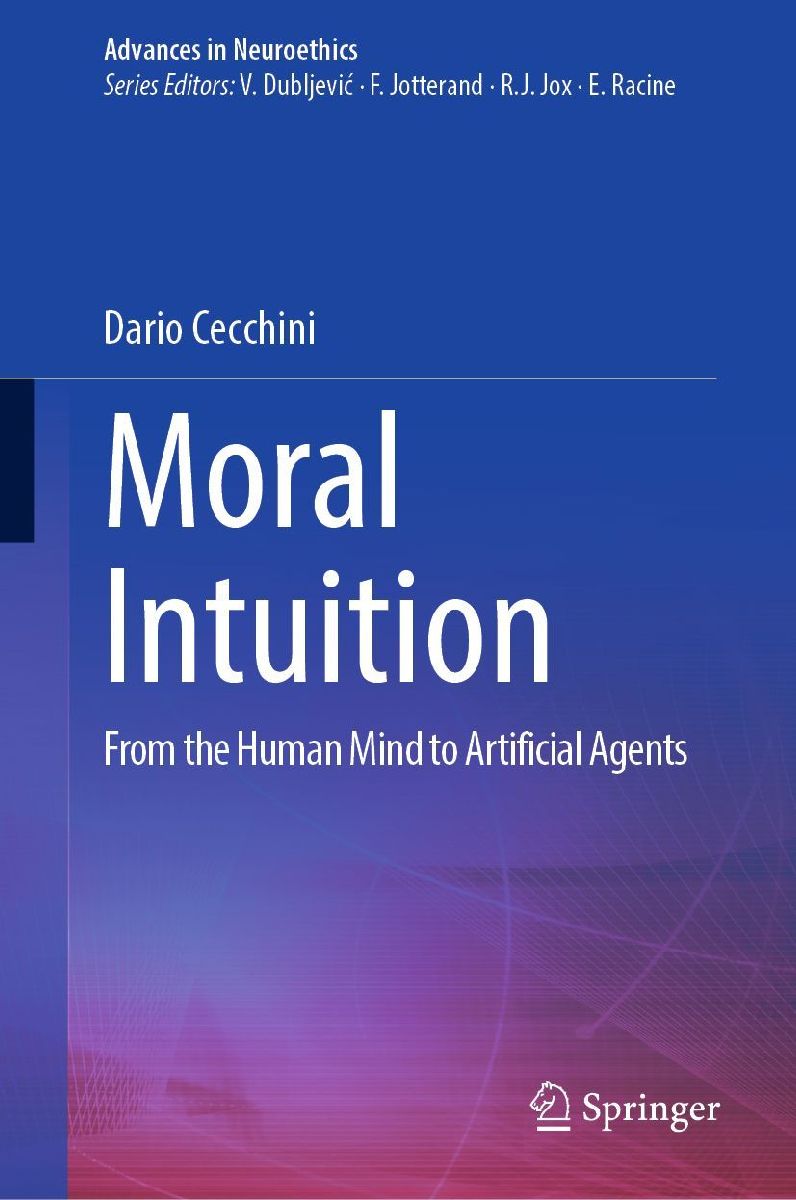
Moral Intuition
From the Human Mind to Artificial Agents
von Dario Cecchini
Aus der Reihe Advances in Neuroethics
- Einband
- Gebunden
- Seiten
- 244
- Sprache
- Englisch
- Erschienen
- Mai 2026
- Verlag
- Springer
Buchbeschreibung
In the tradition of moral philosophy, long dominated by a rationalist paradigm, the idea of moral intuition has often been a source of embarrassment.
How can the mind form a moral judgment within seconds, without any apparent reasoning? In the spirit of neuroethics, this book demystifies moral intuition by examining the mental and neural processes that generate such automatic evaluations.
Ganze Beschreibung lesenWeniger anzeigen
Addressed to specialists in philosophy, psychology, and AI ethics, the book systematically investigates three questions: how moral intuitions work, how they can improve, and how they can be implemented in artificial agents.
Challenging the dominant default-interventionist view of moral reasoning, the first part argues that moral intuitions play a dual role: they detect harm and help in the environment, and they metacognitively regulate the deployment of cognitive resources, triggering reflection when intuitive outputs are uncertain or conflicting.
Building on this foundation, the book offers a dyadic classification of the cognitive biases that shape moral intuitions and critically assesses strategies for mitigating them, including reasoning, expertise, and nudging.
The final part extends this moral-psychological framework to artificial intelligence, arguing that the implementation of moral intuitions in artificial agents is both a feasible and a philosophically defensible goal, compatible with the functional capacities of contemporary AI systems.
In doing so, the book sets a new research agenda for understanding, improving, and implementing moral intuitions in both human and artificial agents.
Inhaltsverzeichnis
- Introduction
- Part 1: Moral intuition: Psychological foundations
- 1. The automaticity of intuitions
- 2. The strength of intuitions: A metacognitive account
- 3. The content of moral intuitions: Dyadic harm and help
- 4. Moral reasoning: The intuition-reflection interplay
- Part 2: Toward better intuitions: Standards, biases, and strategies
- 5. The progress of moral intuitions: A dyadic theory
Ganzes Inhaltsverzeichnis anzeigen (17 Einträge)Weniger anzeigen
- 6. Challenges to moral intuitions’ progress: The problem of biases
- 7. Debiasing strategies: The direct path
- 8. Debiasing strategies: Indirect and hybrid approaches
- Part 3: Moral intuitions and artificial intelligence
- 9. Artificial agency and the alignment problem
- 10. Artificial moral agents
- 11. Toward better socio-digital environments
- Conclusion
- Bibliography
Details
- Erscheinungstermin
- Mai 2026
- Kategorie
- Fremdsprachige Bücher
- Einband
- Gebunden
- Seiten
- 244
- Sprache
- Englisch
- Verlag
- Springer
- Reihe
- Advances in Neuroethics
- Format
- 24,1 × 16,0 cm
- Dicke
- 1,8 cm
- Gewicht
- 528 g
- EAN / ISBN-13
- 9783032201164
Über Dario Cecchini
Dario Cecchini is a Postdoctoral Research Scholar at NC State University. He joined the Neuro
Computational Ethics Research Group in November 2022, funded by the National Science Foundation project …
Mehr über Dario CecchiniWeniger anzeigen
Computational Ethics Research Group in November 2022, funded by the National Science Foundation project "Virtual Reality Simulations of Moral Decision Making for Autonomous Vehicles." Before arriving in Raleigh, Dr. Cecchini obtained a Ph. D. in Moral Philosophy at the University of Genoa (Italy) in March 2022. He studied philosophy for his BA and MA degrees in Florence and Pisa.
With a solid background in metaethics and moral psychology, Dr. Cecchini’s research interests have recently expanded into the field of applied ethics, focusing particularly on the ethics of artificial intelligence. His current projects concern moral judgment, the alignment problem for AI, the ethics of automated vehicles and carebots.
Versand und Rückgabe
Standardversand: 1 bis 3 Werktage, 3,99 €, kostenlos ab 35 €
Liefergebiet: Deutschland
Rücksendung: 14 Tage Widerrufsrecht. Bei einem Widerruf tragen Sie die Kosten der Rücksendung. Bei einer Falschlieferung oder einem Fehler von uns erstatten wir Ihnen das Rückporto. Den Widerruf erklären Sie über den Knopf „Vertrag widerrufen“ im Fuß der Seite.
Hersteller und ProduktsicherheitSpringer Nature Customer Service Center GmbH
Springer Nature Customer Service Center GmbH
Europaplatz 3
69115 Heidelberg
Deutschland
ProductSafety@springernature.com
Mehr aus der Reihe Advances in Neuroethics
Policy, Identity, and Neurotechnology
Veljko Dubljevi¿ (Hrsg.)
Kartoniert, Englisch, 2 Ausgaben
ab 117,69 €

Death Determination by Neurologic Criteria
Ariane Lewis (Hrsg.)
Kartoniert, Englisch, 2 Ausgaben
ab 165,84 €

Brain Organoids in Research and Therapy
Hans-Georg Dederer (Hrsg.)
Kartoniert, Englisch, 2 Ausgaben
ab 117,69 €
Ähnliche Titel



Psychiatrists' Analysis of Politicians' Mental Health
Keith Rasmussen
Kartoniert, Englisch, 2 Ausgaben
ab 25,67 €
Bewertungen
Zu diesem Titel gibt es noch keine Bewertung. Bewerten kann, wer ihn bei uns gekauft hat.
So prüfen wir Bewertungen
Eine Bewertung kann bei uns nur abgeben, wer den Titel über sein Kundenkonto bei uns gekauft hat. Jede Bewertung ist fest mit der zugehörigen Bestellung verknüpft; anders kommt sie technisch gar nicht zustande. Deshalb trägt jede angezeigte Bewertung den Hinweis „Verifizierter Kauf". Wir zeigen positive wie negative Bewertungen und löschen nur bei Rechtsverstößen. Für Bewertungen gibt es keine Gegenleistung.
149,79 €Voraussichtlich 7. bis 9. Dez.