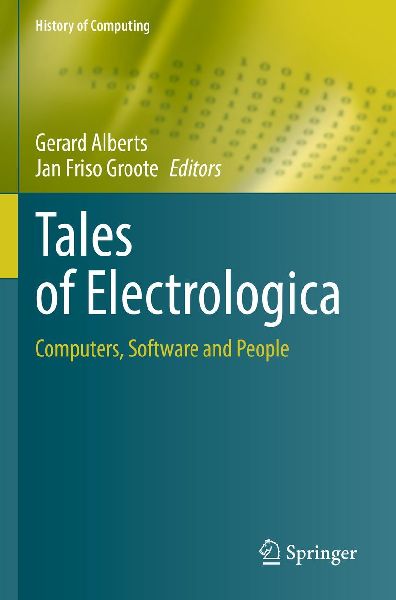
Tales of Electrologica
Computers, Software and People
Herausgegeben von: Gerard Alberts, Herausgegeben von: Jan Friso Groote
Aus der Reihe History of Computing
- Einband
- Kartoniert
- Seiten
- 212
- Sprache
- Englisch
- Erschienen
- Januar 2024
- Verlag
- Palgrave Macmillan
Buchbeschreibung
Manufacturing computers in series was quite a feat in the 1950s.
As mathematical as it gets, the machines discussed here were called X1 and X8.The industrial achievement combined with the background in a mathematical research center made the company Electrologica a legend in Dutch computing. The tales in this book are told by those who have a right to tell.
Ganze Beschreibung lesenWeniger anzeigen
Highly engaged professionals take readers back to their pioneering work with the machines and in retrospect unveil some of the values, which went without saying in the 1960s.
To disagree, Paul Klint relates the contrasting views on software in Dutch research traditions. ALGOL culture: Frans Kruseman Aretz takes the reader along to the detailed decisions on constructing compilers and shows the values of an ALGOL culture transpiring. Signposts: Dirk Dekker for the first time 'owns' his algorithm for mutual exclusion.
In particle physics: René van Dantzig's use case was an Electrologica X8 computer controlling two other computers in three-dimensional detection of colliding particles. Early steps in AI: Lambert Meertens' tale of the X8 machine composing a violin quartet comes with his original presentation, as well as the code in ALGOL 60. The reflections of first hand experiences combine well with the second thoughts of historical research into archival sources.
Historians Huub de Beer and Gerard Alberts offer a view into the boardrooms of the local enterprise Electrologica, and of the electronics multinational Philips. Where pioneers and historians meet in an inspiring dialogue, the reader gains a view on the often implicit decisions constituting the field.
Fortuitously, a copy of the X8 was retrieved from Kiel, Germany, and put on display at Rijksmuseum Boerhaave, Leiden. Sparked by the very material presence of an X8, the present book takes stock of the state of historiography of Electrologica.
Gerard Alberts is an associate professor in History of Digital Cultures, retired from the University of Amsterdam. Jan Friso Groote is a full professor of Formal Methods at the Eindhoven University of Technology.
Inhaltsverzeichnis
- Chapter 1. Electrologica, A Gem (Gerard Alberts)
- Chapter 2. Philips and the Fate of Electrologica (Gerard Alberts)
- Chapter 3. From the X1 to the X8 (Huub de Beer)
- Chapter 4. Software Without Memory (Paul Klint)
- Chapter 5. The Mathematical Center, ALGOL 60 and the Electrologica X8 (Frans Kruseman Aretz)
- Chapter 6. History of Dekker's Algorithm for Mutual Exclusion (Dirk Dekker)
- Chapter 7. The Electrologica X8 and the BOL Detector (René van Dantzig)
- Chapter 8. An Early Experiment in Algorithmic Composition (Lambert Meertens)
Details
- Erscheinungstermin
- Januar 2024
- Kategorie
- Fremdsprachige Bücher
- Einband
- Kartoniert
- Seiten
- 212
- Sprache
- Englisch
- Verlag
- Palgrave Macmillan
- Reihe
- History of Computing
- Format
- 23,5 × 15,5 cm
- Dicke
- 1,2 cm
- Gewicht
- 330 g
- EAN / ISBN-13
- 9783031130359
Über Gerard Alberts (Hrsg.)
Gerard Alberts (1954) is an historian of digital cultures and historian of mathematical thought. He graduated in mathematics and took his PhD cum laude in History.
Mehr über Gerard Alberts (Hrsg.)Weniger anzeigen
Gerard's key contribution to the history of mathematical thinking is pinpointing the rise of mathematical modeling in the middle of the twentieth century. In history of computing his focus has been on the history of software, and history of hacker culture. Recent work has been on webarchaeology. He his member of the editorial board of Annals of the history of computing and of Internet histories.
Gerard Alberts served the research Eurocores project "Software for Europe" (2007-2011) as its project leader. He is retired associate professor history of digital cultures at University of Amsterdam. Gerard Alberts is the editor of the Springer series History of Computing.
Jan Friso Groote (1965) is a full professor in Formal Methods at Eindhoven University of Technology. His interest is in efficiently proving the correctness of the software in computer controlled systems. This for instance led to the book, Modeling and Analysis of Communicating Systems, The MIT Press 2014. Before commencing in Eindhoven, in 1997, he studied Computer Science at Twente University and wrote a PhD on process algebra at CWI, Amsterdam (1991), where he later became a leader of the research group SEN2.
Versand und Rückgabe
Standardversand: 1 bis 3 Werktage, 3,99 €, kostenlos ab 35 €
Liefergebiet: Deutschland
Rücksendung: 14 Tage Widerrufsrecht. Bei einem Widerruf tragen Sie die Kosten der Rücksendung. Bei einer Falschlieferung oder einem Fehler von uns erstatten wir Ihnen das Rückporto. Den Widerruf erklären Sie über den Knopf „Vertrag widerrufen“ im Fuß der Seite.
Hersteller und ProduktsicherheitSpringer Nature Customer Service Center GmbH
Springer Nature Customer Service Center GmbH
Europaplatz 3
69115 Heidelberg
Deutschland
ProductSafety@springernature.com
Mehr aus der Reihe History of Computing
Bewertungen
Zu diesem Titel gibt es noch keine Bewertung. Bewerten kann, wer ihn bei uns gekauft hat.
So prüfen wir Bewertungen
Eine Bewertung kann bei uns nur abgeben, wer den Titel über sein Kundenkonto bei uns gekauft hat. Jede Bewertung ist fest mit der zugehörigen Bestellung verknüpft; anders kommt sie technisch gar nicht zustande. Deshalb trägt jede angezeigte Bewertung den Hinweis „Verifizierter Kauf". Wir zeigen positive wie negative Bewertungen und löschen nur bei Rechtsverstößen. Für Bewertungen gibt es keine Gegenleistung.
37,44 €Voraussichtlich 1. bis 3. Dez.