Perception in Visual Communication. Evolution and Neurology of Vision
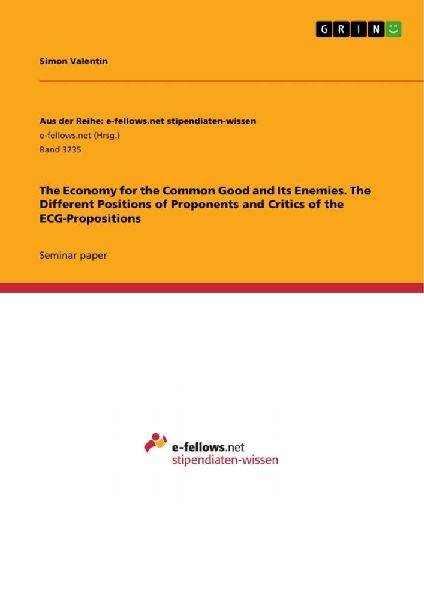
Simon Valentin
Kartoniert, Englisch
17,95 €
von Simon Valentin
Aus der Reihe Aus der Reihe: e-fellows.net stipendiaten-wissen
Seminar paper from the year 2019 in the subject Economics - Other, grade: 1,0, Hertie School of Governance, language: English, abstract: At a time at which the persistent socio-economic crisis is increasingly perceived as a systemic, multiple crisis rather than a cyclical one and at which the traditional economic models are called into question, there is a need to develop new models that respond better to the demands of today's world by promoting a way of fair and sustainable development.
This has led to the resurgence of old and the emergence of new alternative streams of thought that contrast the traditional neoclassical paradigm. However, despite the flourishing critical debate over the current form of capitalism and its underlying economic assumptions, concrete alternative economic models are hard to find.
The Economy of the Common Good (ECG), born in Vienna in October of 2010 as a movement of social innovation, is an expression of such a new economic model that places people and the functioning of their relations at the heart of economic activity. Unlike most movements that advocate for a change in the economic system, the ECG does not only have a vague idea of what is going wrong in the current capitalist system but presents a detailed alternative system, that is open for debate.
Moreover, besides being an interesting utopia, a still small but growing number of initiatives, individuals, firms, and (local) governments all over the world commit themselves to the ECG and adjust their economic behavior, so that the ECG has also very concrete impacts. Both, the concrete nature of the propositions as well the happening change at the ground, make the ECG open for attack and lead to the ideas being highly contested.
In contrast to most critical social movements that coexist with the orthodox mainstream, the ECG has caused a lot of criticism and resistance from economists and economic interest groups. Since today, the debate is conducted in a polemic and non-scientific way and neither the ECG nor its opponents put their position in a theoretical context, although implicitly drawing on existing ideas of economic philosophy.
The debate reveals the often blurred clash of paradigms and normative principles about the governance of the economy within the capitalist society. This paper seeks to exemplify and evaluate this clash with the debate on the ECG and answer the question: How are the different positions of proponents and critics of the ECG-propositions on the governance of the economy informed and driven by economic paradigms?
Standardversand: 1 bis 3 Werktage, 3,99 €, kostenlos ab 35 €
Liefergebiet: Deutschland
Rücksendung: 14 Tage Widerrufsrecht. Bei einem Widerruf tragen Sie die Kosten der Rücksendung. Bei einer Falschlieferung oder einem Fehler von uns erstatten wir Ihnen das Rückporto. Den Widerruf erklären Sie über den Knopf „Vertrag widerrufen“ im Fuß der Seite.
Simon Valentin
Kartoniert, Englisch
17,95 €
Simon Valentin
Kartoniert, Englisch
15,95 €
Daniel Vinokurov
Kartoniert
18,95 €
Vedhas Sabnis
Kartoniert, Englisch
9,99 €
Philipp Huber
Kartoniert, Englisch
42,95 €
An Nguyen
Kartoniert, Englisch
47,95 €
Christian Kreutzer
Kartoniert, Englisch
42,95 €
Zu diesem Titel gibt es noch keine Bewertung. Bewerten kann, wer ihn bei uns gekauft hat.