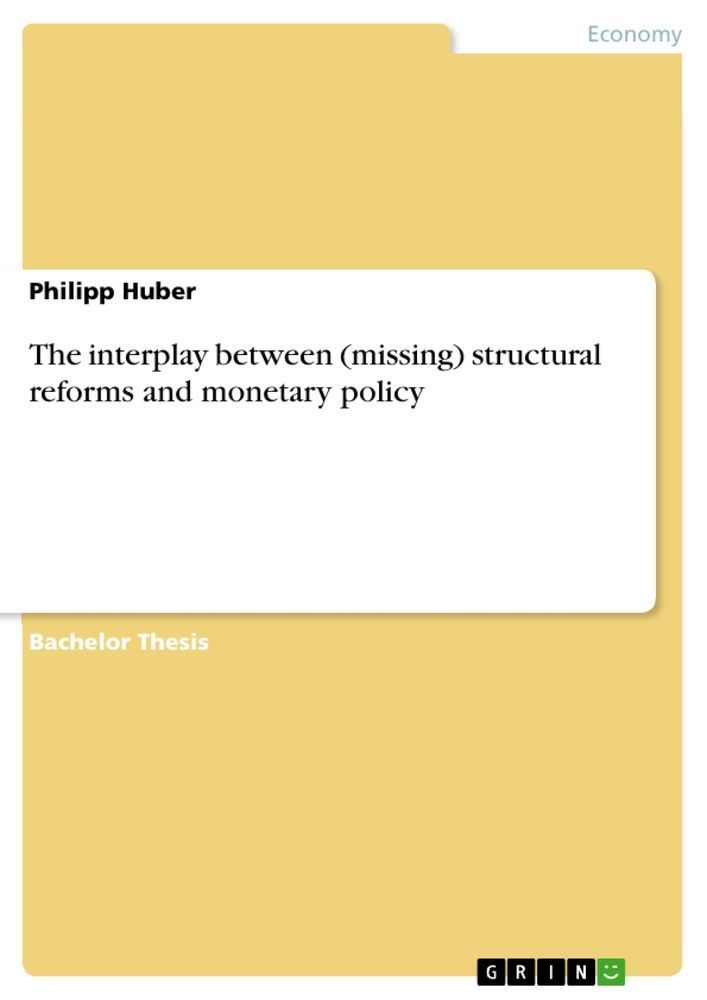
The interplay between (missing) structural reforms and monetary policy
von Philipp Huber
- Einband
- Kartoniert
- Seiten
- 72
- Sprache
- Englisch
- Erschienen
- Oktober 2019
- Verlag
- GRIN Verlag
Buchbeschreibung
Bachelor Thesis from the year 2018 in the subject Economics - Macro-economics, general, grade: 1,3, University of Frankfurt (Main) (House of Finance), language: English, abstract: Many well-known economists argue to achieve a prospering economy; it is crucially important to have an efficient collaboration between a country's monetary policy, concerning a stable currency and inflation rate, as well as a proper fiscal policy, including structural reforms and governmental spendings.
Ganze Beschreibung lesenWeniger anzeigen
In the backdrop of this opinion, the European Monetary Union (EMU) was established in 1999, in which the monetary policy for several countries is centralised in one institution, the European Central Bank (ECB). This is a massive achievement, as for most of Europe's history, it has been at war with itself, which did not foster any trade or other kinds of economic co-operation.
Europe was always a continent of trade barriers, tariffs and different currencies. Therefore, doing business across borders was always highly sluggish, and in the light of all these obstacles, it tended to stifle economic growth. After World War II has left Europe in a devastating condition, the natural choice to rebuild the continent was to remove these ancient barriers.
By implementing the Euro in 1999, this went even a step further. Domestic currencies ended to exist as well as the very individual monetary policies. In consequence the national central banks shifted the control to the newly formed ECB. The Eurozone had now one unified monetary policy, but still many different fiscal policies in the respective member states.
Before the Euro was born, countries like Greece or Italy not only had to pay high interest rates to borrow money, they also could only lend a limited amount, as lenders were not comfortable providing them too many credits. However, as they became members of the European Monetary Union, the tables turned, because big security providers, like Germany, were now part of it.
Details
- Erscheinungstermin
- Oktober 2019
- Kategorie
- Fremdsprachige Bücher
- Einband
- Kartoniert
- Seiten
- 72
- Sprache
- Englisch
- Verlag
- GRIN Verlag
- Format
- 21,0 × 14,8 cm
- Dicke
- 0,6 cm
- Gewicht
- 118 g
- EAN / ISBN-13
- 9783346000712
Versand und Rückgabe
Standardversand: 1 bis 3 Werktage, 3,99 €, kostenlos ab 35 €
Liefergebiet: Deutschland
Rücksendung: 14 Tage Widerrufsrecht. Bei einem Widerruf tragen Sie die Kosten der Rücksendung. Bei einer Falschlieferung oder einem Fehler von uns erstatten wir Ihnen das Rückporto. Den Widerruf erklären Sie über den Knopf „Vertrag widerrufen“ im Fuß der Seite.
Hersteller und ProduktsicherheitGRIN Publishing GmbH
Mehr von Philipp Huber



Ähnliche Titel

Financial Analysis of the Airlines Qantas and Virgin Australia (2015 to 2017)
Vedhas Sabnis
Kartoniert, Englisch
9,99 €

Prediction Model for Stock Excess Returns on Ho Chi Minh City Stock Exchange
An Nguyen
Kartoniert, Englisch
47,95 €

Do signal providers on social trading platforms exhibit behavioral biases?
Christian Kreutzer
Kartoniert, Englisch
42,95 €

The Economy for the Common Good and Its Enemies. The Different Positions of Proponents and Critics of the ECG-Propositions
Simon Valentin
Kartoniert, Englisch
18,95 €
Bewertungen
Zu diesem Titel gibt es noch keine Bewertung. Bewerten kann, wer ihn bei uns gekauft hat.
So prüfen wir Bewertungen
Eine Bewertung kann bei uns nur abgeben, wer den Titel über sein Kundenkonto bei uns gekauft hat. Jede Bewertung ist fest mit der zugehörigen Bestellung verknüpft; anders kommt sie technisch gar nicht zustande. Deshalb trägt jede angezeigte Bewertung den Hinweis „Verifizierter Kauf". Wir zeigen positive wie negative Bewertungen und löschen nur bei Rechtsverstößen. Für Bewertungen gibt es keine Gegenleistung.
42,95 €Voraussichtlich 1. bis 3. Dez.